A hill town that exists because of one building
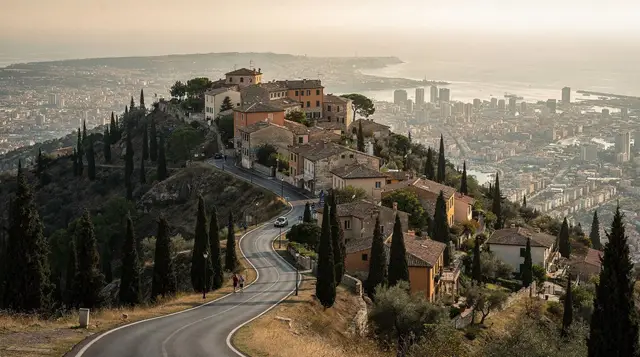
Monreale sits about 8 km above Palermo, high enough on its ridge to look down over the Conca d’Oro, the citrus-growing valley that once supplied much of Palermo’s fruit trade. On its own, the town is a modest, workaday place — a few streets of shops, a market square, apartment blocks stacked on the hillside. Almost nobody visits Monreale for the town. They visit for the Cathedral of Santa Maria Nuova, built in the 1170s by the Norman king William II, and specifically for what covers its interior: roughly 6,400 square meters of gold-ground mosaic, laid by Byzantine and local craftsmen, telling the entire biblical story from Genesis to the Gospels across the nave, aisles and apse.
That is the honest scope of a Monreale visit. This is not a multi-day destination, and treating it as one wastes time better spent elsewhere on the island. It is a half-day trip, cathedral plus cloister plus a coffee in the piazza, done well. Trying to stretch it further usually means padding with a second stop nearby — Cefalù, Mondello or central Palermo — rather than finding more to do in Monreale itself, and that padding is often the right call rather than a compromise.
Getting to Monreale from Palermo
Monreale is reachable without a rental car, and most visitors are better off skipping one. Regular AST bus service connects Palermo — buses generally depart from the area near Piazza Indipendenza, close to the Norman Palace — to Monreale’s main square in roughly 20-30 minutes, depending on traffic on the switchback road up the hill. Buses run frequently enough on weekdays that timing a visit around a specific departure isn’t necessary; check current schedules locally rather than assuming a fixed frequency, since Sicilian regional bus timetables shift and are not always reliable published online.
Driving up is straightforward and only slightly faster than the bus once parking is factored in. Monreale’s own historic core has the same ZTL (zona a traffico limitato) restrictions found in most Sicilian town centers — a restricted zone enforced by automatic cameras, not a suggestion — so a car needs to be left in one of the paid or free lots at the edge of town rather than driven up to the cathedral square itself.
For the general logic of how these zones work across Sicily and where the cameras typically sit, see the ZTL and parking guide; for bus timetables and how Sicily’s regional network fits together more broadly, see the Sicily buses guide and the wider getting around Sicily guide. Anyone renting a car for the wider trip should read the car rental in Sicily guide first, since excess and insurance terms vary a lot between local and international agencies.
A taxi from central Palermo is another option, useful mainly for a group splitting the fare or for anyone short on time, though it costs meaningfully more than the bus for what is a short, well-served route.
Whichever way visitors arrive, the walk from the bus stop or parking area up to the cathedral square involves a stretch of sloped street and, in places, worn cobblestones — manageable for most people but worth knowing about for anyone traveling with a stroller, a wheelchair, or limited mobility. The cathedral square itself and the church interior are level and accessible; it’s specifically the approach through the town that has some gradient.
Why a Norman king built here, not in Palermo
The cathedral’s location is not an accident of geography. William II commissioned it in the 1170s partly as a genuine act of religious patronage and partly as a political move — establishing a new archbishopric at Monreale gave the crown a counterweight to the existing, increasingly powerful archbishop of Palermo, whose cathedral chapter had grown into a rival center of influence.
Building an entirely new, lavishly decorated seat a few kilometers outside the capital was a way of redirecting prestige and resources without directly confronting Palermo’s church establishment. The result is one of the fastest major building projects of its era, with most of the mosaic work completed within a couple of decades — unusually quick for the scale involved, which is part of why the interior reads as a single coherent scheme rather than centuries of piecemeal addition.
That speed and coherence matter for anyone visiting Cefalù’s duomo or the Cappella Palatina afterward, since both were built under earlier Norman kings with different aims and slightly different mosaic programs. Monreale is, in effect, the last and largest word in a building competition that played out across two generations of Norman rule in Sicily, and the cathedral’s scale reflects a king with something to prove.
The cathedral: what’s actually inside
The cathedral’s exterior is relatively plain — golden limestone, a mix of Norman, Arab and Byzantine architectural details on the apse end, nothing that fully prepares a first-time visitor for the interior. Walking in, the entire building is covered floor to ceiling in gold-ground mosaic, arranged as a continuous visual narrative rather than isolated scenes. The apse is dominated by a colossal half-figure of Christ Pantocrator, hand raised in blessing, visible from almost anywhere in the nave. Around and below it, cycles depict the Old Testament from the Creation onward on one side and the life of Christ on the other, plus scenes from the lives of saints Peter and Paul near the altar.
The scale is the point. Other churches in Sicily and elsewhere have Byzantine-style mosaic work — Palermo’s own Cappella Palatina, inside the Norman Palace, is smaller but arguably even finer in the detail of individual panels — but Monreale’s cathedral is the largest continuous mosaic interior of its kind still intact.
Monreale, Cefalù’s duomo and Palermo’s Cappella Palatina together form the “Arab-Norman Palermo and the Cathedral Churches of Cefalù and Monreale” UNESCO World Heritage listing, recognizing a specific fusion of Norman, Byzantine and Islamic building traditions that Sicily produced nowhere else in quite the same way. Anyone comparing the three sites, or deciding which to prioritize with limited time, should read the Arab-Norman Palermo and UNESCO guide, which lays out what’s distinct about each and what’s genuinely repetitive if visiting more than one.
A ground-floor visit to the cathedral nave itself is typically free or low-cost to enter as a place of worship, though the roof terraces and certain side chapels carry a separate ticket, and hours vary around religious services — arriving mid-morning on a weekday, outside of Mass times, generally gives the calmest visit.
A guided cathedral tour is worth considering for a first visit specifically because the mosaic cycle is not self-explanatory without context — knowing which scene is which, and why the sequence runs the way it does, changes what you’re actually looking at. For a fuller walkthrough of the building’s history and the individual mosaic scenes, see the dedicated Monreale cathedral guide.
The cloister: 228 columns, no two alike
Attached to the cathedral is the cloister of the former Benedictine monastery, a separate ticketed entrance from the church itself. It’s a large rectangular courtyard ringed by 228 paired columns, and the detail that makes it worth the extra ticket is that each pair of columns is carved differently — geometric patterns, spiraling designs, figures, many inlaid with the same gold-mosaic technique used inside the cathedral. Walking the full perimeter slowly, actually looking at each pair rather than skimming past, takes 30-45 minutes and is a reasonable break from the more overwhelming scale of the cathedral interior.
A combined cloister ticket with an audio guide app is a practical way to visit at a self-directed pace without waiting for a scheduled tour slot, and it avoids the common mistake of treating the cloister as a five-minute afterthought when it’s the second reason, after the mosaics, that Monreale earns the trip. Visitors who’d rather have a guide walk them through both the cathedral and the cloister together, with the monastery’s history filled in as they go, can also book a private guide covering both in one paced visit rather than two separate self-guided stops.
Crowds, tour buses, and when to actually go
Monreale is one of the most consistently visited sites near Palermo, and it shows. Multiple large coach tours converge on the cathedral square within the same late-morning window most days, particularly when cruise ships are in port at Palermo — the square can fill with idling buses and the church interior with tour groups moving in blocks, which changes the experience of a building meant to be looked at slowly. Arriving right at opening, or after the main tour-bus wave has cleared in the early-to-mid afternoon, gives a noticeably calmer visit than the late-morning peak. This isn’t a reason to skip Monreale, but it’s worth planning around rather than being surprised by on arrival.
Weather-wise, April through June and September through October are the most comfortable months for the walk up from the bus stop or parking area to the cathedral square, which involves some uphill walking regardless of transport choice. July and August push well past 30°C, and the piazza itself has little shade at midday.
Combining Monreale with a bigger day
Because the trip up from Palermo is short, Monreale is routinely paired with other stops rather than treated as a destination requiring its own dedicated day. A combined half-day tour taking in both Cefalù and Monreale works for visitors based in Palermo who want both UNESCO sites without renting a car or piecing together bus connections themselves — though it does mean less time at each stop than visiting separately.
For those staying in Palermo and squeezing Monreale into a broader day of sightseeing, a combined tour of the Capuchin Catacombs and Monreale cathedral pairs two very different but equally central Palermo-area sights in one outing.
Independent travelers building their own day often combine Monreale with central Palermo’s Arab-Norman sights in the morning and the cathedral in the afternoon, or vice versa — see the day trips from Palermo guide for how Monreale fits alongside Mondello, Cefalù and the Palermo catacombs as options for a single day away from the capital.
Palermo itself, its Cappella Palatina, and the Capuchin Catacombs are covered on their own dedicated pages: the Palermo destination page, the Cappella Palatina guide and the Palermo catacombs guide. Visitors basing a longer stay in Palermo and building out a fuller schedule can start from the Palermo in 3 days itinerary or the broader Sicily in 3 days itinerary, both of which slot Monreale in as a half-day addition rather than a standalone stop.
Mondello’s beach is a further option for the same day, since it sits on the opposite side of Palermo from Monreale but is still within a short taxi or bus ride of the city center — see the Mondello destination page for realistic timings if trying to combine a morning at the cathedral with an afternoon at the beach.
Cefalù, roughly an hour east of Palermo by train, is the other common pairing given its own mosaic-covered duomo and status in the same UNESCO listing; see the Cefalù destination page. The Madonie mountains, inland and less visited, are a different kind of day trip entirely for anyone wanting to contrast Monreale’s crowds with quieter hill towns — see the Madonie destination page.
What Monreale doesn’t offer
It’s worth being direct about the limits of a Monreale visit, since some visitors arrive expecting more than a cathedral town delivers. There is a small selection of ceramics and souvenir shops around the main square, largely aimed at the tour-bus trade, and a handful of unremarkable cafés and trattorie — fine for a coffee or a quick lunch before or after the cathedral, not a food destination in their own right the way Palermo’s markets or Catania’s Pescheria are.
Beyond the cathedral and cloister, there isn’t a second major sight that justifies extending the visit; the town’s other churches and viewpoints are minor by comparison. Anyone expecting a fuller day of sightseeing within Monreale itself, rather than a focused visit plus a pairing elsewhere, will likely find the afternoon running short on things to do.
Practical notes before you go
Dress codes at Monreale are enforced the same way as at any active Sicilian church: shoulders and knees covered for both men and women, since this is a functioning cathedral rather than a museum, and staff at the door do turn away visitors in shorts or sleeveless tops during busier periods. A light scarf or shawl carried in a day bag solves this without needing to plan an outfit around it.
Photography without flash is generally permitted inside the nave, though flash and tripods are typically restricted to protect the mosaics, and this can change around religious services — a discreet check at the entrance avoids an awkward moment mid-visit. The roof terraces, where accessible, give a view back down over the Conca d’Oro toward Palermo and the sea, and are worth the extra ticket on a clear day if time allows, though they involve a stair climb with no lift option.
Restrooms and a small bookshop sit near the cathedral exit; beyond that, don’t expect visitor infrastructure on the scale of a major city sight. Cash is useful for the smaller shops and cafés around the square, though most now take cards.
Frequently asked questions about Monreale
How long does a visit to Monreale actually take?
Half a day covers it comfortably: the cathedral interior, the cloister, and time for a coffee or light lunch in the square. Add travel time from Palermo — roughly 20-30 minutes each way by bus or car — and a morning or afternoon slot is enough.
Is Monreale worth it if I’ve already seen the Cappella Palatina in Palermo?
Yes, though the two are genuinely comparable rather than one simply outclassing the other. The Cappella Palatina is smaller and arguably has finer individual panels; Monreale’s cathedral is far larger in scale and includes the cloister, which the Cappella Palatina does not have. Visitors with only a little time and no strong interest in comparing the two can reasonably choose one over both.
Do I need to book cathedral or cloister tickets in advance?
It depends on the season and whether a cruise ship is in port at Palermo that day, both of which affect how busy the site gets. Booking a ticket or guided option in advance removes the uncertainty of arriving to long lines, particularly in the late-morning peak window.
Can I get to Monreale by public transport without a rental car?
Yes — this is the more common approach for visitors based in Palermo. AST buses run from near Piazza Indipendenza in Palermo to Monreale’s main square, and this is generally simpler than driving and parking, especially given Monreale’s own ZTL restrictions in the historic core.
Is Monreale crowded with tour groups?
Often, yes, particularly in the late morning and on days when cruise ships are docked in Palermo. Large coach groups can fill both the piazza and the cathedral interior at once. Arriving at opening or in the early-to-mid afternoon generally means a noticeably calmer visit.
What’s the closest beach to Monreale if I want to combine sightseeing with the sea?
Mondello, on the opposite side of Palermo, is the closest and most popular option, reachable by taxi or bus within the same day as a Monreale visit. It’s a different direction from Monreale, so the combination requires crossing back through or around Palermo rather than a single continuous route.
Is Monreale worth visiting on a rainy day?
Yes, more than most Sicilian sights — the cathedral and cloister are largely indoor or covered, making Monreale one of the more weather-proof half-day options near Palermo compared to beach towns or open archaeological sites.