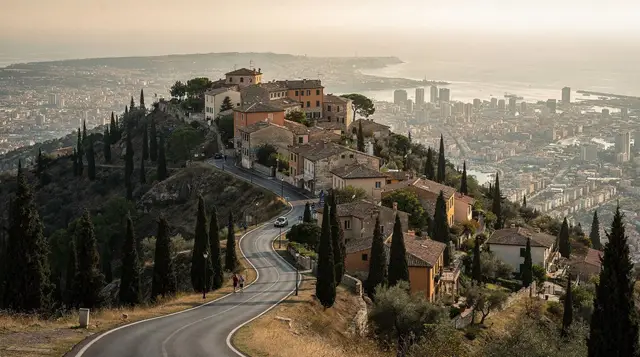
Castelbuono: the village that anchors the park
Almost every trip into the Madonie starts and ends in Castelbuono. It is the largest and most accessible of the mountain villages, built around a 14th-century castle that once belonged to the Ventimiglia family, and it functions as the practical hub for the whole regional park — the place with the most restaurants, the most parking, and the most tour operators running trips into the hills beyond. If you only have half a day, Castelbuono alone is a reasonable use of it: a walkable centre, a market square, and a castle you can visit without booking ahead.
What makes Castelbuono more than a pretty stop is that it is also a working food town. This is the base for the Fiasconaro family’s panettone production, a Sicilian take on the Milanese Christmas cake that has built a genuine national reputation, and it is one of the last places on earth where manna — a sap harvested from cultivated ash trees — is still gathered and sold commercially. Neither of those things is a manufactured tourist attraction; they exist because the surrounding landscape supports them, which is a different kind of authenticity from a town that has rebuilt itself around visitors.
A medieval walking tour of Castelbuono that ends with a local dessert is a sensible way to see the castle, the old streets and the main square with someone who can explain what you are looking at, rather than working it out from a plaque. It also solves the obvious problem of a first visit: knowing which of the pasticcerie on the main street are worth the stop.
Getting to the Madonie and getting around
The Madonie sits inland and uphill from Cefalù, and a car is effectively required to see more of it than Castelbuono’s main square. Public transport between the mountain villages is thin — a bus network exists on paper, but schedules are infrequent and not built around a visitor’s day, and there is no train line into the park itself. If you are relying on public transport for the rest of a Sicily trip, the Madonie is one of the harder regions to fit in without your own vehicle; see getting around Sicily for the wider picture of what works and what does not.
Driving in is straightforward but slower than the map suggests. From Cefalù, Castelbuono is roughly half an hour up into the hills on secondary roads; from Palermo, budget closer to an hour and a half to two hours once you are off the motorway and onto the winding roads that climb toward the park. The roads between villages are narrow, twist constantly along the contours of the ridges, and in several stretches have no lighting at all after dark — a real hazard if you are driving back from a late dinner in one of the smaller towns, not a theoretical one.
In winter, snow at altitude can close roads near Piano Battaglia and the higher passes with little warning, so check conditions before committing to a mountain route between November and March. For the general rules of driving in Sicily and what a rental contract actually covers, see renting a car in Sicily and driving in Sicily.
Do not assume the villages themselves are free of restrictions once you arrive. Castelbuono, the two Petralie and Polizzi Generosa all have historic centres with narrow, largely pedestrian cores, and while the ZTL cameras common in bigger Sicilian towns are less aggressively enforced here, several centres still restrict vehicle access to residents at certain hours. Park at the edge of the old centre — there is usually free or cheap parking within a short walk — rather than trying to drive into the middle of a village built for foot traffic and donkeys, not cars.
Pizzo Carbonara and hiking in the park
The Madonie’s single biggest draw for active travellers is Pizzo Carbonara, at just over 1,979 metres the second-highest peak in Sicily after Mount Etna, and the highest point on the island outside the volcano itself. Unlike Etna, there is no summit access restriction here tied to volcanic activity — Carbonara is a limestone massif, not a volcano — but that does not make it a casual walk. Reaching the summit is a genuine mountain hike with real elevation gain, exposed sections, and no shade for most of the route, and it should be treated with the same respect as any high-altitude trail: proper boots, water, a start early enough to avoid the worst of the afternoon heat, and a realistic sense of your own fitness before committing.
A guided hike to the summit of Pizzo Carbonara is the straightforward way to do this properly if you are not already familiar with the trail network — a guide keeps you on route in terrain where paths are not always well marked, and can read weather conditions that change fast at altitude.
Beyond the summit hike, the Parco delle Madonie has a genuinely large network of marked trails through beech and holly forests, limestone plateaus and small mountain pastures, much of it far less crowded than the coastal walking routes around Cefalù or the Zingaro reserve further west. Spring and autumn are the better hiking seasons: wildflowers and cooler temperatures in April-May, clearer light and stable weather in September-October.
Summer hiking is possible but the trails offer almost no shade, and while the mountains run noticeably cooler than the coast, direct sun at 1,500-1,900 metres is not something to underestimate. For trail options and difficulty levels across the wider region, hiking in Sicily and Sicily’s nature reserves cover routes beyond the Madonie itself, and a guided trek through the heart of the Madonie park from Castelbuono is a good all-round introduction if the summit itself is not the goal.
Cyclists also use the park, mostly on the quieter secondary roads between villages rather than singletrack, and the climbs are long and genuinely steep in places — this is training-ride terrain, not a flat afternoon loop. Cycling in Sicily has the wider context on where the island’s better riding is concentrated.
The Petralie and the smaller hill towns
Beyond Castelbuono, the Madonie’s other defining villages are Petralia Soprana and Petralia Sottana, two adjoining hill towns often listed among the more beautiful villages in Italy, and Polizzi Generosa and Geraci Siculo further into the range. Soprana sits at the higher point, with narrow stone streets and views that stretch across much of the park on a clear day; Sottana sits just below it and functions as more of a working town, with a slightly larger population and a more everyday feel. Seeing both in the same visit makes sense since they are only a few minutes’ drive apart, but treat them as a half-day at minimum once you add the drive from Castelbuono — this is not a quick add-on to a coastal itinerary.
A meeting with one of the last manna producers, usually arranged from Castelbuono, is worth the detour if the food-and-craft side of the Madonie interests you more than hiking. Manna is a genuine, near-vanished tradition: a sap harvested by hand from cultivated ash trees, traditionally used as a natural sweetener and mild remedy, and the Castelbuono-Pollina area is one of the very few places left in the world where it is still gathered and sold commercially — this is not a manufactured demonstration for visitors, it is one of the last working examples of a craft that has mostly disappeared elsewhere.
Polizzi Generosa and Geraci Siculo see far fewer visitors than Castelbuono or the Petralie, and that is more or less the point of going: quiet stone streets, a slower pace, and none of the tour-bus traffic that occasionally reaches Castelbuono’s main square in high season. Neither has much in the way of formal sights beyond the village fabric itself, so go for the walk and a meal rather than a checklist.
The tours grid below includes a village-focused option in Petralia Sottana for a slower, walking-paced introduction to that town specifically, separate from the hiking-focused options higher up this page.
Food and what to actually eat here
The Madonie’s food culture is built around what the mountains produce rather than what a coastal menu offers: mushrooms and chestnuts in autumn, mountain lamb and pork, provola and other aged cheeses made from herds grazing at altitude, and the manna described above used in a handful of traditional sweets. Castelbuono’s pasticcerie sell the Fiasconaro panettone and related products, a genuine point of local pride rather than a souvenir gimmick, and it is worth buying from the town itself rather than a motorway service station on the way out.
Restaurant standards vary more here than on the coast, partly because there is less tourist volume to sustain low-effort places aimed purely at passing trade — a mixed blessing, since it means fewer bad tourist-menu traps but also fewer restaurants overall in the smaller villages, so do not arrive late in a small town expecting a wide choice. Castelbuono has the most reliable spread of options; Petralia Sottana and Polizzi Generosa have fewer, and it is worth checking that something is actually open before building an evening around it, particularly outside the main season.
Where the honest trade-offs are
The Madonie rewards travellers who want mountains and slower village life, and it will disappoint anyone expecting quick, easy sights on the scale of a coastal town. There is no single must-see monument here comparable to a cathedral or a Greek temple — the appeal is the landscape, the villages as a whole, and specific traditions like manna harvesting that only make sense with some explanation. If you are short on time and choosing between the Madonie and a well-known coastal stop, be honest with yourself about what you actually want from the detour.
The driving is the other real trade-off. The roads are narrow, frequently switchback, and unlit in stretches after dark, and the distances on a map understate how long they actually take at mountain speeds. Do not schedule the Madonie as a rushed add-on squeezed between two coastal stops in a single day; it works far better as a dedicated day trip or, better still, an overnight in Castelbuono that lets you start a hike early and avoid driving the mountain roads at night.
How much time to give the Madonie
A single day from Cefalù or Palermo covers Castelbuono properly, plus a short walk or one of the lighter guided experiences, but it does not leave room for a serious hike or a visit to the Petralie as well. Two days lets you split Castelbuono and the manna-and-food side of the visit from a proper hiking day toward Pizzo Carbonara or one of the park’s other trails, with an overnight in Castelbuono removing the need to drive the mountain roads twice in one day.
For day-trip planning from the coast, see Cefalù day trip options and day trips from Palermo; for a fuller regional picture that pairs the Madonie with the neighbouring Nebrodi range, the Madonie and Nebrodi parks is the wider reference. If the Madonie is one stop among several on a longer trip, both a 7-day Sicily itinerary and the Sicily road-trip loop show where a mountain detour like this one can realistically fit against the rest of the island.
Frequently asked questions about the Madonie
Do I need a car to visit the Madonie?
Yes, in practice. Public transport between the mountain villages is limited and not built around a visitor’s schedule, and there is no train service into the park. Without a car, your options are largely limited to a guided day tour departing from Cefalù or Palermo.
How far is Castelbuono from Cefalù and from Palermo?
Castelbuono is roughly half an hour’s drive from Cefalù on secondary roads, and around an hour and a half to two hours from Palermo once you are off the motorway and into the hills. Both are manageable as a day trip, though the Petralie villages and the higher hiking trails add meaningfully more driving time on top of that.
Can I hike to the top of Pizzo Carbonara without a guide?
Experienced hikers with proper equipment and navigation can, but the trail is a genuine mountain route with exposed sections and limited waymarking in places, and conditions change quickly at altitude. A guided hike removes the routefinding risk, especially for a first visit to the massif.
Is the Madonie worth visiting if I only care about beaches and coast?
Probably not as a priority. The Madonie’s appeal is mountains, villages and food traditions, not sea access, and the driving involved to reach it is a genuine time cost. It suits travellers who want at least one inland, cooler-air day built into an otherwise coastal Sicily trip.
What is manna, and is the Castelbuono experience worth doing?
Manna is a sap harvested by hand from cultivated ash trees, traditionally used as a natural sweetener and mild remedy. The Castelbuono-Pollina area is one of the last places in the world where it is still produced commercially, which makes a meeting with a producer a genuine look at a near-vanished craft rather than a staged demonstration.
When is the best time to visit the Madonie for hiking?
April through June and September through November give the most reliable combination of manageable temperatures and stable weather. Winter can bring snow and road closures at altitude; midsummer is hikeable but the trails offer little shade even though the mountains run cooler than the coast overall.
Are the village centres restricted to cars, like on the coast?
Some historic centres, including parts of Castelbuono and the Petralie, limit vehicle access at certain times, and the layout of these towns was built for foot traffic rather than cars in any case. Park at the edge of the old centre and walk in rather than assuming you can drive to the main square.
Can the Madonie be combined with the Nebrodi mountains in one trip?
Yes, the two ranges sit next to each other and are often covered together for travellers with a serious interest in Sicily’s interior. It is a longer, slower-paced trip than a single day, so budget accordingly rather than trying to see both ranges properly in one rushed outing.