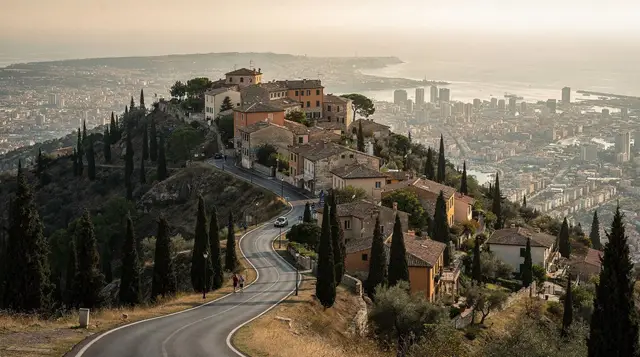
Two full days in Palermo cover the essentials: the Cappella Palatina, the cathedral, Quattro Canti, and one of the three historic markets done properly rather than rushed. A third day lets you add the Capuchin Catacombs, Teatro Massimo, and time to walk Capo or Vucciria without a schedule. Palermo is the obvious base for Sicily’s northwest — Monreale is a short bus ride away, Cefalù and Mondello are both under an hour, and it’s the departure point for hydrofoils to Ustica when the sea cooperates.
Getting oriented in the old town
Palermo’s historic center is dense, layered, and not always polished. Arab-era street patterns sit under Norman churches, which sit under Spanish palaces, which sit under Baroque facades — sometimes on the same building. Quattro Canti, the octagonal Baroque crossroads at the meeting point of the four historic quarters (Albergheria, Capo, Vucciria, Kalsa), is the easiest mental anchor: most sights worth seeing are within a 15-minute walk of it.
Don’t expect a uniformly restored old town. Blocks of beautifully cleaned facades sit next to buildings still scarred from wartime bombing or decades of neglect, with laundry strung across alleys and scaffolding that’s been up for years. That’s part of what makes Palermo different from Sicily’s more manicured towns — it’s a working city first, a tourist destination second, even in 2026. Read that as neither a warning nor an endorsement, just what to expect before you arrive.
Cappella Palatina and Palazzo dei Normanni
The Cappella Palatina, inside the Palazzo dei Normanni (Palazzo Reale), is the single best reason to visit Palermo. It’s a small private chapel commissioned by Roger II in the 1130s, and its walls and ceiling are covered floor to ceiling in Byzantine gold mosaics laid by craftsmen who also worked in Constantinople, combined with a carved wooden muqarnas ceiling from North African and Sicilian Arab artisans.
Norman patronage, Byzantine mosaic technique, and Islamic woodwork in one room is the clearest single expression of Palermo’s Arab-Norman-Byzantine layering, which UNESCO recognized as a World Heritage listing alongside the cathedral and several other Palermo monuments — see our guide to the Arab-Norman UNESCO sites for the full list.
The Palazzo dei Normanni is also the seat of Sicily’s regional parliament, which means parts of it close to visitors on sitting days — check before planning your visit around it. Queues build fast once tour buses arrive mid-morning; going right at opening or in the last hour before closing cuts the wait considerably.
Book a timed-entry tour of the Cappella Palatina and Palazzo dei NormanniFor a deeper, guided walk through the mosaics and the broader Arab-Norman itinerary, see our Cappella Palatina guide.
Palermo Cathedral and the historic core
Palermo Cathedral sits a short walk from the Palazzo dei Normanni and tells a similar layered story from the outside — it was built on the site of a mosque, which itself replaced an earlier Byzantine basilica, and the current structure mixes Norman, Gothic, Baroque, and neoclassical additions across nine centuries of rebuilding. The exterior and cloister are the main draw; the roof terraces (a separate paid ticket) give a view over the old town’s rooftops toward the surrounding hills.
From the cathedral, Quattro Canti is a five-minute walk, and from there you can reach any of the three historic markets on foot in under fifteen minutes.
Ballarò, Capo, and Vucciria: three markets, three characters
Palermo has three historic markets and they are not interchangeable, despite what a single half-day itinerary might suggest.
Ballarò, stretching south from near the Palazzo dei Normanni, is the largest and today the most touristed of the three. It still functions as a real produce and fish market in the mornings, with stalls selling seasonal Sicilian produce, spices, and street food, but afternoons increasingly cater to visitors rather than locals doing their weekly shop. Prices at the more visible stalls have crept up accordingly — it’s still worth visiting, just don’t assume every price is the local one.
Capo, closer to the cathedral and running along Via Sant’Agostino, is smaller and less overrun, with a similar mix of produce, meat, and fish stalls in a narrower, more atmospheric street.
Vucciria, the market closest to the port, has largely stopped functioning as a daytime produce market and instead runs as a nighttime bar and street-food scene, especially on weekend evenings — read our first-hand account of Vucciria after dark before you go expecting a morning market and find shuttered stalls instead.
Our Palermo markets guide breaks down opening hours, what’s genuinely local versus staged for tourists, and which stalls are worth seeking out in each market.
Join a guided street food tour through Ballarò marketStreet food: what to actually order
Palermo’s street food culture is one of the more concrete reasons to spend time in the city rather than just passing through. The dishes worth seeking out — panelle (chickpea fritters), arancine (fried rice balls, cone-shaped in Palermo versus round elsewhere in Sicily), pane e panelle sandwiches, sfincione (a thick, oniony focaccia-style pizza), and, for the adventurous, pani ca meusa (spleen sandwich) — are sold from stalls and small counters throughout Ballarò, Capo, and the streets around Vucciria, usually for a few euros each. A meal from three or four stalls will run cheaper and, in most cases, taste better than a sit-down tourist-menu restaurant near a major sight.
Our street food guide names specific stalls and what to avoid — some of the busiest-looking counters near the main squares cater almost entirely to tour groups and charge accordingly, while quieter stalls a few streets over are where locals actually eat. For a first-timer’s read on where to start, see a first morning in Ballarò. A separate guided option covers both Ballarò and Vucciria in one evening walk if you’d rather have a local point out the good stalls than guess.
The Capuchin Catacombs
The Capuchin Catacombs, beneath the Capuchin monastery a short walk or bus ride from the old town, hold around 8,000 mummified and skeletal bodies arranged along corridors by category — monks, professionals, unmarried women, children — dressed in the clothing of their era, some remarkably preserved, most visibly not. This is a genuinely unsettling sight for a lot of visitors, not a curiosity to breeze through. It is not recommended for younger children, and some adults find it more disturbing than they expected going in. If you’re travelling with kids or are squeamish, it’s worth deciding deliberately rather than adding it to an itinerary by default.
Photography rules are enforced and change periodically, so check current signage rather than assuming you can shoot freely. Our catacombs guide and the first-hand account of visiting the catacombs go into what to expect before you buy a ticket.
Book Capuchin Catacombs admission with audio guideTeatro Massimo
Teatro Massimo is one of the largest opera houses in Europe, opened in 1897 after decades of delays, and it’s the theatre used for the closing rooftop staircase scene of The Godfather Part III. Guided tours run through the auditorium, the royal box, and backstage areas during the day when there’s no rehearsal or performance blocking access; evening opera and ballet performances are a separate, pricier way to see the interior in use. Our Teatro Massimo and opera guide covers both the daytime tour and how to book a performance.
Reserve a guided Teatro Massimo tourGetting there and getting around
Palermo’s airport is Punta Raisi, officially Falcone-Borsellino, about 30-35 km west of the city center along the coast. A direct train (the Trinacria Express line) and regular bus services connect the airport to the city center; taxis are also available at a fixed rate. Our Palermo airport guide covers all three options with current timings.
If you’re renting a car for the wider Sicily trip, do not plan to drive into the historic center. Most of the old town sits inside a ZTL (zona a traffico limitato) — a limited traffic zone enforced by camera, not a person — and an unauthorized entry results in an automatic fine mailed to the rental company (and then to you, with an admin fee added) weeks or months later.
Park at a paid garage or monitored lot outside the ZTL boundary and walk in; our ZTL and parking guide explains how the cameras work and where to park near the center. If you haven’t picked up a car yet, see our car rental guide for what to know before booking, and getting around Sicily for the wider transport picture including trains and intercity buses covered in our Sicily buses guide.
Within the city, the old town is compact enough to walk between the cathedral, Quattro Canti, and all three markets. Buses cover the newer districts and the route out to the catacombs and Teatro Massimo if you’d rather not walk.
Where to base yourself
Staying inside or right at the edge of the historic center (near Quattro Canti, the Kalsa, or the Vucciria side) puts you within walking distance of the cathedral, the Palazzo dei Normanni, and all three markets, at the cost of some noise, especially near Vucciria on weekend nights. Staying further out toward the newer districts or near the waterfront trades that convenience for quiet and often lower prices, at the cost of a longer walk or a bus ride to the sights.
If you want a beach base instead of a city-center hotel, Mondello is a 20-30 minute bus ride from central Palermo and lets you split days between the sights and the sea — see our Mondello destination page for the practicalities.
Day trips from Palermo
Palermo works well as a base for at least four different day trips, and doing one or two properly beats trying to see everything from a single overnight stay.
Monreale, a short bus ride up into the hills above the city, has a cathedral with mosaics that rival — some say surpass — the Cappella Palatina, plus a cloister with over 200 carved columns. It’s the single most common half-day add-on from Palermo.
Cefalù, under an hour east by train, combines a Norman cathedral, a sandy town beach, and a much smaller, calmer old town than Palermo’s.
Madonie, the mountain range inland and east of Palermo, is where to go for hill towns, hiking, and a different pace entirely from the coast — best with a car.
Corleone draws visitors mostly for the name recognition from The Godfather, though the film wasn’t shot there; the town itself has a small anti-mafia museum and a quiet hill-town character worth an honest half-day rather than a pilgrimage built on false expectations.
Bagheria, just east of Palermo, is known for its Baroque villas, notably Villa Palagonia with its grotesque stone figures — a lower-key stop if you’ve already seen Monreale and Cefalù.
Ustica, reached by hydrofoil from Palermo’s port, is a small volcanic island popular for diving and a slower pace, but ferry and hydrofoil schedules to Ustica are cancelled or delayed when the sea is too rough, particularly outside the summer months — always have a backup plan for that day rather than booking anything non-refundable around it.
Our day trips from Palermo guide compares transport options and realistic timings for each of these.
Suggested itinerary and a private alternative
If you’re short on time or planning a full first visit to Sicily around Palermo, our Palermo in 3 days itinerary lays out a day-by-day plan, and the Sicily in 3 days itinerary shows how Palermo fits into a compressed trip covering more of the island.
For a more flexible, guided way to see the highlights without planning your own route between sights, a private walking tour with a local guide covers the Cappella Palatina, the cathedral area, and one of the markets in a single half-day, adjusted to your pace rather than a fixed group schedule.
Nightlife and evenings
Evenings in Palermo split fairly cleanly by neighborhood. Vucciria, after the produce stalls close in the afternoon, turns into an open-air bar scene with cheap drinks sold from small counters and crowds spilling into the street, busiest Thursday through Saturday. The Kalsa district has a quieter, more bar-and-restaurant-focused evening scene.
Teatro Massimo’s opera and ballet season runs through the cooler months and is worth checking regardless of whether you take the daytime tour. Our Palermo nightlife guide covers both scenes in more detail, including which areas to be more careful with belongings late at night, as pickpocketing around crowded market and nightlife areas is a real, if manageable, risk.
Frequently asked questions about Palermo
How many days do you need in Palermo?
Two full days cover the Cappella Palatina, the cathedral, Quattro Canti, and one market properly. A third day allows for the catacombs, Teatro Massimo, and unhurried time in Capo or Vucciria, or a half-day trip to Monreale.
Is Palermo safe for tourists?
Palermo is generally safe for visitors, with the main practical risk being pickpocketing in crowded market areas and on buses, not violent crime. Standard precautions — a bag zipped and worn in front in dense crowds, awareness in Vucciria late at night — are sufficient for most visitors.
Do I need a car in Palermo?
No, and a car is a liability inside the historic center because of the ZTL, which fines unauthorized entries automatically by camera. A car is useful for reaching Madonie or combining several day trips in one outing, but should be parked outside the ZTL boundary and picked up only when leaving the city.
Is the Capuchin Catacombs suitable for children?
It’s not generally recommended for younger children, and some adults also find it more unsettling than expected. The site displays around 8,000 mummified and skeletal remains in corridors, dressed in period clothing, and is a genuine confrontation with mortality rather than a curiosity stop.
How do I get from Palermo airport to the city center?
Punta Raisi (Falcone-Borsellino) airport is about 30-35 km from the center. The Trinacria Express train and regular bus services both run to the city center, and taxis operate at a fixed rate; see our airport guide for current timings and prices.
Are Ballarò, Capo, and Vucciria markets worth visiting if I only have time for one?
Ballarò is the largest and easiest to combine with sightseeing near the Palazzo dei Normanni, but it’s also the most touristed, with some stalls pricing accordingly. Capo, nearer the cathedral, is smaller and feels less staged. Vucciria today is mostly a nighttime bar scene rather than a working morning market, so visit it in the evening, not expecting produce stalls.
Can I do Monreale and Cefalù as day trips from the same Palermo base?
Yes. Monreale is a short bus ride into the hills above the city and works well as a half-day trip, while Cefalù is under an hour away by train and suits a fuller day given the beach and old town combined. Doing both in a single day is possible but rushed.
Is Ustica worth the hydrofoil trip from Palermo?
If diving or a quiet island pace interests you, yes, but treat the schedule as weather-dependent. Hydrofoils to Ustica are cancelled or delayed in rough seas, especially outside summer, so avoid booking onward travel or non-refundable accommodation tightly around a same-day return.