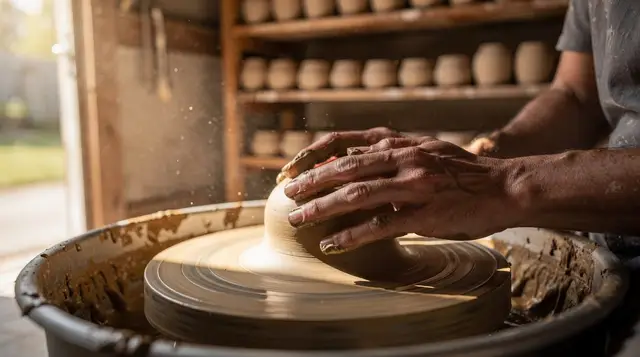
Caltagirone ceramics and the staircase
What is Caltagirone actually known for?
Caltagirone is Sicily's historic center of majolica ceramic production, a tradition dating back centuries, and it is best known for the Scalinata di Santa Maria del Monte, a 142-step staircase where each riser is decorated with hand-painted ceramic tile. The town's workshops sell everything from small souvenir pieces to large architectural tiles.
A town built on clay, and proud of it
Caltagirone, set on a hill in Sicily’s interior between the Val di Noto and the province of Catania, has been a center of ceramic production for so long that the craft has shaped the town’s own architecture, streets and civic identity rather than remaining confined to workshops. Ceramic tile decorates balconies, church domes, street signs and the famous staircase alike, and a visit here is as much about walking through a working ceramic tradition as it is about buying a piece to take home. For the wider destination context, see the Caltagirone destination page.
The Scalinata di Santa Maria del Monte
The staircase connecting Caltagirone’s lower town to the upper Santa Maria del Monte church is the town’s signature sight: 142 steps, each riser decorated with a different hand-painted majolica tile design, executed in the seventeenth and eighteenth centuries and maintained since as one of the clearest physical expressions of the town’s ceramic identity.
Climbing the full staircase takes only a few minutes at a normal pace, but doing so slowly, actually looking at the tile pattern on each step rather than treating it as an obstacle to the view at the top, is the point of the visit — few staircases anywhere function simultaneously as a functional street and an open-air museum. The view back down from partway up, across the tiled risers toward the lower town, is one of the more genuinely distinctive urban views in Sicily’s interior.
Twice a year the staircase becomes a larger event in its own right. In spring, thousands of potted plants and flowers are arranged along the steps for a temporary floral display that transforms the staircase’s character entirely. In mid-July, the steps are illuminated with thousands of colored paper lanterns arranged into a large-scale pictorial design, visible from a distance across the town and drawing visitors well beyond Caltagirone’s normal traffic. Both events draw considerably larger crowds than an ordinary visit, and a trip planned specifically around either display should check current dates in advance, since both are calendar-dependent local traditions rather than fixed annual dates guaranteed to align with any given travel plan.
Where the tradition actually comes from
Caltagirone’s ceramic history predates its best-known Baroque-era staircase by many centuries, with archaeological evidence of pottery production in the area reaching back to before Greek colonization, and continuing through Arab rule, when some of the specific glazing and coloring techniques still used today are generally understood to have been introduced or refined. The town’s name itself is often linked to Arabic roots referencing the local abundance of clay and pottery-making, though the etymology is debated among linguists rather than settled fact.
What is not in dispute is that ceramic production here survived the same 1693 earthquake that devastated much of southeastern Sicily and reshaped the Val di Noto’s eight Baroque towns, with Caltagirone rebuilding not just its churches and streets in Baroque style but doubling down on ceramic decoration as part of that reconstruction — the tiled staircase itself dates from this post-earthquake building period.
Visiting a workshop, and how to shop for the real thing
Numerous ceramic workshops operate throughout the town, ranging from small family studios to larger commercial operations, and visiting one directly rather than buying only from a general souvenir shop is both more interesting and a more reliable way to ensure a piece is genuinely made in Caltagirone rather than imported and relabeled — a real issue for ceramic-style souvenirs sold more generally across Sicily, covered further in the Sicily souvenirs guide.
A ceramic workshop experience gives a hands-on introduction to the process, useful groundwork before shopping seriously, since understanding roughly how many hours of hand-painting go into a piece changes how a price tag reads.
For a broader orientation to the town before diving into a single workshop, a traditional ceramic town walking tour covers the staircase, the historic center and several workshop stops in a single guided outing. A more technically detailed workshop tour explaining the manufacturing process goes deeper into the specific stages — shaping, drying, first firing, glazing, hand-painting, second firing — for visitors who want the full technical picture rather than a shopping-focused visit.
For a smaller, more intimate version, a workshop visit covering the trade’s specific secrets and techniques is pitched at visitors who want a slower, more conversational introduction from an individual artisan rather than a larger group format.
What to actually buy, and what it costs
Prices vary enormously depending on size, complexity and the reputation of the workshop. Small souvenir items — magnets, coasters, small dishes — run a few euros and make an easy, low-commitment purchase. Mid-sized decorative bowls and plates typically run 20 to 60 euros depending on the intricacy of the hand-painted design.
Large decorative pieces, vases or elaborate plates from a respected workshop, can run well over 100 euros, and this reflects the genuine number of hours a skilled painter spends on a single piece rather than an inflated markup aimed at visitors — a useful distinction to keep in mind when comparing a Caltagirone piece against a mass-produced ceramic-style souvenir sold elsewhere on the island. Teste di Moro, the distinctive painted ceramic heads found throughout Sicily, are a Caltagirone specialty in their own right and are covered in more depth in the dedicated Teste di Moro guide.
Shipping and getting ceramics home safely
For visitors buying larger or more fragile pieces, most established workshops offer international shipping, generally a safer option than attempting to pack a large ceramic piece into checked luggage. Shipping costs are typically quoted separately and add meaningfully to the final price for bulky items, but they remove the real risk of breakage in transit that comes with hand-carrying anything larger than a small dish. Smaller, well-wrapped pieces travel reasonably well in a padded carry-on, and workshops experienced with visiting buyers are generally happy to wrap purchases securely on request.
The Museo della Ceramica and other stops beyond the staircase
Beyond the staircase and the workshops, Caltagirone’s ceramic museum houses a chronological collection tracing the craft from its ancient origins through to contemporary work, giving useful context before or after a workshop visit for anyone who wants the full historical arc rather than only the hands-on side.
The town’s Baroque churches, rebuilt after the 1693 earthquake alongside the rest of the Val di Noto, are worth pairing with the ceramic sights, and the bridge of San Francesco d’Assisi, itself decorated with ceramic tile balustrades, is a smaller but genuinely worthwhile stop that many visitors miss entirely while focused on the main staircase. The town’s public gardens, the Giardino Pubblico, also feature ceramic decorative elements integrated into their design, benches and balustrades included, extending the ceramic theme well beyond the buildings usually photographed.
A living craft, not a museum piece
It is worth being direct about something easy to miss on a rushed day trip: Caltagirone’s ceramic tradition is not a preserved historical curiosity kept alive purely for visitors, the way some craft traditions elsewhere have become. Workshops here produce genuinely functional tableware, architectural tile and decorative pieces for the ongoing Sicilian and Italian market, not only for tourist purchase, and many of the same techniques on display in a workshop demonstration are the actual techniques used in daily production.
This distinction matters for anyone deciding how much weight to give the experience: a workshop visit here offers a window into a living regional economy rather than a staged recreation, which is a meaningfully different and, for many visitors, more satisfying kind of cultural encounter.
Caltagirone versus Sicily’s other ceramic towns
Caltagirone is the best-known and most historically significant ceramic center in Sicily, but it is not the only one, and visitors planning a wider craft-focused trip should know the difference. Santo Stefano di Camastra, on the northern coast near Cefalù, has its own long ceramic tradition with a distinct color palette and decorative style, generally leaning toward brighter, more saturated glazes than Caltagirone’s characteristic yellow, green and blue. Sciacca, on the southern coast, also maintains an active ceramic and coral-working tradition, covered in the craft workshops guide, with its own workshops offering hands-on classes distinct from anything available in Caltagirone.
None of these towns are competing versions of the same experience — each has a genuinely distinct visual style and history — and a visitor with time for only one should choose based on overall itinerary logistics rather than assuming Caltagirone is a strict superset of what the others offer. For a trip covering the interior and southeast specifically, Caltagirone remains the clearest single stop given its combination of the staircase, workshops and museum in one town.
Getting to Caltagirone
Caltagirone sits roughly an hour by car from Catania and a comparable distance from Ragusa, making it workable as a half-day or full-day trip from either city, covered in the wider day trips from Catania guide.
Public transport exists but is limited compared to a rental car, and driving is the more practical option for most visitors, with the usual Sicilian caveat about historic center ZTL restrictions covered in the ZTL and parking guide. Staying overnight allows for a properly unhurried visit — enough time for the staircase at both a quiet morning hour and again in the golden evening light, plus a real workshop visit without racing back to a home base before dark.
Combining Caltagirone with the wider region
Caltagirone sits within reach of the Val di Noto’s Baroque towns and Piazza Armerina, home to the mosaic-floored Villa Romana del Casale covered in its own dedicated guide, making a combined day or two covering ceramics, Baroque architecture and Roman mosaics a genuinely efficient use of a stay in Sicily’s interior. Visitors interested in the island’s wider craft tradition beyond ceramics should see the craft workshops guide, and those planning a broader souvenir shopping trip across multiple towns should see the Sicily souvenirs guide.
Frequently asked questions about Caltagirone ceramics
How many steps does the Caltagirone staircase actually have?
142 steps, connecting the upper and lower parts of town, each riser decorated with a different hand-painted majolica tile design, making the climb itself a kind of open-air ceramic museum.
When is the staircase illuminated or decorated with flowers?
The staircase is decorated with thousands of potted plants and flowers for a spring display, and illuminated with colored paper lanterns for a mid-July display — both draw crowds larger than an ordinary visit, worth checking current dates for before planning a trip around either specifically.
Is Caltagirone ceramic authentic, or is it made elsewhere and sold as local?
Genuine Caltagirone ceramic is made in the town’s own workshops using techniques passed down through generations, and buying directly from a workshop rather than a generic souvenir shop is the more reliable way to ensure authenticity, since imported imitation ceramic does circulate in less careful retail settings elsewhere on the island.
Can I take a ceramics workshop class in Caltagirone?
Yes, several workshops in town offer short hands-on classes covering hand-painting or basic shaping techniques, suited to visitors with no prior experience and typically lasting one to two hours.
How far is Caltagirone from Catania or Ragusa?
Roughly an hour by car from Catania, and a similar distance from Ragusa, making it a workable half-day or day trip from either city rather than requiring an overnight stay, though staying a night allows time for both the staircase and a proper workshop visit without rushing.
Are Caltagirone ceramics expensive?
Prices range widely — small souvenir pieces run a few euros, while a hand-painted decorative plate or vase from a respected workshop can run well over 100 euros, reflecting the hours of hand-painting involved rather than an inflated tourist markup.
Ceramics and craft tours on GetYourGuide
Verified deep-linked GetYourGuide tours. Book through these links and we earn a small commission at no cost to you.
Photo: our own image of the location, not the operator’s product photo.