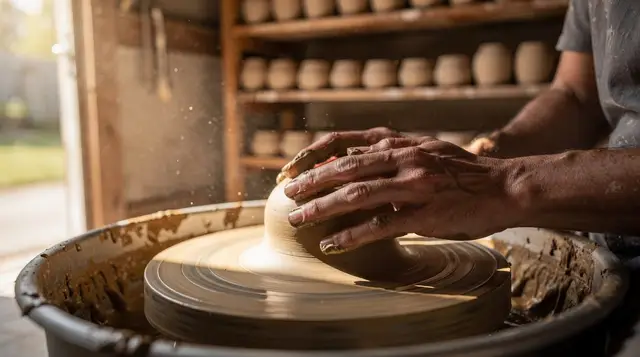
Craft workshops you can join
What is the best craft workshop to book in Sicily for a first-timer?
A ceramic workshop in Caltagirone, the island's most historically significant ceramic town, is the strongest single choice for a visitor with time for only one hands-on craft experience, since it combines the town's staircase and museum with the workshop itself into a full half-day. Coral working in Sciacca and ceramic jewelry in Mazara del Vallo are worth adding for a longer, craft-focused trip.
Making something, not just buying it
Sicily’s craft traditions are strong enough, and accessible enough to visitors, that a hands-on workshop is a genuinely realistic addition to a trip rather than a niche specialist activity. Several towns across the island offer short, beginner-friendly workshops in their local specialty — ceramics, coral working, jewelry-making — and this guide compares the options honestly, covering what each actually involves, what it costs, and who it suits.
Ceramics in Caltagirone: the fullest craft experience
Caltagirone, covered in depth in the dedicated Caltagirone ceramics guide, remains the strongest single option for a visitor with time for only one craft workshop. A ceramic workshop experience in Caltagirone typically covers either hand-painting a pre-shaped piece or a simplified introduction to shaping, combined with the chance to see the town’s working ceramic tradition up close — its famous tiled staircase, museum and dozens of active workshops all within the same compact historic center, making it possible to build an entire half-day or full day around the craft rather than a single isolated activity.
Ceramics in Catania: a city-center alternative
For visitors based in Catania rather than making the roughly hour-long trip inland to Caltagirone, a ceramic workshop in Catania led by a local expert offers a comparable hands-on introduction without leaving the city.
This is a reasonable option for a shorter trip or a schedule that does not allow a dedicated Caltagirone day, though it is worth being honest that it lacks the surrounding context — the staircase, the museum, the density of working workshops — that makes Caltagirone itself such a complete experience. As a standalone activity slotted into a Catania-based stay, it works well; as a substitute for actually visiting Caltagirone, it is a genuine but different, more limited experience.
Coral working in Sciacca
Sciacca, on Sicily’s southern coast, maintains a historic coral-working tradition distinct from the ceramic craft found elsewhere on the island, tied to the town’s long fishing and maritime history. A coral workshop and museum visit in Sciacca combines a museum component explaining the trade’s history with a hands-on introduction to working the material itself, offering a genuinely different craft experience from ceramics for visitors who want variety across a longer trip, or who are based in the south and west rather than near Caltagirone or Catania.
Ceramic jewelry in Mazara del Vallo
Mazara del Vallo, a coastal town in western Sicily with its own distinct North African-influenced history, offers a ceramic jewelry workshop producing smaller, wearable pieces rather than the tableware and decorative objects more associated with Caltagirone. This is a good option for visitors who want a more compact, personal souvenir — something to wear rather than display — and for those already exploring Mazara del Vallo’s own distinct cultural layering, worth knowing about as a smaller-scale addition to a western Sicily itinerary.
Why Sicily’s crafts split so distinctly by town
One of the more interesting things about Sicilian craft traditions, worth knowing before choosing which workshop to prioritize, is how sharply they divide by specific town rather than existing as a generalized island-wide tradition. Caltagirone’s ceramic dominance traces to specific local clay deposits and a documented history of pottery production reaching back well before Arab rule, refined and expanded over the centuries that followed. Sciacca’s coral tradition ties directly to its historic fishing fleet and position on a coastline where coral harvesting was long a viable maritime trade, a resource and skill set entirely separate from Caltagirone’s inland clay economy.
Mazara del Vallo’s own craft identity is shaped by its distinct North African-influenced history and its position as one of Sicily’s most historically significant fishing ports, reflected in the fusion sensibility found in its jewelry work. None of these traditions transplanted easily to other towns historically, since each depended on specific local resources, trade routes or historical circumstances that did not repeat elsewhere on the island in quite the same combination — which is precisely why a craft-focused trip benefits from visiting the specific towns rather than expecting to find, say, genuine coral working readily available in Caltagirone or ceramic workshops of comparable depth in Sciacca.
What these workshops actually involve, format by format
Most ceramic workshops fall into one of two formats: hand-painting a pre-shaped, pre-fired piece with glazes, which requires no prior skill and produces a finished result within the session itself (though it may still need a final firing before collection or shipping), or a more involved shaping and forming session using clay directly, which takes longer to learn and produces a rougher, more personally made piece that will also need firing and glazing afterward.
Coral working and jewelry-making workshops typically involve shaping, polishing or assembling pre-prepared material into a finished piece within the session, generally producing something wearable by the end without the multi-stage firing process ceramics require. Knowing which format a specific workshop offers before booking helps set the right expectations — a painting-only session is more accessible for children and complete beginners, while a shaping session offers a deeper, more technical introduction to the craft for those genuinely interested in the process itself.
Cost and time expectations across formats
Shorter, painting-focused workshops of one to two hours generally run 30 to 60 euros per person, a reasonable cost for a genuinely memorable, low-commitment activity. Longer, more technically involved workshops — full shaping sessions, or multi-stage classes covering several techniques — run higher, often 80 to 120 euros, reflecting both instructor time and material costs. None of these workshops require significant advance planning beyond a normal booking, and most can be added to an itinerary with only a day or two of lead time outside the very peak of summer travel season.
Booking logistics: group size, seasonality and lead time
Most craft workshops covered here run in small groups, often capped at somewhere between six and fifteen participants, which keeps individual instruction time reasonable and avoids the impersonal feel of a much larger class. Demand rises meaningfully during peak summer months and around major holidays, and while these workshops rarely sell out as far in advance as, say, a popular restaurant reservation, booking a few days ahead during July and August is a sensible precaution rather than an overcautious one.
Shoulder-season visitors, covered generally in the best time to visit Sicily guide, have more flexibility to book closer to the actual visit date. None of these workshops are meaningfully weather-dependent in the way an outdoor activity would be, since they run indoors, which makes them a reliable backup plan for a day when rain or extreme heat rules out an otherwise planned outdoor itinerary item.
Combining a workshop with the destination itself
The strongest version of a craft workshop experience treats the workshop as one part of a fuller visit to its host town, rather than an isolated activity squeezed between other stops. In Caltagirone, this means pairing the workshop with the staircase and ceramic museum, covered in the Caltagirone ceramics guide. In Sciacca, it means combining the coral workshop with the town’s own historic center and coastal setting, covered on the Sciacca destination page. Treating any of these as a full half-day rather than a rushed hour gives considerably better value than the workshop alone.
Who these workshops suit, honestly
Craft workshops suit travelers who enjoy hands-on activities and want a tangible, personally made souvenir rather than only a purchased one, and they work particularly well as a rainy-day or high-heat-afternoon activity given that most take place indoors, a genuine advantage during the hottest stretch of Sicilian summer when an outdoor walking tour is less appealing. They suit families with children reasonably well, particularly the simpler painting-based formats, though checking a specific workshop’s age suitability before booking avoids disappointment for very young children with limited patience for a seated activity.
They suit less well travelers on a very tight, sightseeing-dense schedule who would rather spend a limited afternoon covering more ground than settling into a single multi-hour activity — for that kind of traveler, a guided workshop tour without the hands-on component, covered in the Caltagirone ceramics guide, is a faster alternative that still covers the craft’s history and process.
Related traditions worth knowing about
Sicily’s craft landscape extends beyond what has a bookable hands-on workshop attached to it. The Opera dei Pupi puppet tradition, covered in the dedicated Opera dei Pupi guide, involves its own genuinely specialized craft of puppet-building, though this is generally observed via workshop tours and museum visits rather than a beginner-friendly hands-on class, given the skill level involved. The Teste di Moro tradition, covered in the Teste di Moro guide, does have at least one dedicated paint-your-own workshop option, worth knowing about specifically for visitors drawn to that particular legend and image.
Combining workshops with the rest of a Sicily trip
For a craft-focused stretch of a longer trip, combining a Caltagirone ceramic workshop with a Sciacca coral workshop and a stop to see (or attend) an Opera dei Pupi performance covers three genuinely distinct Sicilian craft traditions across a single loop through the island’s interior, south and Palermo respectively. For souvenir-shopping context around any of these crafts, see the Sicily souvenirs guide, and for the secondhand and antique side of Sicilian shopping, distinct from newly made craft goods, see flea markets and antiques in Sicily.
A reasonable one-day itinerary built around a workshop
For a visitor with a single free day to dedicate to craft rather than sightseeing in the usual sense, a workable structure looks something like this: a morning workshop session, roughly two hours, followed by lunch in the host town using whichever local trattoria has a visible mix of locals and visitors, then an afternoon spent walking the town itself — Caltagirone’s staircase and museum, or Sciacca’s historic center and coastline — before heading back to a home base in Palermo, Catania or Agrigento in the early evening.
This structure treats the workshop as the anchor of the day rather than an isolated add-on, and it tends to produce a considerably more satisfying memory of the visit than treating the workshop as a quick stop wedged between other unrelated activities.
Frequently asked questions about Sicilian craft workshops
Do I need any prior experience for these workshops?
No — the workshops covered here are aimed at complete beginners, with an instructor guiding each step, and most run one to three hours, short enough that no serious skill commitment is required beforehand.
Can children take part in ceramic or craft workshops?
Many workshops welcome children, particularly simpler painting-focused sessions rather than wheel-throwing or more technically demanding processes, though checking the specific workshop’s age suitability before booking is worth doing given how much this varies by operator.
Do I get to keep what I make?
Generally yes, though ceramic pieces often need firing and glazing after the hands-on session, meaning the finished piece may need to be collected later or shipped rather than taken home the same day — worth confirming at booking.
How much do these workshops typically cost?
Short introductory workshops generally run 30 to 60 euros per person, while longer, more technically involved classes with a full-day or multi-stage process can run higher, closer to 80 to 120 euros.
Is English spoken at these workshops?
Most operators catering to visiting travelers offer instruction in English alongside Italian, though confirming this specifically at booking is sensible for smaller, more local family-run operations.
What is the difference between a workshop and a guided tour of a workshop?
A hands-on workshop involves actually making something under an instructor’s guidance, while a guided tour of a workshop is an observational visit explaining the production process without a personal hands-on component. Both are valuable but serve different interests — making versus watching and understanding.
Ceramics and craft tours on GetYourGuide
Verified deep-linked GetYourGuide tours. Book through these links and we earn a small commission at no cost to you.
Photo: our own image of the location, not the operator’s product photo.