Cinema Paradiso: Palazzo Adriano and Cefalù
Where was Cinema Paradiso filmed?
The film's central piazza - the heart of the fictional village of Giancaldo - was filmed in Palazzo Adriano, an inland town southwest of Palermo, with additional scenes shot around Cefalù on the north coast and near Bagheria, birthplace of the painter Renato Guttuso.
One small square did most of the work
Giuseppe Tornatore’s Cinema Paradiso built its entire fictional village of Giancaldo around a single real piazza: the main square of Palazzo Adriano, an inland town in the province of Palermo, some distance from the coastal circuits that most Sicily itineraries follow. Unlike the Godfather’s Savoca or the Montalbano series’ Val di Noto towns, Cinema Paradiso’s key location sees comparatively few organised tours, largely because of where it sits on the map rather than any lack of interest in the film. This guide covers what survives to see in Palazzo Adriano, what the production used elsewhere, and how realistic a visit is without a dedicated tour.
Palazzo Adriano: the square that became Giancaldo
Palazzo Adriano’s central piazza, flanked by two churches standing side by side - one Latin-rite, one Byzantine-rite, a legacy of the town’s mixed Albanian and Sicilian settlement history - provided the film’s central square where much of the story’s village life unfolds. The building used as the Cinema Paradiso itself was constructed for the production rather than converted from an existing cinema, and it no longer stands; what remains today is the square and surrounding streetscape the production built its set within, largely intact and recognisable to anyone who has seen the film.
The town’s relative isolation - well inland, off the coastal routes that carried tourism-driven redevelopment to places like Cefalù and Taormina - is precisely why it still looks close to how it did when Tornatore filmed there in the late 1980s. Visiting today means walking the same square, the same church steps, and the same narrow surrounding lanes, without a museum or plaque-heavy visitor infrastructure built up around the connection. It is a quiet, largely undeveloped town rather than a film-tourism destination, and that absence of infrastructure is itself part of the appeal for anyone who prefers a genuine place over a curated experience.
Cefalù’s role in the production
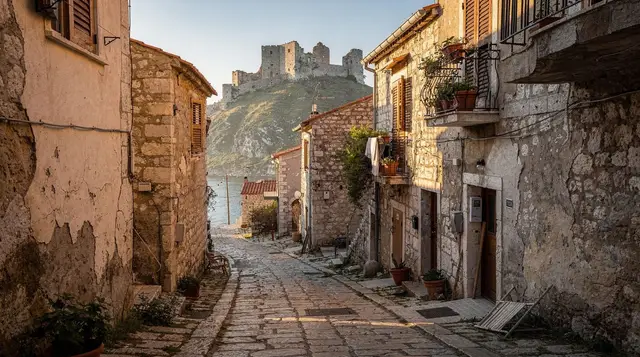
Additional exterior scenes were shot around Cefalù, on Sicily’s north coast, whose old town and harbour lend themselves naturally to period filming thanks to their largely unaltered medieval streets and the dramatic backdrop of La Rocca rising above the town. Cefalù’s own appeal long predates and extends well beyond this one film - its Norman cathedral, sandy town beach and compact historic centre make it one of Sicily’s most visited coastal towns regardless of any screen connection.
Cefalù and Cefalù beach and the Rocca cover the town on its own terms, which is the more useful way to plan a visit here than treating it purely as a film location. Boat Trip to Cefalù is a reasonable way to see the same coastline and La Rocca from the water if you are spending time in the town regardless of the film connection.
Bagheria: Guttuso’s town, not a film set
Bagheria, on the coast between Palermo and Cefalù, was not itself a filming location for Cinema Paradiso, but it carries a closely related cultural thread worth knowing about: it is the birthplace of painter Renato Guttuso, whose vivid, unsentimental depictions of Sicilian small-town life sit in the same emotional register as Tornatore’s film. Villa Cattolica, an 18th-century villa in Bagheria, now houses the Guttuso museum, and makes a worthwhile detour for anyone drawn to the film’s visual and emotional world, even without a direct filming connection.
Villa Cattolica and Guttuso Museum Tour Baroque Meets the 20th Century covers the villa and museum with a guide who can place Guttuso’s work in the context of Sicilian art and history more broadly, alongside the villa’s own Baroque architecture. Bagheria more generally is also known for its collection of eccentric 18th-century noble villas, a separate but related reason to allow it some time on a Palermo-area itinerary.
Why the piazza has two churches side by side
The detail that surprises most first-time visitors to Palazzo Adriano is the two churches standing almost shoulder to shoulder on the same small square - one Latin-rite Catholic, one Byzantine-rite, reflecting the town’s founding by Albanian (Arbëreshë) settlers who fled to Sicily in the 15th century and retained their own Eastern-rite religious tradition alongside the island’s dominant Latin one.
Several other towns in Sicily’s interior share this same Arbëreshë heritage, recognisable by the same pairing of a Latin and a Byzantine church on or near the main square, though Palazzo Adriano’s became famous specifically because Tornatore chose it for his film. Knowing this context turns a quiet architectural detail into a genuinely interesting piece of Sicilian settlement history, worth mentioning if you visit with anyone curious about why the square looks the way it does.
The film itself, briefly
For anyone visiting without having seen the film, or wanting the context refreshed before arriving: Cinema Paradiso follows a boy, Salvatore, growing up in the fictional village of Giancaldo in the years after the Second World War, and his friendship with Alfredo, the projectionist at the village’s single cinema.
The story unfolds mostly in and around that cinema and the square outside it, which is why Palazzo Adriano’s piazza carries so much of the film’s emotional weight - it is, in effect, the stage for most of Salvatore’s childhood as the film presents it. The film exists in more than one cut, with a longer version released some years after the original theatrical cut restoring scenes trimmed for the initial release; either version uses the same Palazzo Adriano footage as its visual anchor.
Getting to Palazzo Adriano
Reaching Palazzo Adriano realistically requires a car - it sits inland in the Sicani mountains area, without a rail connection and with only limited local bus services that do not suit a single day visit well. It is most practically combined with a broader day covering western or central Sicily, rather than treated as a standalone half-day trip from Palermo, given the driving distance involved. General notes on renting and driving are in Renting a car in Sicily and Driving in Sicily; the roads into the town’s inland hills are narrower and quieter than the coastal motorways, with fewer services along the way, so plan fuel and timing accordingly.
Because dedicated tour operators covering Palazzo Adriano specifically are rare compared with the well-trodden Godfather and Montalbano circuits, most visitors either drive themselves or arrange a private driver for the day, particularly if combining the town with other inland central Sicily stops such as Piazza Armerina or a wider look at day trips from Palermo.
How this compares to Sicily’s other film circuits
Cinema Paradiso’s footprint on the island is smaller and less commercially developed than the Godfather’s Savoca circuit or the Montalbano series’ well-established Val di Noto tourist trail, largely because of Palazzo Adriano’s inland, off-route location and the absence of a single standout, still-standing building comparable to Bar Vitelli or Scicli’s town hall.
That makes a visit here feel notably different in character: quieter, less commercialised, and closer to visiting a real Sicilian town that happened to host a film crew once than to following a well-marked tourist circuit. For the fuller comparison across all of Sicily’s screen-tourism options - what each one actually involves, how long it takes, and what it costs - see Sicilian film tours compared.
Worth the detour
Palazzo Adriano rewards visitors who are drawn to the quieter, slower version of Sicily’s film heritage rather than the more organised Godfather and Montalbano circuits - a single unhurried piazza, two adjoining churches, and a town that has changed little since Tornatore’s crew packed up and left. Pairing it with Cefalù on the coast and, time allowing, Bagheria’s Villa Cattolica gives a half-day to full-day route that traces the film’s real geography without needing a dedicated tour operator to make sense of it.
Film location tours on GetYourGuide
Verified deep-linked GetYourGuide tours. Book through these links and we earn a small commission at no cost to you.
Photo: our own image of the location, not the operator’s product photo.