The Godfather tour: what is real and what is not
Did The Godfather really film in Corleone?
No. Francis Ford Coppola shot the Sicilian scenes in Savoca and Forza d'Agrò, two hill towns above Taormina, because 1970s Corleone already looked too modern. A tour badged as a 'Godfather tour' almost always goes to Savoca, not to the town whose name gave the film its family.
The town in the title is not the town on the screen
Every year, travellers arrive in Corleone expecting a film set, a piazza they recognise from the opening wedding scene, maybe the bar where Michael Corleone met Apollonia’s father. None of that is there, because none of it was filmed there. Corleone lent its name to Mario Puzo’s novel and to Francis Ford Coppola’s film family, but by the time the production scouted Sicily in the early 1970s, the real Corleone had already been substantially rebuilt with concrete apartment blocks and modern shopfronts. It did not look like a town frozen in the 1920s, so the production went looking elsewhere, and found what it needed roughly seventy kilometres east, in the hills above Taormina.
This matters for anyone spending money on a “Godfather tour,” because operators are not always precise about what they are selling. Some itineraries genuinely go to the two villages where the film was shot. Others route through Corleone on the strength of the name alone, pair it with a generic countryside drive, and let the traveller assume the connection. Neither is dishonest exactly
- Corleone has its own story worth telling - but it is not the film’s story, and the two get conflated constantly in marketing copy. This guide separates what was actually filmed from what merely shares a name, so you know which village you are paying to see.
Savoca: Bar Vitelli and the wedding church
The real filming took place in Savoca, a small hill town in the province of Messina, reached by a winding road that climbs from the coastal plain near the A18 motorway. Two locations here carry the weight of the film’s most quoted Sicilian scenes.
Bar Vitelli sits on Savoca’s short main street and is where Michael, hiding out in Sicily after the killings in New York, first sees Apollonia and later asks her father for permission to court her. It is a working bar today, not a museum piece behind glass, and visitors can sit at the same tables and order a coffee or a granita. The interior retains much of the look it had on screen, though it has been furnished for decades of tourist footfall rather than preserved as a set.
The second key location is the Church of Santa Lucia, standing on a small square a short walk above the bar. Its steps and forecourt were used for the wedding scene where Michael marries Apollonia - one of the trilogy’s most photographed Sicilian moments. The church itself predates the film by centuries and functions as an ordinary parish church, with opening hours tied to services rather than tourism.
Taormina: Savoca Godfather Tour with Lunch covers both sites from Taormina in a single half-day, typically with a stop for lunch built into the itinerary rather than left to find on arrival - useful in a village with a genuinely small number of places to eat. For the fuller village-by-village breakdown of what else is worth seeing in Savoca beyond the two film sites, see Savoca and Forza d’Agrò.
Forza d’Agrò: the town that played itself and others
A short drive from Savoca, Forza d’Agrò supplied additional street scenes and exterior shots, occasionally standing in for locations the story needed but that Savoca alone could not provide. The two villages sit close enough together, both perched above the Ionian coast with views back toward Taormina and the sea, that almost every operator visits them on the same itinerary rather than separately.
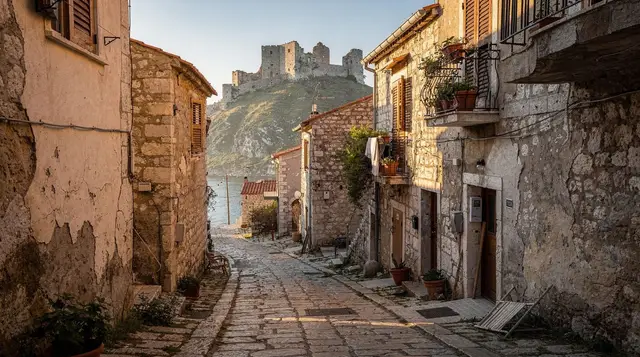
Forza d’Agrò has less of a single “must-see” location than Savoca’s bar and church, and more of a general period atmosphere - narrow stepped lanes, a castle ruin above the village, and a skyline that has changed little since the 1970s. Several operators use it as the second half of a combined half-day, and From Catania: Private Godfather Tour Forza d'd'Agrò and Savoca is built exactly around that pairing, departing from Catania rather than Taormina, which matters if your base is on the airport side of Etna rather than the coast.
Castello degli Schiavi: the Corleone estate that never existed
One further genuine filming location deserves a mention because so few tours advertise it clearly. Castello degli Schiavi, near Fiumefreddo di Sicilia between Catania and Taormina, provided exterior shots used for the Corleone family’s compound in later instalments of the trilogy - the walled estate seen in flashback and in the final film’s closing sequences.
It is a private property, not generally open for casual walk-up visits, which is why it rarely features on the standard Savoca-and-Forza-d’Agrò circuit even though it is arguably as significant to the films. The Godfather Tour and Castello Degli Schiavi Visit is one of the few itineraries that includes access to the grounds alongside the Savoca stops, departing from Catania and worth prioritising if seeing this specific location matters to you more than ticking off Bar Vitelli again.
Corleone itself: a different, sobering trip
None of this means Corleone is not worth visiting - it simply is not a film set. The town’s real significance is contemporary rather than cinematic: for much of the twentieth century it was associated with one of Sicily’s most powerful and violent mafia clans, the so-called Corleonesi, and today it houses the CIDMA (Centro Internazionale di Documentazione sulla Mafia e sul Movimento Antimafia), a museum documenting organised crime and the anti-mafia resistance movement that grew up in response to it, including the work of magistrates Giovanni Falcone and Paolo Borsellino.
A visit here is a markedly different experience from an afternoon at Bar Vitelli - more sober, more historical, and grounded in real events rather than a film’s fictionalised version of them. Corleone: Guided Tour of Cidma Movimento Antimafia takes visitors through the museum with a guide who can explain the town’s actual history, which is a more honest way to spend a few hours in Corleone than hunting for a wedding scene that was never filmed there. For more on the town beyond this single museum, Corleone covers the wider destination, and day-trip logistics from Palermo are covered in Day trips from Palermo.
Comparing what different operators actually sell
Because “Godfather tour” is used loosely in marketing, it is worth reading an itinerary closely before booking rather than trusting the title alone. Three questions separate the useful listings from the vague ones:
Does it name Savoca specifically? A listing that only says “Sicilian villages” or “the countryside of the film” without naming Savoca or Forza d’Agrò is worth double-checking before booking - it may be an unrelated countryside drive using the film’s name for search visibility.
Which departure point, and how long is the drive? Tours from Taormina reach Savoca in roughly 40 minutes; tours from Catania or Messina add meaningfully more driving time in each direction, which matters if your day is otherwise packed. Vespa Tour of Savoca the Godfather Experience and Bar Vitelli runs from the Taormina side and covers the same core sites at a slower pace than a coach tour, worth considering if you would rather explore on two wheels than sit in a minibus.
Is lunch included, or an extra cost on arrival? Savoca’s dining options are limited by the village’s size, and a tour that includes a fixed lunch stop avoids the awkwardness of nine other tourists competing for the same three tables at 1pm.
For a side-by-side comparison of every Sicilian film-location tour, not only Godfather-themed ones, see Sicilian film tours compared, which also covers the Montalbano and White Lotus circuits.
Getting there without a tour
Driving yourself to Savoca and Forza d’Agrò is entirely realistic if you already have a rental car, covered in Renting a car in Sicily and Driving in Sicily. Both villages have small car parks at their edges; neither has a meaningful ZTL restriction of the kind found in larger towns, but the roads climbing up from the coast are narrow with tight switchbacks, so allow more time than the map distance suggests and drive cautiously on blind bends. General ZTL advice for the rest of Sicily’s town centres is in ZTL zones and parking in Sicilian cities.
Without a car, reaching either village by public transport is inconvenient - infrequent local buses exist but do not run on a schedule built around a single afternoon visit, which is the practical reason most travellers book a tour or a private driver rather than attempt it independently. If a tour is the more sensible option for your trip but you are unsure which operator to trust, cross- reference the price against What a week in Sicily actually costs and treat any listing significantly cheaper than the rest as a signal to read the inclusions twice, not as a bargain.
Why Coppola ended up in Savoca at all
Francis Ford Coppola’s production team scouted locations across Sicily in the early 1970s looking for somewhere that still resembled the island as it appeared in the novel’s 1920s setting - narrow lanes, stone buildings, an absence of modern signage and traffic. Corleone, despite lending its name to the story, had already moved on from that look by the time the crew arrived.
Savoca and Forza d’Agrò, by contrast, had seen comparatively little redevelopment thanks to their relative isolation on the ridge above the Ionian coast, which is precisely what made them usable without extensive set dressing. This same logic - isolation preserving a period look that more developed towns lost - explains why several of Sicily’s other screen-tourism locations, Palazzo Adriano among them, also sit in less-visited corners of the island rather than its best-known coastal towns.
The trilogy’s Sicilian scenes, film by film
The first Godfather (1972) uses Savoca and Forza d’Agrò for Michael Corleone’s exile sequence - Bar Vitelli, the wedding at the Church of Santa Lucia, and the surrounding village streets. The scenes recur only briefly across the sequels: The Godfather Part II (1974) returns to Sicily in flashback for young Vito Corleone’s backstory, while The Godfather Part III (1990) uses Sicily again for its climactic sequences, including exterior shots at Palermo’s Teatro Massimo, covered in Teatro Massimo and opera in Sicily.
Visitors focused specifically on the first film’s most quoted scenes should prioritise Savoca; those interested in the trilogy’s fuller Sicilian footprint have reason to add a stop at Teatro Massimo in Palermo as well.
Inside the CIDMA museum
The CIDMA museum in Corleone is arranged less like a conventional history museum and more like a documentary record - photographs, court documents and personal testimony connected to the Corleonesi clan’s rise and the decades-long investigation and prosecution effort that eventually broke much of its power, including the work of magistrates Giovanni Falcone and Paolo Borsellino, both assassinated in 1992. It is a considerably heavier visit than Bar Vitelli’s coffee-and-granita atmosphere, and worth allowing a slower pace and a quieter mood afterward rather than scheduling it directly before a lighter stop.
Fitting this into a wider Sicily itinerary
A half-day at Savoca and Forza d’Agrò slots naturally into a Taormina-based stay, and pairs well with a morning at Taormina itself or an early look at the ancient theatre of Taormina before the afternoon drive uphill. Travellers building a full one- or two-week route around the island can see where this fits into the bigger picture in Sicily in 7 days, and those specifically chasing film and TV locations across the island - Montalbano’s Val di Noto, The White Lotus’s Taormina, or Cinema Paradiso’s Palazzo Adriano - should start with Sicilian film tours compared before committing to one region.
Whatever you book, the single fact worth remembering is simple: if an itinerary’s headline photo is Bar Vitelli or the steps of Santa Lucia, it is describing Savoca, whatever town’s name appears in the listing title.
Film location tours on GetYourGuide
Verified deep-linked GetYourGuide tours. Book through these links and we earn a small commission at no cost to you.
Photo: our own image of the location, not the operator’s product photo.