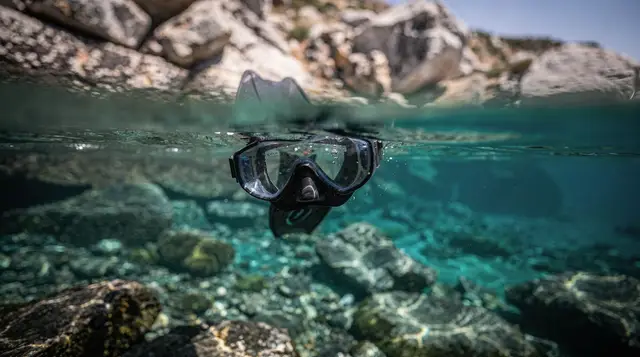
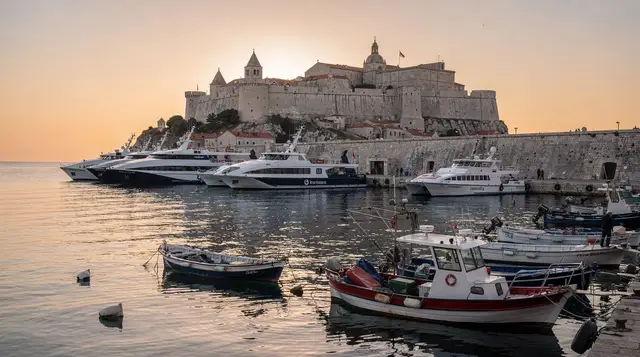
Cefalù beach and the Rocca
What makes Cefalù different from Sicily's other beach towns?
Its beach sits directly below a historic old town and a Norman cathedral, with a steep fortified hill, La Rocca, rising straight from the streets — so a single stop combines swimming, medieval architecture and a genuine hike, reachable by train from Palermo.
A beach with a fortress standing over it
Cefalù pairs its beach with more history and elevation, in a smaller footprint, than almost anywhere else on Sicily’s coast. The sand runs directly along the edge of the old town, with the twin towers of the Norman cathedral visible from the water, and directly above both, a steep limestone headland called La Rocca rises straight out of the streets, crowned with the ruins of an ancient fortification.
Few Sicilian beach towns pack a swim, a UNESCO-recognised cathedral and a genuine hike with a view into walking distance of each other quite this tightly, which is a large part of why Cefalù has become one of the north coast’s most visited stops, alongside Mondello further west toward Palermo. Unlike Mondello, which is reached from Palermo mainly by bus or car, Cefalù also sits directly on the main rail line along the north coast, making it one of the more straightforward beach towns in Sicily to visit without arranging your own transport at all.
The beach itself
Cefalù’s beach is a stretch of sand backed directly by the old town’s buildings and the cathedral above, split, like most well-known Sicilian beaches, between paid lido sections with sunbeds and umbrellas and free public sand. The water is generally calm and shallow enough for comfortable family swimming, and the setting — old town walls and rooftops as a backdrop rather than a modern seafront — gives it a different character from a purpose-built resort beach like Mondello. The general mechanics of the lido-versus-free split, and what a fair day’s rental costs, are covered in Lidi or free beach: how Sicilian beaches work, which applies here as it does at most of Sicily’s well-known beaches.
Because Cefalù’s beach sits so close to the old town’s narrow streets, both fill up together in peak season: a crowded beach in July or August usually means crowded streets behind it too, and the two feed into each other on the busiest days. Unlike Mondello’s open bay, where the beach and the town seafront run parallel to each other along a single wide curve, Cefalù’s sand sits directly against a compact medieval streetscape, which gives it a more atmospheric backdrop for photographs but also means the beach itself is somewhat narrower relative to demand, especially directly below the cathedral where most visitors naturally gravitate first.
Climbing La Rocca
Above the town, La Rocca is a steep limestone headland that has been fortified in some form since antiquity, and a marked, stepped path climbs from the edge of the old town toward its summit, passing stretches of ancient and medieval wall on the way up. At the top sit the remains of a megalithic structure known locally as the Temple of Diana, older than the Norman town below by many centuries, alongside further fortification ruins and a genuinely wide panoramic view back over Cefalù’s rooftops, the cathedral, the beach and the coastline in both directions.
The climb itself is the honest catch: it gains real elevation quickly, the steps and path are exposed to full sun for almost the entire ascent, and there is nowhere to buy water once you start — carrying more than feels necessary is standard advice repeated by nearly every guide who has led this hike in August heat. A steady pace covers the ascent in roughly 30 to 45 minutes, with a similar time back down, which makes it a two-hour round trip once you factor in time at the summit for the view — a genuine outing, not a five-minute detour, and one better attempted in the morning or early evening than under the midday sun.
Footwear matters here more than at the beach below: the path is a mix of stone steps, uneven natural rock and loose gravel in places, and the sandals that are perfectly fine for a day on the sand are a poor choice for the descent in particular, where a slip on smooth, worn stone is the most common minor injury reported by visitors who have done this hike. Trainers or light hiking shoes are a considerably safer choice, alongside a hat and sunscreen for a climb with almost no tree cover along its length.
Cefalù: la Rocca Archaeological Park Hiking Private Tour and Cefalù: Rocca Guided Hike with Photography Tips both pair the climb with a guide who knows the site’s history and the best viewpoints along the way, useful for a first ascent or for anyone who wants more context on the ruins at the top than a self-guided walk would provide.
The cathedral and the old town
Below La Rocca, Cefalù’s Norman cathedral is one of the key monuments of Sicily’s Arab-Norman heritage, its interior mosaics — smaller in scale than Monreale’s or Palermo’s Cappella Palatina, but part of the same artistic and historical tradition — drawing visitors regardless of their interest in the beach itself. Local tradition holds that the cathedral was founded by the Norman king Roger II after his ship survived a storm off this stretch of coast, a vow-fulfilled-by-a-church story repeated across several Sicilian religious sites from this era, whether or not every detail is historically precise.
What is not in dispute is the building’s place in the wider Arab-Norman architectural tradition that also produced Monreale’s cloister and Palermo’s Cappella Palatina, blending Norman, Byzantine and Arab craftsmanship into a style found nowhere outside this part of Sicily. See Monreale cathedral and its cloister and Arab-Norman Palermo: the UNESCO route for the wider context of this architectural tradition across Sicily’s north coast.
The streets behind the cathedral hold a genuinely atmospheric old town, dense with the kind of narrow lanes and small squares that made Cefalù a natural filming location — most famously for Cinema Paradiso, whose story is set in a fictional Sicilian town built from several real locations across the island, Cefalù among them. See Cinema Paradiso: Palazzo Adriano and Cefalù for how the town fits into that wider story. A medieval washhouse, fed by a natural spring and tucked into the old town’s lower streets, is another small but genuine historic sight worth the short detour, a working piece of everyday medieval infrastructure rather than a monument built for display.
Cefalù: History and Legends Guided Walking Tour covers this side of Cefalù in more depth, useful for anyone who wants the old town’s history alongside, rather than instead of, the beach and the Rocca.
If you only have half a day
Visitors squeezing Cefalù into a shorter stop from Palermo, rather than staying overnight, face a real trade-off between the beach, the cathedral and the Rocca climb, since doing all three properly takes most of a day. A reasonable half-day priority order: the cathedral and old town streets first, since they take the least time and close on a fixed schedule; a swim next, since the beach is available all day; and the Rocca only if time and energy allow, given it is both the most physically demanding element and the one most affected by midday heat.
Trying to fit the full climb into a rushed afternoon after a late train from Palermo is the most common way visitors end up disappointed with the Rocca specifically — better to skip it on a short visit than attempt it half-heartedly in the wrong part of the day.
Eating in Cefalù
Cefalù’s old town has a dense concentration of restaurants serving the seafood this stretch of coast is known for, with terraces looking out toward the beach and the Rocca alike, and prices that run higher directly on the seafront than a few streets back, in the same pattern found in most well-known Sicilian beach towns. See Sicilian seafood: tuna, swordfish and sea urchin for what to expect on a typical coastal menu here, and Eating in Sicily: hours, coperto and tipping for the general practicalities of dining out anywhere on the island — service times, the coperto charge, and tipping expectations that differ from what many visitors are used to at home.
How Cefalù compares to Mondello and Taormina
Of Sicily’s town-and-beach combinations, Cefalù sits between Mondello’s easy, flat convenience and Taormina’s clifftop drama. It has a smaller, more historic old town directly behind the sand than Mondello’s open resort seafront, and a beach that is easier to reach and swim from than Isola Bella’s narrow bay below Taormina, without needing a cable car. Taormina or Cefalù covers this specific comparison in depth if you are deciding between the two as a longer base rather than a shorter stop on a wider itinerary, and The best beaches in Sicily, region by region sets all three in the context of the island’s full coastline.
Family visits and accessibility
The beach itself is manageable for most families, with generally calm, shallow water and a short walk from the old town’s restaurants and facilities. The Rocca climb is a different matter: the steps and uneven path are not manageable with a stroller and are a genuine challenge for young children in midsummer heat, so families with very young children often skip the summit and settle for the beach, cathedral and old town instead, which together already make for a full and worthwhile day without the climb. See Sicily with kids and The best family beaches in Sicily for how Cefalù fits into a wider family itinerary.
Seeing the coast from the water
Boat Excursions in Cefalù gives a different perspective on the same setting — the cathedral, the Rocca and the old town seen from the water rather than the sand, along this stretch of coast where clear water and sea caves are common a short distance from the beach itself. It is a reasonable way to add variety to a stay that has already covered the beach and the climb, particularly in the cooler hours of early evening.
Getting there
Cefalù is one of the more convenient beach towns in Sicily to reach without a car: it has its own train station with regular service from Palermo, typically 45 minutes to an hour depending on the service, making it a realistic day trip or a base in its own right for travellers relying on public transport.
By car, the drive from Palermo runs a similar length of time along the coastal motorway, though parking within easy walking distance of the beach and old town fills up in peak season, as it does at almost every well-known Sicilian beach town. Paid parking areas exist on the edges of the old town, generally a short walk from both the beach and the cathedral, and arriving before mid-morning gives a meaningfully better chance of finding space than a midday arrival in July or August.
For visitors relying on the train, Cefalù’s station sits close to the old town, an easy walk rather than requiring a taxi or bus onward, which is one of the reasons it works so well as a car-free day trip destination from Palermo compared with beaches further from the rail line, such as San Vito Lo Capo or Scala dei Turchi.
Combining Cefalù with the Madonie mountains
Inland from Cefalù, the Madonie mountain range offers a completely different kind of day out — hiking, cooler air, and mountain villages a world away from the coast in feel despite the short drive involved. The Madonie and Nebrodi parks covers this option for travellers based in Cefalù who want a change of pace from the beach and the old town, and Cefalù as a day trip sets out how a single day here from Palermo typically divides between the beach, the Rocca and the old town if you are not staying overnight.
When to go
Cefalù’s beach follows the same seasonal pattern as the rest of Sicily’s north coast — see Sea temperature in Sicily, month by month for the water conditions across the calendar. The Rocca hike is more comfortable in spring, early summer mornings or autumn, when the climb’s lack of shade is less punishing; attempting it at midday in July or August is considerably harder than the modest distance suggests. Sicily in August covers why that month brings the heaviest crowds here as elsewhere on the island, and shoulder-season visits — May, June or September — give a noticeably calmer version of both the beach and the old town’s streets.
Outside the swimming season, Cefalù remains genuinely worth a visit for the cathedral, the old town and the Rocca alone — cooler temperatures actually make the climb considerably more pleasant, and the crowds thin out enough that the streets around the cathedral feel closer to how they must have looked before the town became one of the north coast’s most visited stops. A winter or early spring day trip, without any expectation of swimming, is a reasonable way to see Cefalù’s architecture and views at their most comfortable, if you can accept skipping the beach entirely.
The honest bottom line
Cefalù rewards visitors who treat it as more than a beach stop: the sand and swimming are genuinely good, but the combination with the Rocca’s ruins and view, the Norman cathedral, and an old town dense enough to have drawn film productions is what sets it apart from a purely coastal destination like Mondello or San Vito Lo Capo. The trade-off is that doing all of it properly — a swim, the cathedral, the climb — takes a full day rather than an afternoon, and the Rocca specifically punishes anyone who underestimates the heat and skips the water. Budget the time, carry more water than feels necessary for the climb, and Cefalù delivers one of the more complete single-town days available anywhere on Sicily’s coast.
For travellers weighing where to spend a limited number of nights along the north coast, Cefalù’s combination of train access from Palermo, a genuinely walkable old town, and a beach good enough to anchor a multi-day stay makes it a stronger case for an overnight or two than most other beach towns covered in this guide, several of which work better as day trips than as a base in their own right. Staying overnight also solves the Rocca’s timing problem outright: an early climb before the day-trip crowds arrive from Palermo, followed by a full, unhurried day at the beach and in the old town, is a noticeably better experience than trying to compress all three into a single rushed afternoon between trains.
Beach and coastal trips on GetYourGuide
Verified deep-linked GetYourGuide tours. Book through these links and we earn a small commission at no cost to you.
Photo: our own image of the location, not the operator’s product photo.