Ortigia on foot: a half-day route
How long does it take to walk Ortigia properly?
A half-day, roughly three to four hours, covers the Duomo, Piazza Duomo, the Fonte Aretusa and the waterfront around Castello Maniace at a comfortable pace, with time to linger rather than rush between stops.
An island small enough to walk, dense enough to fill a day
Ortigia is the small island that forms the historic core of Syracuse, connected to the mainland city by two short bridges and compact enough to cross on foot in under fifteen minutes end to end. What makes it worth considerably more time than that crossing suggests is the density of what is packed into that small footprint: a cathedral built directly over an ancient Greek temple, a freshwater spring that grows papyrus a few meters from the open sea, a working morning fish market, and a waterfront promenade running the full circuit of the island’s edge.
Unlike the purpose-built Val di Noto towns further south, where the Baroque rebuilding after 1693 largely defines the entire visible townscape, Ortigia’s Baroque overlays a much older Greek and medieval city, so its architecture reads as layered rather than uniform — worth keeping in mind as a genuinely different kind of historic center from Noto or Ragusa Ibla.
Piazza Duomo and the temple hidden inside the cathedral
Piazza Duomo, an elongated Baroque square lined with pale limestone facades, is the natural starting point for a walk through Ortigia and one of the more striking showcase squares in the whole region. Its centerpiece, the Duomo, holds the single most unusual architectural fact in this guide series: rather than being demolished to make way for later construction, the 5th-century BC Doric temple to Athena that originally stood on the site was incorporated directly into the cathedral’s fabric.
The temple’s massive stone columns are visible embedded in the exterior walls along one side of the building, and inside the nave, several more stand exposed within the church’s own structure — a rare case anywhere in the Mediterranean of continuous religious use across roughly 2,500 years, with each era’s builders adapting rather than erasing what came before. Standing inside the nave and spotting where ancient fluted stone gives way to later masonry is worth doing slowly rather than as a quick glance on the way to photograph the Baroque facade outside.
The Fonte Aretusa: a spring by the sea
A short walk from Piazza Duomo, along Ortigia’s western edge, the Fonte Aretusa is a freshwater spring pool separated from the open sea by only a low wall, tied to the ancient Greek myth of the nymph Arethusa, who was said to have transformed into the spring while fleeing the river god Alpheus.
Beyond the myth, the pool is genuinely unusual for a more concrete reason: it is planted with papyrus, a plant otherwise associated with the Nile rather than European waterways, growing here in a natural, non-cultivated setting rather than a botanical garden display. The contrast between the still, plant-filled pool and the open sea immediately beside it, separated by only a narrow stone edge, makes this one of the more photogenic and genuinely unusual stops on the island, and a reasonable rest point partway through a longer walk.
Back streets and Baroque palazzi away from Piazza Duomo
Away from the main route between Piazza Duomo and the Fonte Aretusa, Ortigia’s back streets hold a scattering of Baroque-era noble palazzi, many still private residences and visible only from outside, their carved balconies and doorways a smaller-scale echo of the grander examples seen in Noto or elsewhere in Sicily.
These streets are narrower and quieter than the main tourist route, and walking them without a fixed destination for twenty or thirty minutes is one of the better ways to get a sense of Ortigia as a place people actually live, rather than purely a historic set piece — a genuinely different texture from the more purely monument-focused stretch around the Duomo.
The waterfront and Castello Maniace
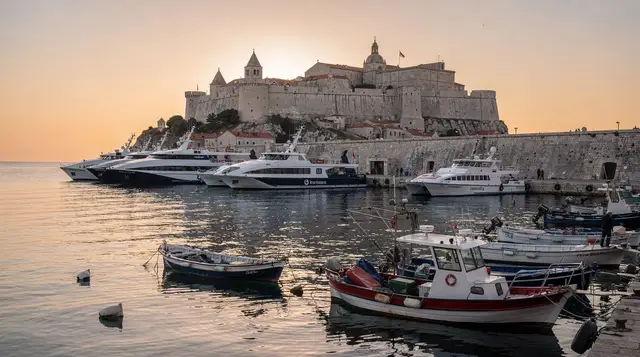
Continuing around Ortigia’s edge from the Fonte Aretusa, the waterfront promenade follows the island’s outer perimeter toward Castello Maniace, a 13th-century fortress occupying the island’s southern tip, with open sea views on three sides. The walk itself, largely flat and shaded in patches by the surrounding buildings, is a genuinely pleasant way to circle back toward the bridges connecting Ortigia to the mainland, and gives a clear sense of the island’s small scale from outside its dense internal street grid. The castle’s interior, where accessible, adds a different, more military architectural register to a walk otherwise dominated by churches and civic buildings.
Ortigia after dark
Like much of the wider region, Ortigia’s key facades are floodlit after sunset, and Piazza Duomo in particular takes on a different character once the daytime crowds thin and the surrounding restaurants and bars fill their outdoor tables — a genuinely lively evening scene given the island’s popularity as a place to stay overnight rather than only a day-trip stop from further inland. A slow evening walk from Piazza Duomo down to the Fonte Aretusa and back along the waterfront, once the heat of the day has broken, is a reasonable way to close out a day based in or near Syracuse, and gives a noticeably calmer view of the same sights covered in daylight above.
What is free, and what genuinely costs extra
The Duomo’s nave is generally accessible for a modest entry fee as a working cathedral rather than a free civic monument, reflecting its dual role as an active parish church and a major visitor sight; the Fonte Aretusa and the waterfront promenade cost nothing at all. Castello Maniace typically charges a separate entry fee for its interior, worth weighing against the fact that its exterior and the surrounding sea views are visible and photographable without paying to go inside.
As with the rest of the region, spending on time rather than tickets is the more reliable way to get the most out of a visit here — a slow walk through the back streets described above costs nothing and reveals more of the island’s actual character than a quick circuit between the two or three paid sights.
The morning market
The Mercato di Ortigia, tucked into the streets near the island’s northern bridge, runs mornings — roughly Monday through Saturday — and is largely wound down by early afternoon, worth timing a visit around rather than assuming it operates all day like a permanent retail street. It functions much like Catania’s Pescheria further north, a working commercial space supplying the island’s own restaurants and households rather than a staged tourist attraction, and several small eateries around its edges serve whatever was bought that morning.
A food and culture tour through Ortigia covers the market alongside the wider historic route, useful for visitors who want the food context explained alongside the architecture rather than treating the two as separate outings. A more specifically food-focused street food and history tour leans further into tastings along the same general route.
Guided routes through the old town
Ortigia’s dense, occasionally maze-like street pattern — a legacy of its much older, pre-Baroque urban layout — means a guided route adds real value for visitors who want the historical layering explained as they walk rather than pieced together from a guidebook afterward. A private walk through Ortigia with a local guide covers the route above with commentary on the temple-to-cathedral transformation and the island’s Greek origins in more depth than a self-guided visit typically allows.
For visitors with mobility considerations or simply less time, a panoramic tour by electric cab through the alleys and past the main monuments covers the same general ground at a different pace and without the walking.
Ortigia and the wider Val di Noto
Ortigia’s Baroque-era buildings, including much of the fabric around Piazza Duomo, date to the same post-1693 reconstruction period as the towns covered in the Val di Noto guide, even though Syracuse and Ortigia belong to their own separate UNESCO listing (Syracuse and the Necropolis of Pantalica) rather than the Val di Noto grouping itself.
This distinction is worth being precise about: the shared rebuilding history connects Ortigia visually and historically to Noto, Modica and Ragusa, but the formal UNESCO designations are separate, a detail covered at the full-island level in the Sicily UNESCO sites guide. In practical terms, Ortigia sits close enough to Noto — under an hour by car — that the two are commonly combined into a single day, covered in the day trips from Syracuse guide and the Syracuse and the Val di Noto in 4 days itinerary.
Pairing Ortigia with mainland Syracuse
Ortigia covers only the historic island core of Syracuse, and visitors with more than half a day should consider crossing back to the mainland side of the city for the Neapolis archaeological park, home to a well-preserved Greek theatre still used for performances and the so-called Ear of Dionysius, a large artificial limestone cave with unusual acoustic properties.
This ancient Greek layer of Syracuse’s history predates Ortigia’s Baroque rebuilding by well over a thousand years and gives useful context for understanding just how many distinct eras this single city has passed through — Greek foundation, Roman rule, Byzantine and Arab periods, Norman conquest, and finally the post-1693 Baroque reconstruction visible on Ortigia’s own streets today. The two halves of the city are a short walk or bus ride apart, making a combined day realistic for visitors with a full day to spend rather than a rushed half-day stop.
What a rushed cruise-stop itinerary usually misses
Ortigia is a common stop for cruise passengers docking at Syracuse for a few hours, and the resulting itineraries tend to compress the island into a fast loop between Piazza Duomo and the Fonte Aretusa, skipping the back streets, the waterfront circuit around Castello Maniace, and the market entirely if the ship’s schedule does not align with its morning hours.
That compressed version is not wrong, exactly, but it leaves out most of what makes Ortigia rewarding beyond its two most photographed stops. Visitors with only two or three hours are better served picking one additional detour — the waterfront walk or the back streets — rather than trying to see everything on this list at a jog, since a rushed pace defeats much of the point of a place this compact and this dense with detail.
Getting there and getting around
Ortigia is connected to mainland Syracuse by two short bridges, both an easy walk from the mainland train station, and the island itself is small enough that a car adds nothing but parking difficulty — most of its streets are pedestrian or narrow enough to make driving impractical regardless of ZTL restrictions, which apply here as in the rest of the region and are covered in the ZTL and parking guide. Visitors arriving by car are better off parking on the mainland side or at the edge of the island and walking in.
When to walk it
April through June and September through October offer the most comfortable conditions for the walk described above, much of which crosses open piazzas with limited shade. July and August routinely push past 35°C in this part of Sicily, covered in Sicily in summer, though Ortigia’s waterfront sections benefit from a sea breeze that the more enclosed streets of inland Val di Noto towns do not share. Early morning, timed to catch the market before it winds down, or the two hours before sunset, when Piazza Duomo’s facades catch warm late light, are both better choices than a midday walk in peak season.
Eating on the island
Ortigia’s restaurant scene is genuinely stronger than many day-trip visitors expect, benefiting from both a resident population and a steady flow of overnight guests rather than only lunchtime tour groups passing through. As elsewhere in the region, a small per-person coperto at sit-down restaurants is standard practice rather than a sign of overcharging, covered more generally in the Sicily food etiquette guide, and tables directly on Piazza Duomo tend to charge a premium for the view that a restaurant two streets back does not.
Fresh seafood, tied directly to the morning market’s daily catch, is a reasonable specialty to prioritize here specifically, given how short the supply chain between the Mercato di Ortigia and the surrounding kitchens genuinely is.
Frequently asked questions about walking Ortigia
Why is Ortigia’s cathedral built into ancient columns?
The Duomo was constructed by converting an existing 5th-century BC Greek Doric temple to Athena, incorporating its original columns directly into the cathedral’s structure rather than demolishing them — visible embedded in the exterior walls and inside the nave itself.
What is the Fonte Aretusa?
A freshwater spring pool right beside the sea on Ortigia’s western edge, tied to the ancient myth of the nymph Arethusa, and unusually planted with papyrus, one of the few places in Europe where it grows in a natural, non-cultivated setting.
Is Ortigia the same as Syracuse?
Ortigia is the small island that forms Syracuse’s historic core, connected to the mainland part of the city by two short bridges. “Syracuse” refers to the wider city, of which Ortigia is the oldest and most visited part.
Is Ortigia part of the Val di Noto UNESCO listing?
Syracuse and the Necropolis of Pantalica, including Ortigia, form their own separate UNESCO World Heritage listing, distinct from the Val di Noto Baroque towns, though Ortigia’s Baroque-era buildings share the same post-1693 rebuilding context as Noto, Modica and Ragusa.
When is Ortigia’s market open?
The Mercato di Ortigia runs mornings, roughly Monday through Saturday, and is largely finished by early afternoon — worth an early visit rather than assuming it runs all day.
Is Ortigia worth an overnight stay, or is a day trip enough?
A day trip covers the main route comfortably, but an overnight stay lets a visitor experience the island after the crowds thin in the evening and the market opens early the next morning — a genuinely different, calmer version of the same place than a single daytime visit provides.
Do you need a car to visit Ortigia?
No — Ortigia is small and entirely walkable, and a car is a genuine liability on its narrow streets, most of which are pedestrian or subject to strict ZTL access in any case.
Baroque towns and heritage tours on GetYourGuide
Verified deep-linked GetYourGuide tours. Book through these links and we earn a small commission at no cost to you.
Photo: our own image of the location, not the operator’s product photo.