The largest Greek temple site outside Greece
The Valley of the Temples — despite its name, a ridge rather than a valley — is the reason most visitors come to Agrigento, and it deserves the reputation: this is the largest archaeological site of Greek and Roman antiquity anywhere in the world outside Greece itself, a UNESCO World Heritage listing since 1997, and the single most complete surviving picture of a Greek colonial city’s sacred architecture in the Mediterranean. Ancient Akragas, founded by Greek colonists in 582 BC, grew wealthy enough on grain and trade to build a row of monumental temples along its southern ridge, oriented to face the sea, and several of them survive today in a condition that ordinary visitors rarely encounter outside a handful of sites in Greece proper.
The site runs roughly 1,300 meters from end to end along the Via Sacra, the ancient processional road, and covers considerably more ground than that in total — this is not a compact archaeological park like Segesta’s single temple and theatre, and treating it as a quick stop badly underestimates both the distance involved and the heat exposure along the way.
The temples, one by one
The Tempio della Concordia is the site’s centerpiece and one of the best-preserved Greek temples anywhere, Sicily or Greece included — its survival owes largely to its conversion into a Christian basilica in the 6th century, which kept the structure standing and largely intact rather than left to be quarried for building material, the fate that befell most of the valley’s other temples. Built around 430 BC, its 34 Doric columns stand essentially complete, and it is the image most people picture when they picture Agrigento at all.
The Tempio di Giunone (Juno, or Hera), at the ridge’s eastern end, sits in a more fragmentary but still striking state, with a number of standing columns and a clear sense of its original scale; it is also one of the best points from which to look back along the full run of the Via Sacra. At the opposite, western end, the Tempio di Ercole (Heracles) is the oldest of the surviving temples, dating to the late 6th century BC, and today stands as a row of re-erected columns rather than a complete structure — the columns were raised in the early 20th century from fallen drums found scattered on the ground, a reconstruction rather than an untouched survival, though a striking one regardless.
The Tempio di Giove Olimpico (Olympian Zeus) was, in its intact state, reportedly the largest Doric temple ever attempted anywhere in the Greek world, though it was never fully completed and now lies almost entirely collapsed — its scale is legible mainly through the sheer quantity of fallen stone blocks scattered across the site, plus a full-scale replica of one of the temple’s telamones (giant carved figures that would have supported the entablature) lying on the ground near the ruins, giving a genuine sense of just how outsized the original ambition was.
Nearby, the so-called Tempio dei Dioscuri (Castor and Pollux) — the four-columned corner that appears on nearly every Agrigento postcard — is worth knowing is largely a 19th-century reconstruction assembled from architectural fragments belonging to several different original buildings rather than a single intact temple; it looks the part, and remains one of the most photographed spots in the valley, but it is not the untouched ancient structure it is often taken for.
Kolymbethra: the garden inside the archaeological park
Less visited than the temples themselves, the Giardino della Kolymbethra sits in a side gorge within the archaeological park’s boundaries — originally an ancient reservoir and irrigation system, later planted over centuries with citrus, olive and almond groves, abandoned through much of the 20th century, and restored by the Italian conservation trust FAI beginning in the 1990s.
It requires a separate ticket from the main temple circuit but is a genuinely different experience: shaded, planted, and quiet, in direct contrast to the exposed stone of the temple ridge above. A private tour of the Valley of the Temples including the Kolymbethra garden is a sensible way to combine both halves of the site without missing the garden, which a rushed visit focused purely on the temples easily overlooks.
When to visit: early, at sunset, or by night
The single most important practical fact about the Valley of the Temples is that it has almost no shade over its full 1,300-meter length, and midday visits in the warmer months are genuinely uncomfortable rather than merely inconvenient. Early morning, in the first couple of hours after opening, is the classic approach for cooler temperatures and better light for photography. Sunset is the second obvious option, and a skip-the-line sunset tour both avoids the ticket queue and times the walk for when the temples’ honey-colored stone takes on its best color, with noticeably cooler conditions than a midday visit.
In summer, the park runs organized night openings, and a night tour with skip-the-line access is worth serious consideration for a July or August visit — walking among floodlit temples after dark, with the day’s heat broken, is a genuinely different and in some ways more atmospheric experience than the daytime version, and avoids the worst of the season’s heat entirely. For visitors who prefer a self-paced visit at whatever hour suits them, a self-guided audio guide is a straightforward way to get context without committing to a scheduled group departure.
Why Akragas built so many temples
Ancient Akragas, at its height in the 5th century BC, was among the wealthiest cities in the Greek world, its fortune built on grain exports and its favorable position between Carthaginian and Greek spheres of influence in the western Mediterranean — a position that also made it a frequent target, sacked by Carthage in 406 BC in an attack that effectively ended its golden age.
The temple-building program that produced the ridge visible today was compressed into a remarkably short window, roughly a century, reflecting both the city’s sudden wealth and a degree of competitive civic pride with other Greek colonies on the island, particularly Syracuse and Selinunte, each racing to build ever more ambitious sacred architecture. The Roman writer Cicero, who prosecuted the corrupt governor Verres for looting Sicily’s temples and artworks, singled out Akragas among the island’s greatest cities in his account — a reminder that the site’s reputation for grandeur is not a modern tourism invention but a judgment shared by observers two thousand years closer to the temples’ construction.
Tickets, crowds, and a few honest warnings
Buying tickets online in advance avoids the queue at the main entrance, which forms quickly once tour buses arrive, generally from mid-morning. As with most major Italian archaeological sites, informal ticket sellers occasionally work the approach roads and car parks near the entrances, offering “skip the line” access at a markup over the official online price — there is no reason to buy from anyone other than the official ticket office or a licensed tour operator, since the park’s own online system already provides the fast-track access being sold at a premium.
The archaeological museum, the Museo Archeologico Regionale, sits a short walk from the temples and holds finds from the site, including a fragment of one of the Olympian Zeus temple’s telamones — worth the modest additional time for anyone with a deeper interest in how the objects found on-site inform the reconstructed picture of ancient Akragas. For the wider archaeological context across the island, see the Sicilian archaeological museums guide and Greek Sicily explained.
An e-bike alternative, and a wine-tasting pairing
For visitors who would rather cover the 1,300-meter site with less walking in the heat, an e-bike tour of the Valley of the Temples and historic downtown is a practical option that also extends into Agrigento’s own old town, which most visitors otherwise skip entirely in favor of the temples alone. For a slower, food-and-wine-oriented afternoon after the temples, a Valley of the Temples tour combined with a wine tasting pairs the archaeology with the surrounding countryside’s produce — the area around Agrigento sits within Sicily’s broader DOC wine zones, though it is less internationally known for wine than Etna or Marsala.
Visiting with children
The Valley of the Temples is, on balance, a workable family destination, but the lack of shade and the real walking distance involved mean a midday summer visit with young children is a genuine mistake rather than a minor inconvenience — plan around an early morning or evening slot instead, and bring more water than seems necessary. Strollers manage the main paved paths reasonably well, though the ground becomes uneven closer to some of the temples themselves.
Children generally respond better to the scale of the fallen Zeus temple’s giant telamone figure, which is easy to grasp as “the biggest one,” than to the more subtle architectural merits of the Concordia temple’s completeness — worth keeping in mind when deciding how to sequence a family visit along the ridge. See the wider Sicily with kids guide for how Agrigento fits into a broader family itinerary.
Agrigento’s old town: worth a look, not a detour
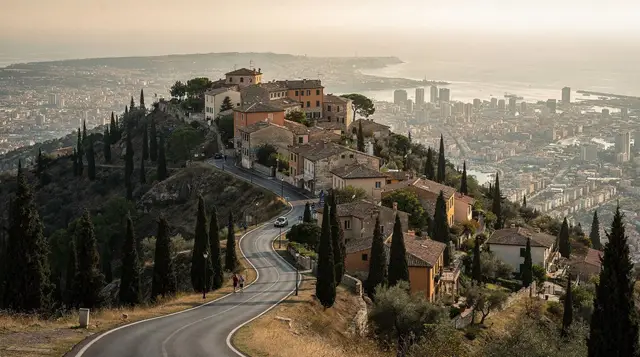
Modern Agrigento sits on a hill above the Valley of the Temples, and its historic center, centered on via Atenea, is a genuine medieval and later town rather than a purely modern service base for the archaeological park. It receives a fraction of the temples’ visitor numbers and shows real wear in places — this is a working Sicilian city, not a restored showpiece — but the Cattedrale di San Gerlando and a scattering of Baroque churches along the steep streets above via Atenea are worth an hour or two for anyone staying overnight rather than day-tripping straight back out. Most visitors, reasonably, prioritize the temples and treat the old town as a secondary stop rather than a primary reason to come.
Nearby: Scala dei Turchi and Pirandello’s house
The Scala dei Turchi, the white marl cliff formation, sits about 20 minutes west of Agrigento along the coast and is a near-universal add-on to a Valley of the Temples visit — full detail, including the site’s genuinely restricted and often-closed access, sits on the separate Scala dei Turchi destination page. A short drive in the other direction, at Caos on Agrigento’s outskirts, the birthplace of Nobel laureate Luigi Pirandello is preserved as a small museum, a modest but genuine literary pilgrimage stop for anyone with an interest in his work.
Piazza Armerina and the Villa Romana del Casale mosaics, roughly 90 minutes northeast, are a common combination for visitors building a longer archaeology-focused loop through the interior — see the separate Piazza Armerina destination page and the day trips from Agrigento guide for realistic routing.
Getting there and getting around
Agrigento has train connections to Palermo (roughly 2 hours) and a more limited link toward Catania that typically requires a change; the Sicilian trains guide covers realistic timings for both routes. Most visitors arrive by car via the SS640 from Caltanissetta or along the coastal road from the west, and the Valley of the Temples has its own dedicated car parks at both the eastern and western entrances, making a rental car a genuinely practical option here in a way it is not in some of Sicily’s more pedestrianized old towns.
See the driving in Sicily guide and car rental in Sicily guide for the wider practicalities, and the getting around Sicily guide for how Agrigento fits into a longer, car-based loop of the island.
When to come
April through June and September through October give the most comfortable daytime walking conditions for the full length of the Via Sacra. Midsummer routinely exceeds 35°C, with the exposed stone paths holding heat well into the evening — this is one of the clearest cases in Sicily where a night visit genuinely outperforms a daytime one rather than being merely a scheduling compromise.
Late winter brings the Sagra del Mandorlo in Fiore, an almond blossom festival held in the Valley of the Temples itself, when the almond trees scattered among the ruins bloom against the ancient stone — a striking, less crowded alternative to a summer visit for anyone traveling outside peak season. See the best time to visit Sicily guide for the wider seasonal picture.
Frequently asked questions about visiting Agrigento
How long does it take to walk the whole Valley of the Temples?
Budget at least 2-3 hours for the main temple circuit alone, more if adding the Kolymbethra garden or the archaeological museum. The site runs roughly 1,300 meters end to end with almost no shade, so pace and water matter more here than at most Sicilian sites.
Is it better to visit at sunrise, sunset, or at night?
All three beat a midday visit for comfort. Sunset gives the best light for photography and cooler temperatures; a summer night tour, when available, avoids the day’s heat entirely and shows the temples floodlit, a genuinely different atmosphere from the daytime version.
Is the Temple of Castor and Pollux original?
Not entirely — the four standing columns and entablature seen today are a 19th-century reconstruction assembled from fragments belonging to several different ancient buildings, not a single intact original temple. It remains a striking and widely photographed structure regardless.
Do you need a full day for Agrigento, or is half a day enough?
Half a day covers the temple circuit at a reasonable pace. A full day allows time for the Kolymbethra garden, the archaeological museum, and either the old town or a stop at Scala dei Turchi on the way out.
Is Agrigento’s old town worth visiting, or just the temples?
The temples are the priority for nearly everyone, and reasonably so. The old town is a real, if unpolished, Sicilian hill town worth an hour or two for visitors staying overnight, but it is not essential for a day-tripper focused on the archaeological park.
How far is Agrigento from Palermo and from Catania?
Roughly 2 hours from Palermo by car or train, and around 2-2.5 hours from Catania by car, longer by train since the direct rail connection is limited. Most visitors combine Agrigento with either a Palermo-based western loop or an interior route toward Piazza Armerina.
Can you visit the Valley of the Temples without a car?
Yes — it is reachable by local bus from Agrigento’s train station and town center, and several organized day tours run directly from Palermo, Catania and other bases. A car simply makes combining the temples with Scala dei Turchi and the surrounding area more efficient in a single day.
Is the Kolymbethra garden included in the standard temple ticket?
No — it requires a separate ticket, run through the FAI conservation trust rather than the main archaeological park authority. It is easy to miss entirely if not planned for in advance, and worth the extra stop for anyone wanting a shaded, planted contrast to the exposed temple ridge.