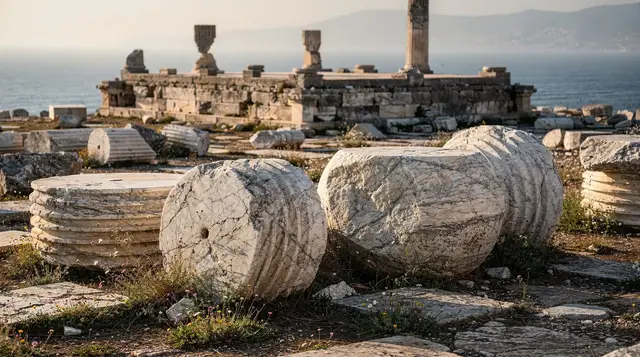
The archaeological museums worth your time
Which archaeological museum in Sicily is worth prioritising if I only have time for one?
The Museo Archeologico Regionale Antonio Salinas in Palermo has the broadest collection, including the metopes from Selinunte's temples, and is the best single stop if your trip does not otherwise include Syracuse or Marsala. If your route already covers Syracuse, the Museo Archeologico Regionale Paolo Orsi there is arguably richer for its region-specific depth, and Marsala's Museo Baglio Anselmi holds a genuinely unique object: a reconstructed Punic warship.
Why the ruins are only half the story
Standing among the fallen columns of Selinunte or walking the ridge at the Valley of the Temples, it is easy to assume you are seeing the full extent of what survives from ancient Sicily. You are not. Almost every major site on this island has had its most detailed, most fragile and most historically informative material — carved reliefs, statues, painted pottery, jewellery, small ritual objects — removed to purpose-built museums for conservation, leaving the open-air sites themselves as largely architectural: columns, walls, foundations, the bones of a building rather than its decoration.
Understanding Greek, Elymian, Sicel and Phoenician Sicily properly means pairing the ruins with at least one of the island’s major archaeological museums, and the three covered here — Palermo’s Salinas museum, Syracuse’s Paolo Orsi museum, and Marsala’s Baglio Anselmi museum — each add something distinct that no amount of time on site alone provides.
The Salinas museum, Palermo: the broadest single collection
The Museo Archeologico Regionale Antonio Salinas, in Palermo’s historic centre, holds the single broadest archaeological collection on the island, drawing from sites across all of Sicily rather than one region. Its most significant holding is the surviving group of metopes — carved stone relief panels that ran along the friezes of Selinunte’s Doric temples — spanning archaic to classical periods and showing a clear stylistic evolution in how Greek sculptors across roughly two centuries handled mythological scenes, from stiffer, more formal early work to the more naturalistic, dynamic compositions of the classical period.
Seeing these metopes is, in a real sense, necessary to properly understand Selinunte itself: the temples on site are architectural shells, and the metopes are the clearest surviving evidence of what their decorative programme actually depicted and how sophisticated it became.
An audio-guide app ticket for the Salinas museum is a practical way to work through a collection this broad at your own pace, since a rushed walk-through easily misses the metopes’ significance relative to everything else on display.
The Paolo Orsi museum, Syracuse: regional depth
The Museo Archeologico Regionale Paolo Orsi, named for the archaeologist whose early 20th-century excavations shaped much of what is known about ancient Syracuse and the wider southeast of the island, holds material from Greek Syracuse, from Sicel sites predating Greek colonisation, and from the region’s prehistoric periods, giving it a depth of regional coverage that a broader, island-wide collection like Palermo’s cannot match for this specific area. It pairs naturally with a visit to the Neapolis archaeological park, since a meaningful share of the objects on display were excavated from the theatre, the latomie quarries and the wider Neapolis area you can also walk through on the same day.
A guided tour of the Paolo Orsi museum is worth the time specifically because the collection rewards context that display labels alone do not always provide — how a given find relates to a specific building or burial you may have just seen at Neapolis.
Baglio Anselmi, Marsala: a genuinely unique object
The Museo Archeologico Baglio Anselmi in Marsala is smaller than the other two, but it holds something neither can match: the excavated and partially reconstructed hull of a Carthaginian warship, almost certainly sunk during the First Punic War against Rome in the third century BC and recovered from the seabed near the Egadi Islands in the 1970s.
Ancient warship construction is otherwise known mainly through artistic depictions and written descriptions rather than surviving physical hulls, which rot and disintegrate in most marine conditions far more completely than stone or ceramic material — this makes the Marsala ship one of the more archaeologically important individual objects anywhere in Sicily, disproportionate to the museum’s modest size. It sits naturally alongside a visit to Mozia and the Phoenician and Carthaginian history of the surrounding Stagnone lagoon, a short drive away.
Which one to prioritise
If your trip covers only one region intensively, match the museum to it: Palermo’s Salinas museum for a Palermo-and-west-coast-based trip, especially one including Selinunte or Segesta; Syracuse’s Paolo Orsi museum if Syracuse and the Val di Noto are on the route; Marsala’s Baglio Anselmi if Trapani, Marsala or Mozia are part of the plan. If your trip is broad enough to include all three areas, all three museums are worth the relatively modest time each takes, since none of them requires more than a couple of hours even at a thorough pace.
For material from the interior — Piazza Armerina and Morgantina — the relevant collections sit closer to the sites themselves rather than in one of these three regional museums; see Villa Romana del Casale and Morgantina and the Aidone museum, including the repatriated Venus of Morgantina. A combined tour of the Roman villa and the Aidone museum and a guided tour of Morgantina itself cover that side of the picture.
A practical reason to plan around museums: the heat
Beyond their archaeological value, Sicily’s major museums have a genuinely practical use on a hot-weather trip: they are generally air-conditioned, unlike almost every open-air ancient site covered elsewhere on this list. Building a rough rhythm of open-air sites in the cooler morning or evening hours, with an indoor museum stop through the hottest part of a summer afternoon, is a sensible way to structure a day in July or August rather than an afterthought — see Sicily in summer and the best time to visit Sicily for the wider seasonal picture.
Getting there and combining with the sites
Palermo’s Salinas museum sits in the historic centre, walkable from most central accommodation — see Palermo and the Arab-Norman UNESCO route for how it fits a wider day of Palermo sightseeing.
The Paolo Orsi museum in Syracuse is a short distance from both Ortigia and the Neapolis park, making it easy to fold into a single Syracuse day — see day trips from Syracuse. Marsala’s Baglio Anselmi museum sits near the town’s waterfront, close to where boats depart for Mozia — see getting around Sicily for the wider transport picture across all three towns.
Fitting it into a longer trip
These three museums work best as additions to days already built around their nearby archaeological sites rather than standalone destinations — a Selinunte or Segesta day gains from a later or earlier Palermo museum stop, a Neapolis day gains from the Paolo Orsi museum, and a Mozia or salt-pans day gains from Baglio Anselmi. See Sicily in 7 days and Western Sicily in 5 days for itineraries that naturally accommodate this pairing without adding extra driving days.
Smaller collections worth knowing about
Beyond the three regional heavyweights, several smaller museums are worth folding into a visit if you are already at the corresponding site. Agrigento has its own Museo Archeologico Regionale near the Valley of the Temples, holding finds specific to ancient Akragas, including original fragments of the giant telamon figures from the unfinished Temple of Olympian Zeus that are not part of the composite figure displayed on site itself — a natural extra stop given its location directly beside the temple ridge rather than requiring a separate trip.
Caltagirone’s Museo Regionale della Ceramica, while focused on the town’s celebrated ceramic tradition rather than classical antiquity specifically, still connects to the island’s deeper craft history in a way that complements the more purely archaeological collections elsewhere. None of these smaller museums individually justify a special trip on their own merits in the way the three main collections do, but each rewards the modest extra time if you are already on site for the associated ruins.
Planning a museum-heavy day for bad weather
Sicily’s ancient sites are almost entirely open-air, which makes an unexpected rainy day, more common in the shoulder seasons than most visitors expect, a genuine planning problem if your itinerary is built around ruins rather than indoor attractions.
Having one or more of these museums identified in advance as a fallback option — particularly Palermo’s Salinas museum, given its size and the amount of material it holds — gives a workable alternative for a day when wind, rain or an unseasonal cold snap make an open hillside site like Selinunte or the Valley of the Temples considerably less appealing than usual. See Sicily weather month by month for how likely this actually is depending on when you travel.
Looting, repatriation and why so many labels mention it
A recurring theme across Sicily’s archaeological museums, and one worth understanding before you visit any of them, is how much of the island’s ancient heritage passed through illicit excavation and export during the 20th century before eventually being recovered. The Venus of Morgantina, returned from the Getty Museum in 2011, and the Morgantina silver, returned by the Metropolitan Museum of Art, are the best-known individual cases, but they reflect a wider pattern that shaped Italian and international cultural heritage law, including tightened export controls and greater cooperation between Italian authorities and foreign museums from the late 20th century onward.
Many object labels across these collections note a find’s excavation history, including gaps where an object passed through private hands before entering a public collection, and that history is itself part of what these museums now represent — not just ancient Sicily, but the modern, ongoing effort to keep what survives of it properly documented and in place.
Combined tickets and practical visiting tips
Some of these museums offer combined ticketing with nearby sites or other collections, though arrangements change and are worth checking current details for rather than assuming a specific discount or bundle remains in place. Bags are commonly required to be checked at an information desk or small cloakroom on entry, and photography rules vary by museum and by gallery, with flash photography typically restricted around fragile painted or gilded surfaces — check current signage rather than assuming a blanket policy applies uniformly throughout a given collection.
Most of these museums are considerably quieter than the archaeological sites they relate to, since far fewer visitors make the additional effort to see the finds after visiting the ruins, which in practice means a more relaxed, less crowded experience than almost anywhere else on this list.
Building a Palermo museum day around bad weather or midday heat
Palermo has enough museum density that a single wet or extremely hot day can be spent almost entirely indoors without feeling like a compromise. The Salinas archaeological museum pairs naturally with Palazzo Abatellis, which holds Sicily’s major collection of medieval and Renaissance art rather than classical antiquities but sits within easy walking distance in the same historic centre, giving a genuine full-day indoor itinerary if conditions outside make an open-air site like Monreale’s cathedral cloister or a Palermo walking tour considerably less appealing than usual.
This kind of contingency planning is worth doing in advance for a Palermo-based portion of any trip, rather than improvising on the day itself, since a wet or extremely hot day is more disruptive to an itinerary built around outdoor sites than to one that already has an indoor alternative identified.
University missions and the ongoing work behind the displays
Much of what fills these museums’ galleries reflects decades of work by Italian university archaeology departments and, in some cases, foreign archaeological missions operating under agreement with Italian cultural heritage authorities — the same institutional structure that governs work at active sites like Morgantina and Mozia.
Object labels increasingly note not just where and when a find was excavated, but which institution led the work, reflecting a broader shift in Italian archaeological practice toward transparency about a find’s full custodial history, partly in response to the same looting and repatriation issues discussed above. This is worth bearing in mind as a visitor: the museum galleries you are walking through represent an ongoing, still-active field of research, not a fixed, finished historical record assembled once and left unchanged.
Audio guides, apps and visiting with children
Several of these museums now offer audio guide apps or handheld devices as an alternative to a live guided tour, which can work well for visitors who want context at their own pace without committing to a fixed group schedule — see the Salinas museum’s own audio app option mentioned above as one example. For children, these museums are generally a more comfortable option than the open-air sites on a hot day, and collections like the Salinas museum’s Selinunte metopes or the Baglio Anselmi Punic ship tend to hold younger visitors’ attention through their sheer visual scale and the tangible, physical presence of the objects, in a way that more abstract architectural remains on an open site do not always achieve as directly.
Treat museum time as part of the itinerary, not an afterthought
The single most common mistake visitors make with these three museums is treating them as optional extras to be squeezed in only if time allows, rather than budgeting for them from the start of an itinerary the way a major archaeological site would be. Given how directly the Salinas museum’s metopes inform Selinunte, the Paolo Orsi museum’s finds inform Neapolis, and Baglio Anselmi’s Punic ship informs Mozia, planning at least one of these visits into a fixed day, rather than as a flexible maybe, is the difference between seeing Sicily’s ancient sites as isolated ruins and understanding them as the fuller, better-documented civilisations they actually represent.
The three museums, ranked by how essential they are
If forced to prioritise, the order most consistently recommended is: Salinas in Palermo first, for its breadth and the Selinunte metopes specifically; Paolo Orsi in Syracuse second, given how directly it explains the Neapolis park; and Baglio Anselmi in Marsala third, valuable chiefly for the Punic ship and best treated as a bonus for anyone already visiting Mozia rather than a destination in its own right.
A final practical note
None of these three museums requires advance booking in the way some archaeological sites do in peak season, which makes them a genuinely flexible addition to slot into whichever day of a trip ends up needing an indoor option, rather than something that has to be fixed in the itinerary weeks ahead of arrival.
What to actually plan for
Do not treat these museums as optional extras if you have seen the corresponding site — the Salinas museum’s Selinunte metopes in particular change how the temple ruins themselves read, and skipping the museum leaves a real gap in understanding what the site’s decorative programme actually looked like. Do not rush any of the three in under 45 minutes; each rewards at least an hour of unhurried attention. And do not overlook Marsala’s Baglio Anselmi assuming a small museum means a minor stop — the Punic ship is a genuinely rare survival with few equivalents anywhere in the ancient Mediterranean world.
Greek and Roman site tours on GetYourGuide
Verified deep-linked GetYourGuide tours. Book through these links and we earn a small commission at no cost to you.
Photo: our own image of the location, not the operator’s product photo.