Greek Sicily explained: who built what, and when
Was ancient Sicily simply a Greek island?
No. Greek colonists founded major cities from the eighth century BC onward and left the temples most visitors come to see, but they shared the island throughout antiquity with native Sicels, Sicanians and Elymians, and with Carthaginian settlements in the west, and the wars between these groups shaped why some sites were finished and others were destroyed or abandoned mid-construction.
Sicily was never just Greek
It is easy to walk through the Valley of the Temples or Selinunte and come away thinking of ancient Sicily as simply a Greek island with a few ruins left behind. It was not. For most of antiquity, Sicily was shared, unevenly and often violently, among Greek colonists concentrated mainly along the east and south coasts, native populations — the Sicanians, Sicels and Elymians — who predated Greek arrival and adapted to it in different ways, and Carthage, whose Phoenician-founded settlements controlled much of the west of the island.
The temples that survive today are, overwhelmingly, the work of one of these groups, the Greek colonists, but understanding the other three explains why some sites look the way they do — finished or abandoned, standing or rubble — far better than Greek history alone can.
The Greek colonies: independent cities, not one Sicily
Greek colonisation of Sicily is traditionally dated from 734 BC, with the founding of Naxos on the east coast near what is now Giardini Naxos and Taormina, followed within a year by Syracuse in 733 BC, and a wave of further colonies over the following two centuries, including Gela, Akragas (Agrigento), Selinus (Selinunte) and Megara Hyblaea, the mother city of Selinunte itself.
These were independent city-states, often intensely rivalrous, and Greek Sicily’s internal wars — Syracuse against Akragas, Selinus against Segesta, and periodic conflicts drawing in mainland Greek powers like Athens and Sparta — were at least as consequential to the island’s history as any external threat. The idea of a unified “Greek Sicily” is a modern simplification; the reality was closer to a cluster of competing, often warring, Greek-speaking states that happened to share an island and a broadly common culture.
The Valley of the Temples at Agrigento and the sprawling ruins at Selinunte represent this Greek colonial building tradition at its most ambitious — huge Doric temples built on the proceeds of grain, wine and olive oil wealth, intended as much to project civic and religious power as to serve any single deity.
The Sicanians, Sicels and Elymians: who was already there
Before, during and after Greek colonisation, three distinct native populations occupied different parts of the island. The Sicanians are generally regarded as the oldest attested group, associated mainly with central and western Sicily. The Sicels, who gave the island its name (Sicilia), are thought to have arrived later, possibly from the Italian mainland, and settled mainly in the east, where sites like Morgantina show a genuine layering of Sicel and later Greek culture rather than one simply replacing the other.
The Elymians, centred on Segesta and the hilltop city of Eryx (modern Erice), are linked by some ancient writers to legendary Trojan refugees — a claim modern historians treat as origin myth rather than established fact — and are notable for building substantially in Greek architectural style, including Segesta’s famous unfinished Doric temple, while remaining politically and often militarily opposed to the neighbouring Greek colony of Selinunte.
The distinction matters when you are actually standing in front of a ruin: Segesta’s temple looks Greek because the Elymians borrowed Greek architectural language, not because Segesta was a Greek city. Getting that backward misreads the whole site.
Carthage and the Phoenicians: the west belonged to someone else
Sicily’s western end, roughly from modern Trapani and Marsala down toward Palermo, was for long stretches of antiquity under Carthaginian rather than Greek control, built on earlier Phoenician trading settlements. Mozia, a small island in the Stagnone lagoon near Marsala, is the clearest surviving example of this Phoenician and later Carthaginian presence, alongside Palermo and Solunto further along the coast.
Carthage and the Sicilian Greek cities fought repeated, often devastating wars over control of the island, and the destruction of Selinunte in 409 BC and the sacking of Akragas in 406 BC, which left the Temple of Olympian Zeus permanently unfinished, both trace directly back to Carthaginian military campaigns.
Rome, and the layering that followed
Sicily became Rome’s first overseas province following the First Punic War against Carthage, concluding in 241 BC, and Greek cities across the island generally continued to function, often prosperously, under Roman administration, with Greek language and civic culture persisting for centuries rather than being erased outright.
This is why several sites show clear physical layering of Greek foundation and Roman rebuilding — Taormina’s ancient theatre is the clearest single example, a Greek-founded structure substantially reworked by Roman builders in the second century AD for different forms of spectacle. Syracuse’s Neapolis park shows the same pattern at a larger scale, with a Greek theatre and a separate, later Roman amphitheatre sitting within the same archaeological zone.
Reading a ruin: why some sites are complete and others are not
Once the groups are clear, the condition of individual sites tells a more specific story. A temple that survives largely intact, like the Temple of Concordia at Agrigento, usually owes its condition to continuous later use — in that case, conversion into a church, which protected it from being quarried for stone. A temple that is unfinished, like Segesta’s or Selinunte’s Temple G, points to an interrupted building project, most plausibly halted by war.
And a site reduced to rubble or a bare foundation, like the altar of Hieron II at Syracuse or the Temple of Olympian Zeus at Agrigento, usually indicates deliberate later stone-robbing, often for entirely unrelated building projects centuries afterward — the fortifications built on Ortigia in the 16th century, for instance, consumed stone from both the Syracuse altar and its Roman amphitheatre.
A practical map of who built what
For the Greek colonial building tradition at its most complete, the Valley of the Temples at Agrigento is the clearest single site. For the Elymian adoption of Greek form, Segesta’s unfinished temple and theatre.
For Greek Sicily’s largest and least crowded site, Selinunte’s sprawling temple groups and acropolis. And for the clearest Greek-to-Roman layering, Syracuse’s Neapolis archaeological park, home to both a working Greek theatre and a Roman amphitheatre a short walk apart.
Building this into a trip
A trip that deliberately covers all four groups — Greek, Elymian, Sicel and Carthaginian — realistically needs to combine western Sicily (Segesta, Selinunte, Mozia) with the south coast (Agrigento) and the interior (Morgantina), which is more driving than a single loop can comfortably cover on a short trip. See Western Sicily in 5 days for the Elymian and Carthaginian side, Baroque towns and Greek temples in 5 days for Agrigento and the interior, and the full Sicily road-trip loop if you have the time to combine all of it into one longer trip.
Magna Graecia: Sicily’s place in a wider Greek world
Sicily’s Greek colonies were part of a much broader pattern of Greek settlement across southern Italy and the western Mediterranean known collectively as Magna Graecia (“Greater Greece”), which also included major cities on the Italian mainland such as Taranto, Naples (originally Neapolis, unrelated to Syracuse’s district of the same name) and Cumae.
Sicily’s Greek cities were not an isolated colonial outpost but part of an interconnected network of trade, culture, occasional military alliance and frequent rivalry stretching across the whole region, with Syracuse in particular growing, at its height under rulers like Dionysius I, into arguably the most powerful single Greek city anywhere, mainland Greece included — a scale worth keeping in mind when a modern visitor’s instinct might be to think of Sicily as peripheral to the story of ancient Greece rather than central to it.
A short chronology
A rough timeline helps place the individual sites relative to each other: Sicanians and other native populations occupy the island from prehistory; Phoenician trading settlements, including the precursor to Mozia, appear from around the ninth century BC; Greek colonisation begins in 734 BC with Naxos, followed rapidly by Syracuse and the wave of colonies that produced Selinunte, Akragas and the others; the fifth century BC sees the peak of temple-building at Agrigento and Selinunte alongside escalating conflict with Carthage; 409 to 406 BC brings the destruction of Selinunte and the sack of Akragas, halting the Temple of Olympian Zeus mid-construction; 397 BC brings the destruction of Mozia by Dionysius I of Syracuse; and 241 BC marks Sicily’s absorption into the Roman Republic as its first overseas province, beginning the Greek-to-Roman layering visible at sites like Taormina’s theatre and Syracuse’s Neapolis park today.
Reading a Doric temple: the vocabulary that makes the sites make sense
A handful of architectural terms recur across every Greek and Elymian site on this island, and knowing them turns a row of columns into something more legible. The stylobate is the raised platform a temple’s columns stand on; the columns themselves support an entablature, the horizontal structure running along the top, which is divided into the architrave (the plain lower band), the frieze (the decorated middle band, where Doric temples alternate triglyphs — blocks with vertical grooves — with metopes, the carved or painted panels, like those from Selinunte now in Palermo’s Salinas museum), and the cornice above.
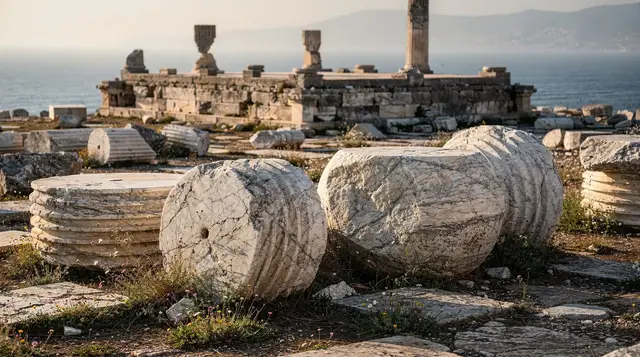
At each end, the roofline forms a triangular pediment, often filled with sculpture in a temple’s most complete state, though almost none survives intact on any Sicilian site. Column fluting, the vertical grooves cut into a shaft, is a finishing step that Segesta’s unfinished temple never received, which is exactly why its plain, unfluted columns stand out once you know what you are looking for. Applying this vocabulary across sites — comparing Concordia’s complete entablature at Agrigento to Segesta’s unfluted stylobate, or identifying where Selinunte’s Temple E was reassembled through anastylosis — turns a series of otherwise similar-looking ruins into a set of distinct, comparable buildings with their own individual stories.
Myth embedded in the landscape
Greek Sicily’s mythology was not separate from its geography — ancient Greeks read the island’s own landscape as physical evidence for their myths. The abduction of Persephone by Hades, one of the central myths of Greek religion, was widely located by ancient tradition at Lake Pergusa, near modern Enna in the island’s interior, making Enna a major cult centre for Demeter and Persephone throughout antiquity.
Off the eastern coast near Aci Trezza, the distinctive sea stacks known as the Faraglioni dei Ciclopi were identified by ancient and later tradition with the rocks the blinded Cyclops Polyphemus hurled at the fleeing Odysseus in Homer’s Odyssey — a myth that gave the wider region its lasting association with Etna and the Cyclopes, said to work at their forges beneath the volcano. None of this is presented by serious modern scholarship as literal history, but it is a genuine part of how the ancient Greeks themselves understood and narrated the island they had settled, and it adds a layer of meaning to sites and landscapes that a purely architectural or political account leaves out.
The legacy today: names, words and a living inheritance
Greek Sicily’s influence did not end with the arrival of Rome, or Byzantium, or the Arab and Norman conquests that followed. Many Sicilian place names carry Greek roots directly through to the present, from Syracuse (Greek Syrakousai) and Agrigento (from Greek Akragas, via Latin Agrigentum) to Taormina (from Tauromenium) and Selinunte itself, whose modern name preserves the ancient Greek name for the wild celery that reportedly grew along its rivers.
Sicilian dialect, distinct from standard Italian, retains a number of words of Greek origin absorbed over more than two millennia of continuous contact, alongside layers from Arabic, Norman French and Spanish reflecting the island’s whole subsequent history — a linguistic record of exactly the sequence of rule outlined in the chronology above. Understanding this continuity is a useful corrective to treating Greek Sicily as something that ended cleanly in the third century BC when Rome arrived; in place names, in dialect, and in the continued use of theatres like Syracuse’s and Segesta’s for live performance today, it has never entirely stopped being visible.
Using this guide alongside the individual site pages
This overview is deliberately broad, and it works best read alongside the dedicated guide for whichever site you are actually planning to visit — the Valley of the Temples, Segesta, Selinunte, Syracuse’s Neapolis park, Taormina’s ancient theatre, Morgantina and Mozia each go into far more site-specific detail on tickets, timing and logistics than makes sense to repeat here.
Think of this page as the map that shows how those individual sites relate to each other historically and politically, and the other guides as the practical, on-the-ground detail for actually visiting each one.
Why this framework matters more than any single date
None of the individual facts above — a founding year, a siege date, a temple’s dedication — matters as much on its own as the overall pattern they form together: a genuinely multicultural island where Greek colonists, native Sicanians, Sicels and Elymians, and Carthaginian settlers competed, traded, intermarried and fought across roughly five centuries before Rome absorbed the whole picture into a single province. Holding that pattern in mind while standing in front of any individual ruin, rather than trying to memorise a full timeline, is the single most useful thing a visitor can take from this overview into the sites themselves.
A framework, not a substitute for the individual stories
This overview deliberately trades depth on any single site for breadth across all of them, which means it will underserve anyone wanting the full detail on, say, exactly why Temple G at Selinunte fell or exactly what the Ear of Dionysius’s acoustics actually do — that detail lives in the dedicated guide for each site, linked throughout above, and is worth reading in full once you have this wider map in place.
One caution on sourcing
Much of ancient Sicilian history, particularly for the earlier native populations, rests on a combination of archaeological evidence and often-biased ancient Greek and Roman written sources, so treat specific attributions and motivations, especially around the more mythologised episodes, as the best current reading of imperfect evidence rather than settled certainty in every detail.
The one habit worth building before you travel
Before visiting any single site on this list, take thirty seconds to place it on the map above: Greek colonial, Elymian, Sicel-Greek, or Phoenician-Carthaginian. That single act of orientation does more to make a ruin legible than any amount of on-site signage, and it is the one habit this whole overview is really trying to build.
What to actually keep in mind
Do not assume every Greek-looking temple was built by Greek colonists — Segesta is the clearest counterexample on the island. Do not assume a ruined or unfinished site is less significant than a complete one; often the opposite is true archaeologically, since unfinished construction preserves evidence, like Segesta’s unworked column bosses, that finished buildings do not. And do not treat “ancient Sicily” as a single culture with a single story — the wars between these groups, as much as any one of them alone, are what actually produced the island’s archaeological landscape.
Greek and Roman site tours on GetYourGuide
Verified deep-linked GetYourGuide tours. Book through these links and we earn a small commission at no cost to you.
Photo: our own image of the location, not the operator’s product photo.