Palermo street food, what to eat and where
What is the one Palermo street food to try if you only try one?
Pane con la milza (pani ca' meusa), a soft bun filled with veal spleen and lung braised in lard, is the single most Palermo thing you can eat, sold from small stands identifiable by a steaming pot at the counter. If offal is not for you, sfincione — thick, spongy pizza with tomato, onion and caciocavallo — is the safer and equally authentic second choice.
A city that eats standing up
Palermo’s street food is not a curated food-hall version of Sicilian cooking — it is the everyday eating habit of a city where a full sit-down lunch was, for generations, a luxury for special occasions rather than a weekday routine. The dishes below are cheap, fried or braised, sold from stands that have been in the same family for decades, and eaten standing at the counter or walking. Trying to understand Palermo without trying at least three or four of them is trying to understand the city with one sense switched off.
This guide covers what to actually order, roughly what it costs, and where the reliable stands cluster, mostly around Palermo’s historic markets and the Vucciria district. For the markets themselves — hours, what is real spectacle versus tourist theatre — see the companion Palermo markets guide.
Pane con la milza: the dish that defines Palermo
Pane con la milza, known locally as pani ca’ meusa, is a soft sesame roll filled with veal spleen and lung, slow-braised in lard and served either “schettu” (plain) or “maritatu” — married, meaning topped with a spoon of fresh ricotta and grated caciocavallo cheese. It is sold from small counters with a visible steaming pot, most famously near the Ballarò and Capo markets, and it is a dish that draws a real split among visitors: some find it one of the best things they eat in Italy, others cannot get past the offal and the faintly metallic taste. There is no way to know which camp applies without trying it, and ordering “schettu” the first time is the gentler introduction.
This is not a dish invented for tourists — it long predates Palermo’s current tourism numbers, tied historically to the city’s Jewish kosher butchery tradition, in which the fifth quarter of the animal (offal) was worked into cheap, filling food for dock and market workers. Knowing that context changes how it reads: not a shock snack, but a genuine piece of the city’s working-class food history.
Sfincione: Palermo’s own pizza, and nothing like Naples
Sfincione is Palermo’s answer to pizza, and it shares almost nothing with the thin-crust Neapolitan version beyond the tomato. It is thick, spongy and focaccia-like, topped with tomato sauce, caramelized onions, oregano, anchovies and a dusting of breadcrumbs, with caciocavallo cheese worked into or under the topping rather than melted generously across it the way mozzarella would be. It is baked in trays and sold by the slice, warm rather than hot, and it holds up well as a mid-morning or late-afternoon snack rather than strictly a meal. Bakeries sell it alongside bread; market stands sell it alongside everything else.
Panelle and crocchè: the vegetarian backbone of the street food scene
Panelle are chickpea flour fritters, thin and slightly gelatinous inside a crisp fried shell, traditionally served inside a soft roll (panino con panelle) rather than eaten alone. Crocchè — sometimes spelled cazzilli, a nickname unprintable in polite company but universally used — are fried potato croquettes, simple and starchy, usually sold from the same stand and often combined in the same roll as panelle for a filling, entirely vegetarian lunch that costs a few euros. These two, more than anything else on this list, are the safest first Palermo street food for a nervous eater: familiar textures, no offal, and reliably good even from mediocre stands.
Stigghiola and frittola: for the more adventurous
Stigghiola is grilled lamb or goat intestine, wound around a spring onion or leek and cooked over open coals until charred and smoky, sold from stands identifiable by the distinctive smell and visible grill, particularly around Ballarò in the evening. Frittola is a mix of leftover veal off-cuts — cartilage, small bits of meat, fat — boiled with bay leaves and spices, then fried and served warm, historically a way of using every part of the animal that a household or butcher could not otherwise sell.
Both are genuinely more challenging than pane con la milza for most outside visitors, and neither is essential to “getting” Palermo the way pane con la milza and panelle are, but both reward curiosity if offal in general has not been a dealbreaker so far.
Arancine: Palermo’s version of the rice ball argument
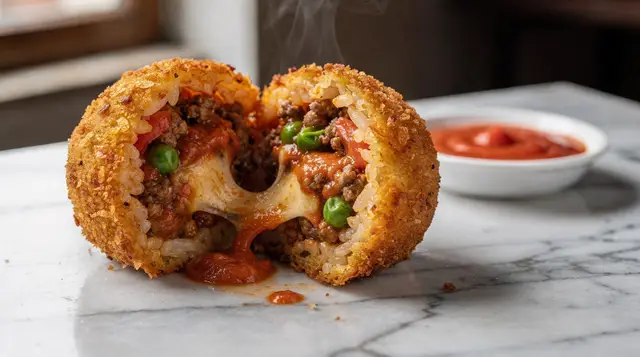
Arancine — round, feminine in Palermo’s dialect, most commonly filled with ragù, peas and caciocavallo, or with butter and ham (al burro) — are sold everywhere from bakeries to bars to dedicated stands, and a good one should have a thin, crisp shell rather than an oily, soggy one. The debate over whether it is arancina (Palermo, round) or arancino (Catania, conical) is a genuine regional fault line rather than a manufactured tourist story — the arancini explained guide covers both sides and how the Accademia della Crusca eventually ruled that both forms are correct Italian.
Where the stands cluster
The Ballarò market, the most consistently lively of Palermo’s markets, is also the densest concentration of street food stands, running through the late afternoon well after the produce stalls have closed for the day — the markets guide has fuller opening hours and a walking order. The Capo market, narrower and more compressed, has its own cluster of respected pane con la milza and panelle stands, some with multi-generation reputations.
The Vucciria, once Palermo’s most famous market, now functions mainly as a nighttime eating and drinking district rather than a working morning market — worth visiting after dark for the atmosphere rather than at dawn expecting produce stalls, as the same guide explains. Borgo Vecchio, smaller and less visited by tourists, has a reputation among Palermitani for some of the best stigghiola in the city, precisely because it sees fewer visitors and has less pressure to adjust for outside tastes.
A guided street food tour through the historic center is a reasonable way to try five or six dishes in one sitting with a local explaining what is what, which matters more here than in most food cities given how many of these dishes have no English name and no real equivalent. For a market-specific version, a Ballarò market street food tour stays within a single market rather than covering the wider center.
A tour built around panelle, arancina and cannoli is the gentler, non-offal version for anyone who wants the flavors without the spleen. For those specifically curious about Vucciria and Ballarò together, a tour covering both markets combines the daytime and nighttime versions of the city’s market culture in one outing.
A tradition rooted in scarcity, not spectacle
It helps to understand why Palermo’s food culture developed this way in the first place. For much of the city’s history, a large share of the population worked in the port, the markets themselves, or in domestic service, and a hot sit-down meal at midday was neither affordable nor practical for a working day spent standing or moving. Street food filled that gap: cheap, fast, calorie-dense, sold in small enough portions that even a modest daily wage could stretch to cover lunch.
Offal in particular — spleen, lung, intestine, off-cuts — was worked into food precisely because it was the least expensive part of the animal, not because anyone set out to create a delicacy. That a spleen sandwich has since become one of the most-discussed foods in Sicily, written about in international food press, is a genuine reversal of fortune for what began as poverty food, and Palermitani are often quietly amused by how much visitors are now willing to queue for it.
This history also explains why so much of the tradition is tied to specific families and specific stands rather than to restaurant chains or standardized recipes. A pane con la milza stand passed down for three generations is not a marketing story — it reflects a food economy where a single cart or counter was, for a family, the entire business, refined slowly over decades rather than franchised or scaled. Visitors who ask a stand owner how long the family has run the counter often get a genuinely long answer, and it is one of the more grounding ways to understand Palermo beyond its churches and palaces.
Seasonal notes
Street food in Palermo runs year-round, unlike some of the island’s more seasonal specialties, though a few things shift with the calendar. Stigghiola and other grilled items are more comfortable to eat outdoors in the cooler months and shoulder seasons — spring and autumn, covered more generally in the best time to visit Sicily guide — than standing over a hot coal grill in the peak of an August afternoon.
Conversely, granita and other cold treats, more associated with the eastern coast and covered in the granita and brioche guide, become the more sensible choice during Palermo’s hottest weeks. None of the core dishes disappear seasonally, but a visitor’s own appetite for standing at an open-air stand does shift meaningfully between April and August, and this is worth factoring into when a dedicated street food day is scheduled within a longer trip.
What it actually costs
Street food in Palermo is genuinely cheap by Italian standards. A pane con la milza panino runs roughly 3.50 to 5 euros depending on the stand and whether it is “maritatu.” A panelle and crocchè roll is typically 3 to 4 euros. Sfincione is sold by weight or by slice, usually 2 to 3 euros for a satisfying piece. Arancine range from 2 to 3.50 euros depending on size and filling.
A full street food crawl covering four or five stops rarely exceeds 15 to 20 euros per person, which is a fraction of a comparable sit-down meal — and this is one of the genuine reasons Palermo’s food culture is worth the detour, independent of the historical interest: the ratio of flavor to cost here is unusually good even by Sicilian standards, covered more broadly in the Sicily budget guide.
Practical notes: hours, cash, and hygiene
Most stands are cash-only or card-reluctant, so carry small notes. Many close in the early afternoon and reopen in the early evening, following the general Sicilian rhythm covered in the food etiquette guide — this is truer of Ballarò and Capo’s food-focused stalls than of the produce stands, which run a straighter morning-to-afternoon schedule. Stigghiola and frittola stands tend to appear later in the day and into the evening, when the coal grills are lit. None of the market areas are dangerous, but normal city awareness around bags and phones applies in the densest, most crowded aisles, as it would in any busy market anywhere.
Combining street food with the rest of Palermo
Street food pairs naturally with a walk through Palermo’s Arab-Norman heritage — the Arab-Norman Palermo UNESCO route passes close to both Ballarò and the Capo — and with the more sobering Capuchin Catacombs, which sit a short walk from the Ballarò market and make an odd but common half-day pairing for visitors covering the historic center on foot.
Travelers planning a longer stay often build a full day around Palermo itself before continuing to Cefalù or inland, and the Palermo in 3 days itinerary allocates a specific morning to markets and street food rather than treating it as an afterthought squeezed between sights.
For dessert after all that fried food, Palermo’s pastry tradition — cannoli, cassata, frutta martorana — is covered separately in the cannoli and Sicilian pastry guide, and for a citywide comparison of which food tour format suits which traveler, see Sicilian food tours compared.
Frequently asked questions about Palermo street food
Is pane con la milza actually good, or just a novelty for tourists?
It is a genuine working-class Palermo dish, not a tourist stunt, though the texture — soft, faintly metallic, quite fatty — is a real barrier for some visitors. Order it “schettu” (plain) rather than “maritatu” (with ricotta and caciocavallo) for the least intense version.
How much does a typical street food lunch in Palermo cost?
A generous street food lunch — a panelle and crocchè roll, an arancina, and a drink — runs roughly 6 to 10 euros at a stand, well under half of a sit-down trattoria bill for a comparable amount of food.
Is Palermo street food safe to eat?
Yes. Turnover at busy stands is fast, which means fried items are cooked to order rather than sitting under a heat lamp. Picking a stand with a visible queue of locals, not just tourists, is a reasonable proxy for freshness.
Do I need a guided food tour, or can I just wander and eat?
Wandering works if you already know the names of the dishes and roughly where the markets are, which this guide covers. A guided tour is worth it mainly for first-time visitors who want the history and dialect context alongside the food, and for anyone nervous about trying spleen or lung without a local vouching for it first.
Is street food only found in the markets, or elsewhere too?
The markets — Ballarò, Capo, Vucciria, Borgo Vecchio — have the highest concentration, but many of the best-regarded stands are standalone kiosks in ordinary residential streets, some run by the same family for generations.
What should vegetarians eat as Palermo street food?
Panelle, crocchè and sfincione are all meat-free and widely available at the same stands that sell pane con la milza, so vegetarians are not shut out of the tradition — see the wider vegetarian and vegan in Sicily guide for restaurant options beyond street stands.
Street food and market tours on GetYourGuide
Verified deep-linked GetYourGuide tours. Book through these links and we earn a small commission at no cost to you.
Photo: our own image of the location, not the operator’s product photo.