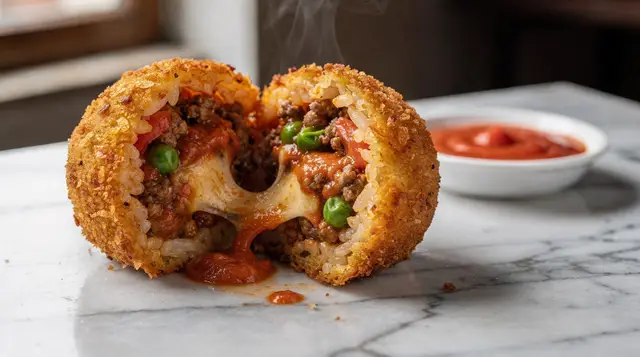
Arancini or arancine, the whole argument
Is it arancino or arancina?
Both are correct Italian, confirmed by the Accademia della Crusca (Italy's authority on the language) in 2016. Palermo and western Sicily generally use the feminine "arancina," round in shape; Catania and eastern Sicily generally use the masculine "arancino," conical in shape, said to represent Mount Etna.
An argument that outlasted the dish’s own origins
No single food ignites more good-natured regional pride in Sicily than the fried, stuffed rice ball sold on nearly every street corner from Trapani to Syracuse. What it is called — and, more visibly, what shape it takes — splits cleanly along an old fault line between Palermo and the west, and Catania and the east. This is not a manufactured tourist talking point invented for guidebooks; it is a genuine, long-running linguistic and culinary dispute that Italy’s own language authority eventually felt compelled to formally address. This guide covers both sides fairly, without picking a winner, because there genuinely isn’t one.
Arancina: Palermo’s round original
In Palermo and across most of western Sicily, the dish is arancina, feminine, and it is shaped round — literally “little orange,” a reference to the color and shape of the golden fried shell rather than to any ingredient. The most traditional filling combines ragù (a slow-cooked meat and tomato sauce), peas and caciocavallo cheese, though butter-and-ham (al burro) is an equally established and widely available alternative, particularly popular as a lighter option or for those who prefer it without tomato.
Palermo’s arancine are sold everywhere — bakeries, bars, dedicated street food stands, train station kiosks — and a good one is judged on the crispness and evenness of the shell and the density of the rice inside, which should feel properly packed rather than hollow or loose.
A hands-on class in Palermo to prepare the traditional arancina palermitana is a reasonable way to understand the technique behind a dish that looks simple but is genuinely fiddly to get right — the rice has to be cooked, seasoned and cooled properly before it can be shaped and stuffed, and the frying temperature has to be high enough to crisp the shell without the filling leaking out. For the wider Palermo street food scene beyond arancine specifically, see the Palermo street food guide.
Arancino: Catania’s conical version, and the Etna theory
In Catania and much of eastern Sicily, the same category of dish is arancino, masculine, and shaped conical rather than round. The most commonly repeated explanation ties the cone shape to Mount Etna, visible from much of the city on clear days and looming over the region’s identity in a way that extends well beyond food — the volcano’s shadow shows up in local branding, place names and civic pride generally, covered in the dedicated Mount Etna guide.
It is worth being honest that this is folk etymology rather than a documented historical fact — nobody has produced a contemporary source explicitly stating “we shaped it like the volcano” — but it is the explanation locals themselves reach for, and it is a plausible enough story that it has become part of how Catania talks about its own food culture.
Fillings in Catania lean toward the same ragù-and-caciocavallo base as Palermo, though pistachio-filled and seafood versions are more commonly found here, reflecting both the Bronte pistachio trade inland and Catania’s own strong seafood tradition centered on La Pescheria, covered in the Pescheria market guide.
A private tour in Catania built around arancino tasting is a compact, efficient way to sample several fillings without committing to a full food tour, and a dedicated arancini cooking class in Catania covers the conical shaping technique specifically, which differs enough from the round Palermo method that it is worth learning separately if the goal is to genuinely understand both traditions rather than just eat them.
What the Accademia della Crusca actually said
The dispute over arancino versus arancina became prominent enough, and divisive enough among Sicilians themselves, that in 2016 the Accademia della Crusca — Italy’s oldest and most authoritative body on the Italian language, founded in the sixteenth century — issued a formal response. Its conclusion was straightforward: both forms are legitimate Italian, reflecting genuine regional variation rather than one being a corruption or mistake relative to the other.
This did not end the argument at the level of Sicilian pride — Palermitani and Catanesi continue to needle each other about it exactly as before — but it settled the linguistic question definitively for anyone who wanted an authoritative answer rather than a partisan one. The honest, neutral position for a visitor is simply to use whichever word matches the city currently being visited, and to expect a knowing smile either way.
Beyond ragù: the other fillings worth knowing
While ragù with peas and caciocavallo, and butter-and-ham, cover the large majority of what is sold, both traditions have long supported other fillings without controversy. Spinach and cheese versions are common in both cities as a vegetarian option beyond the plain cheese-and-butter style, and are genuinely satisfying rather than an afterthought. Pistachio versions, more associated with the east given the Bronte trade covered in the Bronte pistachio guide, tend to be richer and sweeter, sometimes served closer to a dessert item than a savory lunch.
Seafood fillings — often built around shrimp or a light seafood ragù — appear more frequently near the coast in both regions and pair naturally with the wider Sicilian seafood tradition covered in the Sicilian seafood guide. None of these variants is a modern novelty invented for tourists; all have documented histories reaching back at least a century within their respective regional traditions.
A tour built around trying several fillings at once
For visitors who want to sample a genuine range of fillings and forms rather than committing to a single stand’s version, a Palermo food tour covering ten tastings, including arancini and cannoli puts the rice ball into its wider street food context alongside Palermo’s pastry tradition, which is covered separately and in more depth in the cannoli and Sicilian pastry guide.
Where the dish actually comes from
Behind the regional squabble over shape and gender sits a shared origin story that both cities generally agree on. Rice itself arrived in Sicily under Arab rule between the ninth and eleventh centuries, part of the same wave of agricultural introductions that also brought citrus, sugarcane and much of the irrigation technology still visible in the island’s countryside today.
Saffron-colored rice, formed around a filling and portable enough to carry on a journey or a workday, is generally understood to descend from this period, though the specific fried, breaded form familiar today likely developed later, closer to the thirteenth century under Norman and Swabian rule, when the dish’s practicality as portable, keep-well food for travelers and hunters would have mattered as much as its flavor. This shared Arab-Norman heritage runs through much of Sicilian food and architecture alike, and the same historical layering shows up more visibly in the Arab-Norman Palermo UNESCO route.
What is clear is that the dish predates the modern Palermo-versus-Catania rivalry by many centuries, and the round-versus-conical divide is a comparatively recent development in that longer history, likely settling into its current regional pattern sometime in the nineteenth or early twentieth century as the dish became a fixture of urban street food rather than home cooking specifically. Neither city can credibly claim to have invented arancini outright, which is part of why the 2016 ruling landed as a reasonable diplomatic resolution rather than a surprising one.
The modern, gourmet turn
In the last couple of decades, arancini and arancine have also become a canvas for more adventurous, higher-end interpretations well beyond the classic ragù and butter-and-ham fillings — nero di seppia (squid ink) versions with black rice shells, truffle and mushroom fillings, and seasonal vegetable versions all now appear on menus in both cities, particularly in restaurants positioning themselves as elevated Sicilian rather than strictly traditional.
This gourmet turn is a genuine, ongoing evolution rather than a betrayal of the original street food, and it exists alongside, not instead of, the classic versions sold from the traditional stands covered above. A visitor curious only about the historic dish should stick to the traditional fillings at market and street stands; a visitor curious about where Sicilian cuisine is heading might deliberately seek out one of the more experimental restaurant versions for comparison.
How to judge quality wherever you are
Whichever city and whichever shape, the same basic quality signals apply. A good arancina or arancino should feel notably heavy for its size — a sign the rice inside has been properly packed and rested rather than left loose or under-cooked. The shell should be thin, evenly golden and not visibly oily; a shell that leaves a heavy grease stain on the paper it is wrapped in is generally a sign of oil that was not hot enough during frying.
Freshness matters more than almost anything else: a stand with fast turnover, ideally one with a visible queue of locals rather than only visitors, is consistently the best predictor of a good one, since a fried item sitting under a heat lamp for hours loses the shell’s crispness regardless of how well it was made originally. Price is a rough but useful signal too — in most of Sicily a well-made arancina or arancino runs 2 to 3.50 euros depending on size and filling, and prices well above that in obviously tourist-oriented locations are not automatically better.
Where the debate fits into a wider Sicily trip
For travelers moving between the two cities, the arancina-versus-arancino comparison is a genuinely enjoyable, low-stakes way to engage with Sicily’s real regional differences, which run deeper than food — dialect, historical influences, and civic identity all shift meaningfully between Palermo and Catania, discussed directly in Palermo or Catania.
Those building an itinerary that covers both should see Sicily in 7 days or the Sicilian food and wine week itinerary, both of which allow time in each city to make the comparison firsthand rather than relying on secondhand accounts. For a broader look at how guided food experiences differ across the island, see Sicilian food tours compared, and for the practical rhythm of Sicilian meals generally — including why lunch counters like these often have their busiest hours before 1pm and after 7pm — see the food etiquette guide.
Frequently asked questions about arancini and arancine
Why does the shape differ between Palermo and Catania?
The most common explanation ties the conical shape in Catania to Mount Etna, visible from the city on clear days, though this is folk etymology rather than a documented historical fact. The round shape in Palermo has no comparably tidy explanation and may simply be the older, more literal form, since “arancina” translates as “little orange,” describing the shape and color rather than any landmark.
Which filling is the “real” one?
There is no single original filling. Ragù with peas and caciocavallo is the most traditional and widespread across both cities, but butter-and-ham, spinach, pistachio, and seafood versions are all long-established variations rather than modern novelties, and none of them disqualifies a dish from being a genuine arancina or arancino.
Did the Accademia della Crusca really rule on this?
Yes. In 2016 the Accademia della Crusca, Italy’s oldest linguistic authority, addressed the dispute directly and concluded that both arancino and arancina are legitimate, reflecting genuine regional variation in Italian rather than one being a corruption of the other.
Where can I try both versions in one trip?
Palermo and Catania are roughly 2.5 to 3 hours apart by car or train, making a same-trip comparison entirely realistic for visitors covering both the west and east of the island, and food-focused walking tours in each city typically include a version of the local shape.
Are arancini fried or baked?
Traditionally deep-fried, which gives the crisp, golden shell that distinguishes a good one from a poor one. Some modern bakeries and health-conscious kitchens offer baked versions, but a fried arancina or arancino is still the standard against which the dish is judged.
How can I tell if an arancina or arancino is good before buying?
A good one feels heavy for its size, a sign the rice inside is properly packed, not hollow, and has a thin, evenly golden, non-greasy shell. A stand with a fast turnover and a visible queue of locals is a more reliable signal than appearance alone.
Street food and market tours on GetYourGuide
Verified deep-linked GetYourGuide tours. Book through these links and we earn a small commission at no cost to you.
Photo: our own image of the location, not the operator’s product photo.