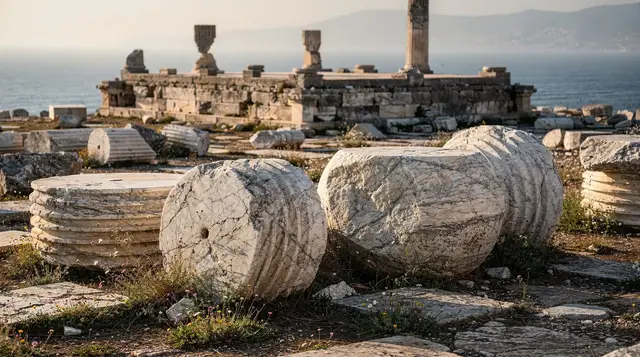
The Neapolis archaeological park in Syracuse
What is the Neapolis archaeological park in Syracuse, and how long does it take?
It is the archaeological zone on the mainland side of modern Syracuse, holding the Greek theatre, the limestone quarries known as the latomie (including the Ear of Dionysius), the Roman amphitheatre and the altar of Hieron II. Two to three hours covers the main sights at a normal pace, longer if the Greek theatre is hosting its summer drama festival and you want to see a performance.
Ancient Syracuse’s second half
Modern Syracuse is really two places: Ortigia, the small island that was the original Greek settlement and is now the old town of restaurants, the cathedral and the waterfront, and the Neapolis archaeological park, sitting on the mainland a short distance away, which was the “new city” — Neapolis literally means new city in Greek — that grew up around the theatre district as Syracuse expanded into one of the largest and wealthiest cities in the ancient Greek world under tyrants like Gelon, Hieron I and Dionysius I.
Neapolis is where almost everything visitors come to Syracuse’s ancient side to see: the Greek theatre, the limestone quarries known as the latomie, the Roman amphitheatre, and the altar of Hieron II.
The Greek theatre: still in use after 2,500 years
Cut directly into the natural rock of the Temenite hill in the fifth century BC and substantially enlarged under Hieron II in the third century BC, the Greek theatre at Syracuse could originally seat around 15,000 people and is among the largest and best-preserved Greek theatres anywhere. It has a documented connection to the birth of Greek drama itself: ancient sources record that Aeschylus, the earliest of the great Athenian tragedians, staged some of his own plays here, including what may have been a specially commissioned work, during visits to Syracuse in the fifth century BC.
That connection to living performance did not end in antiquity. The theatre hosts an established annual festival of classical Greek drama, typically running through spring, staged by the Istituto Nazionale del Dramma Antico in the same space the original plays were designed for — sightlines, acoustics and all. If your dates line up, watching a performance here is a fundamentally different way to experience the site than a daytime walk-through, and tickets for the festival are separate from standard archaeological park entry, so check current listings well ahead if this interests you.
A golden-hour guided tour of the Greek theatre times the visit for softer light and lower temperatures, which matters on a site with almost no shade over the seating itself.
The latomie and the Ear of Dionysius
Below and around the theatre, the latomie are a network of vast limestone quarries that supplied much of the stone used to build ancient Syracuse, later repurposed — according to the historian Thucydides, describing events after Syracuse’s decisive defeat of the Athenian invasion in 413 BC — as a place of brutal captivity for thousands of Athenian prisoners of war, many of whom reportedly died there from exposure and starvation. Whether every detail of that account is precise is debated among historians, but the quarries’ use for large-scale confinement is generally accepted.
The best-known feature is the Ear of Dionysius (Orecchio di Dionisio), an artificial cave roughly 23 metres high with a distinctive curved, ear-like profile and unusually strong acoustic properties — a whisper at one end can be audible at the other. The name and the associated legend, that the tyrant Dionysius I used the cave to spy on conversations among prisoners held inside, date only to the early 17th century, coined by the painter Caravaggio during a visit in 1608. It is a good story and a genuinely striking acoustic space, but treat the eavesdropping tale as later embellishment rather than established ancient fact.
The Latomia del Paradiso, the garden-like quarry area surrounding the Ear of Dionysius, is now planted with citrus and other trees and is one of the shadiest, most pleasant corners of the whole park — worth slowing down for rather than treating as a quick stop on the way to the amphitheatre.
The Roman amphitheatre: built for a different kind of spectacle
A short walk from the Greek theatre, the Roman amphitheatre dates to around the third century AD, under Roman rule, and is one of the largest of its kind in Sicily — a full oval rather than the semicircular Greek theatre form, built for gladiatorial combat and staged animal hunts rather than drama. Much of its outer stone seating was removed in the 16th century, like the altar of Hieron nearby, to help build the Spanish fortifications on Ortigia, so what survives is mostly the lower tiers and the central arena, with a drainage channel still visible around its perimeter.
A guided tour covering the Greek theatre and the wider Neapolis park is a practical way to link the Greek and Roman phases of the site, since it is easy to walk past the amphitheatre without registering how differently it was designed and used compared to the theatre just up the path.
The altar of Hieron II: a monument mostly gone
Near the park’s edge, a long stone platform is what remains of the altar of Hieron II, built in the third century BC and originally around 200 metres long — one of the largest sacrificial altars in the ancient Greek world, reportedly able to accommodate the ritual slaughter of hundreds of animals at once during major public festivals.
Almost all of its superstructure was dismantled in the 16th century for building material, principally for the fortifications the Spanish built around Ortigia to defend Syracuse’s harbour, so what survives is essentially the base and rock-cut foundations rather than a complete monument. It is easy to underwhelm yourself here if you expect a standing structure; understanding what the base represents in scale is most of what there is to see.
Planning the visit: timing, tickets and heat
Budget two to three hours for a normal-paced visit covering the theatre, latomie, amphitheatre and altar, longer if a festival performance is part of the plan. The open sections around the amphitheatre and altar have little shade, while the latomie, being partly sunken and planted, run noticeably cooler — factor that into when you visit each part if the day is hot, which in Syracuse from June through August it usually is.
A small-group tour of the Neapolis archaeological park covers the full site with context on the theatre’s dramatic history, the quarries’ use as a wartime prison, and the later stone-robbing that shaped what survives of the amphitheatre and altar today.
Getting there from Ortigia
Neapolis is roughly a 15 to 20 minute walk from Ortigia, or a short bus or taxi ride if the heat or the distance makes walking unappealing, particularly returning uphill in the afternoon. Most visitors structure the day around doing Neapolis first, in the cooler morning hours on largely shadeless quarry paths, then moving to Ortigia’s narrower, naturally shaded streets for the afternoon and evening — the reverse order tends to work less well, since Neapolis in full afternoon sun is a harder visit than Ortigia at the same hour.
See day trips from Syracuse for how to extend the day toward Noto or the Val di Noto towns, and getting around Sicily for the wider transport picture; Syracuse’s train station connects to Catania and onward to Palermo and Messina, making it one of the easier ancient sites on this list to reach without a car.
The Paolo Orsi museum: where the finds actually live
Many of the objects excavated from Neapolis and the wider Syracuse area — including material from the latomie and earlier phases of the city not visible on the ground today — are held at the Museo Archeologico Regionale Paolo Orsi, a short distance from the archaeological park and widely regarded as one of the best archaeological museums in Sicily.
A guided tour of the Paolo Orsi museum fills in context that the open-air site, being mostly stone and space, cannot provide on its own. See the archaeological museums worth your time for how it compares to Palermo’s Salinas museum and the museum at Marsala.
Fitting it into a longer trip
Neapolis works as a half-day anchor for Syracuse and the Val di Noto in 4 days, usually paired with an afternoon or full day in Ortigia and a separate day for Noto and the Baroque towns further south — see the Val di Noto guide for that side of the trip, and Sicily in 7 days for how this fits a wider island-wide route.
Beyond Neapolis: the Euryalus fortress and the aqueducts
Ancient Syracuse’s defensive perimeter extended far beyond the Neapolis park itself. On the Epipolae plateau, on the western edge of the modern city, the Euryalus Castle (Castello Eurialo) was the largest and most sophisticated Greek military fortification of its era, built under Dionysius I in the early fourth century BC as part of a massive expansion of Syracuse’s walls following the city’s near-catastrophic siege by Carthage.
Its layout, including underground tunnels designed for defenders to move troops without exposure to attackers above, is considered one of the most advanced surviving examples of Greek military engineering anywhere. It sits a fair distance from Neapolis and draws far fewer visitors, making it a genuinely quiet option for anyone who has already done the main theatre and latomie circuit and wants a different, less-visited piece of ancient Syracuse’s defensive history.
Closer to Neapolis, sections of ancient aqueduct channels, some Greek and some later Roman, still run through parts of the wider archaeological zone, feeding the latomie quarries and, in antiquity, the city’s water supply — a reminder that Syracuse’s ancient infrastructure extended well beyond its most famous monuments into the everyday engineering that let a city of this size function at all.
Best time of day and photography
Morning light works well across most of Neapolis, particularly for the Greek theatre’s stone seating, which photographs with clearer texture and shadow definition before the sun climbs directly overhead. The Latomia del Paradiso and the Ear of Dionysius benefit from their partial tree cover at almost any hour, making them a reasonable stop even at midday if the rest of your schedule has pushed later than planned. The amphitheatre and the altar of Hieron, both in more open ground, are best seen either early or in the last couple of hours before closing, when the lower sun angle picks out the remaining stonework more clearly than the flat light of midday.
San Nicolò dei Cordari: a church built into the quarry
Within the Latomia del Paradiso, a small Norman-era church, San Nicolò dei Cordari, sits partly built into the quarry rock itself, its name recalling the rope-makers (cordari) who once used the cool, sheltered quarry space to work their craft, since the constant temperature and humidity inside a limestone quarry suited rope-making better than exposed open ground.
Beneath the church, a large cistern, part of the ancient water system feeding the latomie, is sometimes accessible depending on current arrangements — a further layer of use stacked onto a space that began as a Greek quarry, held Athenian prisoners after 413 BC, and was later reused for religious and practical purposes across the medieval period. It is a small, easily missed detail within a much larger site, but it captures how continuously this landscape has been reused across more than two thousand years, rather than being frozen at any single historical moment.
Visiting with children and accessibility
The Greek theatre’s stone seating and the amphitheatre both involve some uneven, worn ancient stone surfaces that require a degree of care underfoot, and neither is straightforwardly wheelchair accessible in all sections — check current provisions if mobility is a concern, since paths and viewing arrangements have been adjusted over time. For children, the Ear of Dionysius tends to be the highlight of the whole park: the acoustic effect is immediately, tangibly interesting in a way that an abstract discussion of ancient drama or Roman spectacle is not, and the cool, shaded Latomia del Paradiso around it is also simply a more comfortable place to spend time with children on a hot day than the open theatre seating or amphitheatre.
Tickets: combined passes and what they cover
Entry to the Neapolis archaeological park is sometimes available as a combined ticket with the Paolo Orsi museum or other Syracuse attractions, though the exact bundling and pricing structure changes over time — check current options at the ticket office or through an official reseller rather than assuming a specific combination is available on a given day. During the spring drama festival, ticketing for performances in the Greek theatre is handled separately from standard daytime archaeological entry, and seating for a performance may not grant the same daytime access to walk freely through the theatre and surrounding areas, so treat the two as distinct visits requiring separate planning rather than one covering the other.
Syracuse’s long arc: from Greek superpower to Roman province
At its height under rulers like Gelon and Hieron II, Syracuse was arguably the most powerful city in the Greek world, mainland Greece included, controlling much of eastern Sicily and repeatedly repelling Carthaginian and, in 415–413 BC, Athenian invasion attempts — the destruction of the Athenian expeditionary force outside Syracuse’s walls remains one of the most significant military campaigns of the entire classical Greek period, and is well documented by the contemporary historian Thucydides.
Syracuse’s independence ended only when Rome besieged and captured the city in 212 BC during the Second Punic War, a siege notable for Archimedes’ reported use of ingenious defensive engineering devices against the Roman fleet, and for the Roman soldier who killed Archimedes despite orders to spare him, an episode that became one of antiquity’s most retold cautionary tales about the value, and vulnerability, of scientific genius in wartime.
Neapolis, and the theatre and quarries within it, were built and rebuilt across this entire arc, from Greek imperial ambition through Roman incorporation, which is part of why the site rewards a visit with at least some sense of Syracuse’s larger political history in mind rather than treating the ruins as disconnected monuments.
A park that repays a second look
Given how much ground Neapolis covers — theatre, latomie, amphitheatre, altar, and the small church tucked inside the quarry itself — most first-time visitors leave having genuinely absorbed only the theatre and the Ear of Dionysius, the two stops that dominate every guidebook photograph. A slower second pass, or simply an extra half hour built deliberately into the first visit, tends to surface the amphitheatre’s drainage channel, the altar’s true scale, and San Nicolò dei Cordari in a way a single rushed circuit rarely does.
What to actually plan for
Do not skip the latomie in favour of just the theatre and amphitheatre — the Ear of Dionysius and the Latomia del Paradiso are, for most visitors, the most memorable part of the park, and they also happen to be the coolest, shadiest section on a hot day. Do not expect the altar of Hieron to look like a monument; it is a foundation, and knowing that in advance avoids disappointment. And do not plan a summer-afternoon visit if you can avoid it — the theatre seating and the amphitheatre have almost no shelter from direct sun in the middle of the day.
Greek and Roman site tours on GetYourGuide
Verified deep-linked GetYourGuide tours. Book through these links and we earn a small commission at no cost to you.
Photo: our own image of the location, not the operator’s product photo.