The ancient theatre of Taormina
Is Taormina's ancient theatre Greek or Roman?
Both, in layers. It was originally built by Greek settlers, probably in the third century BC, then substantially rebuilt and enlarged by the Romans in the second century AD for gladiatorial and arena-style spectacles, which is why the surviving brickwork and structural additions are mostly Roman even though the site and basic form are Greek. Either way, the real draw is the view: the stage frames Mount Etna and the coastline behind it, arguably the single most photographed backdrop of any ancient theatre in Sicily.
The theatre everyone photographs, whether they know its history or not
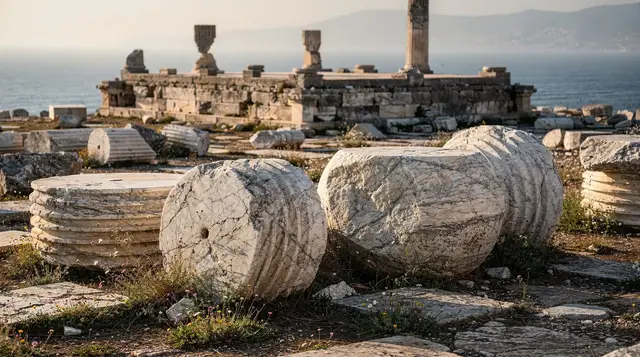
Taormina’s ancient theatre is one of the most photographed ancient structures in Sicily, and for most visitors that happens for reasons that have very little to do with archaeology: from inside the seating, looking toward where the stage building once stood, the view runs straight through the ruined structure to Mount Etna and the curve of the Ionian coast below. It is a genuinely rare combination — an ancient monument and an active volcano in the same frame — and it is worth being clear-eyed that this view, not the building’s archaeological purity, is the main reason the site draws the numbers it does.
That is not a criticism of the theatre itself. It is a real ancient structure with a real, layered history, even if the layer most visitors engage with is the 20-minute photo stop rather than the second-century Roman renovation underneath it.
Greek foundations, Roman rebuild
The theatre’s origins are Greek, likely dating to around the third century BC, built by the Greek-founded city of Tauromenium on a hillside site chosen, in classic Greek theatre-design fashion, at least partly for its views. What stands today, however, is largely the product of a substantial Roman-era rebuilding in the second century AD, which enlarged the structure and adapted it for Roman entertainment forms — there is reasonable evidence the Romans reworked it to accommodate gladiatorial contests and arena-style spectacles, a use the original Greek design would not have anticipated.
That rebuild is why so much of the surviving brickwork and structural technique visible today reads as Roman rather than Greek, even though the site, the basic bowl shape, and some underlying elements trace back to the earlier Greek theatre.
This layering — Greek plan, Roman execution — is a useful way to think about several Sicilian sites, but Taormina is one of the clearest examples of it, since the two building phases are close enough in scale that neither one simply erased the other.
Why the stage building is mostly gone, and why that helps
Ancient theatres in the Greek tradition were typically built with a scene building (skene) behind the performers, which in a fully intact Roman-adapted theatre would often have blocked any view beyond the stage entirely. At Taormina, the seaward section of that structure has substantially collapsed over the centuries, and rather than diminishing the site, this accident of decay is exactly what opened up the sightline to Etna and the coast that now defines the whole visitor experience. It is worth remembering, standing there, that ancient audiences watching a performance here would likely have seen a solid wall, not a volcano — the view as photographed today is a product of ruin, not original design.
The summer festival: a working theatre again
Taormina’s ancient theatre remains an active performance venue, hosting Taormina Arte and a broader summer programme of concerts, film screenings and cultural events that make use of the space much as it was originally intended, if with modern amplification and staging. If a concert or festival date coincides with your visit, seeing a performance in a theatre this old, with Etna as an unavoidable backdrop even after dark, is a different experience from a daytime walk-through — check current listings ahead of time, since access to certain areas and seating layout can shift around event dates.
Planning the visit: timing and tickets
The seating area faces largely open sky with limited shade, so timing matters more here than the short walk from town might suggest. Morning visits are quieter and cooler; the hour or two before sunset gives the best light on Etna and the coastline but is also, predictably, the busiest window, since everyone chasing that specific photograph tends to arrive at the same time.
A skip-the-line ticket with audio guide is worth it in peak season, when entrance queues can build quickly given how compact and popular the site is relative to somewhere like the Valley of the Temples. A guided visit covering the theatre’s lesser-known corners is useful if you want more than the photo stop — most visitors see the view and leave without registering the Greek-to-Roman rebuild story at all.
Getting there
The theatre sits within Taormina’s historic centre, a short uphill walk of a few minutes from the main pedestrian street, Corso Umberto — no shuttle, no rural drive, which makes it one of the most logistically simple ancient sites on this list to fold into an otherwise ordinary day of walking around town. See Taormina for the town itself, and getting around Sicily for how Taormina connects by train (via the Taormina-Giardini station down at sea level, with a bus or taxi up to the town) to Catania and Messina.
Combining it with Giardini Naxos and the Etna day trip
Down at sea level, Giardini Naxos holds its own, less-visited archaeological park — the actual site of the first Greek colony in Sicily, founded before Taormina itself, with its own small museum.
A visit to the Giardini Naxos archaeological park and museum pairs naturally with the Taormina theatre as a fuller day covering both the earlier Greek colony and its better-known hilltop neighbour, and a sunset tour of the Naxos archaeological park is a quieter alternative to the crowds at Taormina’s own sunset viewing window.
Given the proximity of Mount Etna, many visitors also fold a volcano excursion into the same trip — see the Mount Etna complete visitor guide and Etna in a day: the realistic options for how that combines with a Taormina base.
Fitting it into a longer trip
Taormina’s theatre is a natural half-day stop within Sicily in 7 days or Sicily in 5 days, usually combined with a Taormina old-town walk and either an Etna day or an Isola Bella beach afternoon on the same base. See day trips from Taormina for the fuller range of what a Taormina stay can cover beyond the theatre itself.
The Naumachie and the Odeon: Taormina’s other Roman remains
The theatre is not the only Roman-era structure in Taormina’s old town. A short walk along Via Teatro Greco and into the town centre, the Naumachie is a long, imposing brick retaining wall, roughly 122 metres in length, punctuated by niches that likely once held statues — its exact original function is debated, with theories ranging from a monumental cistern or nymphaeum (an ornamental fountain structure) to a substructure for a now-vanished gymnasium complex, rather than an actual site for staged naval battles despite the name, which was applied later based on a misreading of its scale.
Closer to Piazza Vittorio Emanuele, a small Roman Odeon — a compact, roofed or partially roofed theatre used for music and more intimate performances rather than large drama productions — survives in a considerably smaller and less visited state than the main theatre, tucked between later buildings in a way that makes it easy to walk past without registering it as ancient at all. Neither site takes more than a few minutes to see, but both round out a picture of Taormina as a Roman town with more surviving infrastructure than the main theatre alone suggests.
Best times for the view and for photography
The classic photograph — theatre seating in the foreground, Etna smoking gently behind the ruined stage wall — works best in the golden hour before sunset, when the light warms the theatre’s stonework and, on clear days, catches the volcano’s summit plume if conditions allow. This is also, predictably, the most crowded single window at the site, since most visitors are chasing exactly the same shot. Early morning offers a quieter alternative with cooler, clearer air that often gives a sharper view of Etna itself, before any midday haze builds up over the strait — a reasonable trade if avoiding crowds matters more to you than golden-hour light.
Accessibility: steep steps and uneven stone
The theatre’s seating (cavea) is arranged on the natural hillside in steep tiers of ancient stone, uneven in places and without consistent handrails throughout, which makes it a genuinely demanding site for visitors with limited mobility — the lower terraces and the flatter orchestra area near the stage are generally more manageable than climbing to the upper rows, and it is worth checking current accessibility provisions directly if this affects your visit, since arrangements can vary and improve over time. The approach from Taormina’s town centre also involves a moderate uphill walk on paved streets before reaching the site entrance itself.
Combining with Isola Bella and Castelmola
Many visitors pair a morning at the theatre with an afternoon at Isola Bella, the small tied island and beach below Taormina reached by cable car or a walking path down from the town, offering a natural contrast between the hilltop archaeology and the coastline it overlooks.
In the other direction, the hilltop village of Castelmola, a short drive or a longer uphill walk above Taormina, gives a still higher vantage point over the same landscape the theatre frames, along with its own distinct, quieter atmosphere away from Taormina’s busier streets — see day trips from Taormina for how these fit together into a single multi-stop day without excessive backtracking.
Tauromenium: a city founded by refugees
Taormina’s ancient name, Tauromenium, has a founding story directly tied to the destruction of a neighbouring Greek city. In 403 BC, Dionysius I of Syracuse destroyed Naxos, the earliest Greek colony on Sicily’s east coast and the immediate predecessor of modern Giardini Naxos, as part of his campaign to consolidate control over eastern Sicily.
Decades later, in 358 BC, the Greek commander Andromachus founded Tauromenium on the hillside above the ruins of Naxos, settling it partly with descendants of the displaced Naxian population — meaning Taormina’s Greek civic identity is, in a real sense, a direct continuation of the older colony destroyed a generation earlier rather than an entirely separate foundation. Andromachus is also notable as the father of the historian Timaeus of Tauromenium, one of the most important Greek historians of Sicily, whose now largely lost work was a major source for later ancient writers describing the island’s Greek period.
From Roman municipium to Byzantine, Arab and Norman town
Tauromenium continued as a functioning city through the Roman period, when its theatre received the substantial rebuilding visible today, and it remained continuously inhabited through the fall of the Western Roman Empire and into the Byzantine period, when Sicily came under Byzantine Greek administration for several centuries.
It was later taken during the Arab conquest of Sicily in the ninth century, becoming part of the Arab emirate that also shaped Palermo’s Arab-Norman heritage, before passing to Norman control in the 11th century alongside the rest of the island. This unusually continuous occupation, largely unbroken from Greek antiquity through to the present day, is part of why Taormina’s old town layout and its ancient theatre survive so legibly compared to sites that were abandoned outright and only rediscovered centuries later through archaeological excavation.
Tickets and queues in high season
Taormina’s ancient theatre draws some of the heaviest single-site visitor traffic in eastern Sicily given its combination of easy access from the town centre and its reputation for the Etna view, and ticket queues in July and August can build quickly, particularly around midday and the pre-sunset window when most visitors specifically time their visit. Booking the skip-the-line entry mentioned earlier is worth the modest extra planning in peak season for this reason alone, separate from any interest in the audio guide content itself.
The rest of Taormina’s old town
Beyond the theatre, Taormina’s compact historic centre rewards a couple of hours of unhurried walking along Corso Umberto, the town’s main pedestrian street, taking in Piazza IX Aprile’s terrace view over the coastline, the medieval Palazzo Corvaja near the theatre entrance, and the network of quieter side streets running off the main corso, largely free of the theatre’s crowds even in high season.
Treating the theatre as one stop within a broader old-town visit, rather than the sole reason to come up the hill, makes better use of a trip to Taormina than a single in-and-out visit focused only on the ancient site itself, particularly given how much of the town’s later Norman, Aragonese and Baroque-period architecture sits within a short walk of the theatre entrance.
Why the theatre keeps drawing visitors back
Repeat visitors to Taormina consistently describe the theatre as a place worth returning to across multiple trips, in a way few other single sites on this list attract the same repeat interest — largely because Etna’s visible activity changes from visit to visit, the light and season shift the whole scene, and a summer festival performance offers a genuinely different experience from a quiet off-season morning walk-through. Treating a single visit as definitive undersells how much the site’s character depends on conditions outside anyone’s control on the day.
A site that works for almost any traveller
Few ancient sites in Sicily manage to satisfy a genuine history interest, a casual first-time visitor and a photographer chasing one specific shot equally well, but Taormina’s theatre largely does — the Greek-to-Roman layering rewards the first, the short walk from town and the unmistakable view serve the second, and the golden-hour Etna backdrop serves the third, all within the same compact site and the same hour or two of a visit.
Bringing water and sun protection regardless of season
Even with the theatre’s convenient in-town location, the seating area’s lack of shade means the same basic preparation applies here as at every other ancient site on this list: water, a hat, and sun protection, carried up from town rather than assumed to be available for purchase once inside the gate.
One last practical note on timing your whole day
Because the theatre sits inside the town rather than requiring a separate outing, it is easy to underestimate how much time a proper visit plus a walk through the rest of Taormina’s old town actually takes — treat the theatre and the town together as at least half a day, not a quick hour squeezed between a beach morning and an Etna afternoon.
What to actually plan for
Do not go purely at the busiest sunset hour expecting a quiet visit — if the photograph matters more to you than the crowd, that trade-off is worth knowing in advance. Do not skip the archaeological information boards or a guide assuming there is nothing to the site beyond the view; the Greek-to-Roman rebuild is a genuinely interesting story that most visitors leave without hearing. And do not assume Giardini Naxos below is skippable just because it draws far fewer visitors — it is, in a real sense, the older and historically prior site, and it is a fraction of the crowd.
Greek and Roman site tours on GetYourGuide
Verified deep-linked GetYourGuide tours. Book through these links and we earn a small commission at no cost to you.
Photo: our own image of the location, not the operator’s product photo.