The navel of Sicily, literally
Enna has been nicknamed the “Umbilicus Siciliae” — the navel of Sicily — since antiquity, a reference to its position at roughly the geographic center of the island and its commanding elevation above the surrounding countryside.
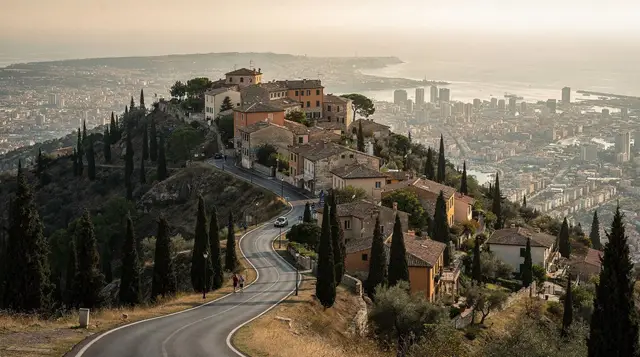
At 931 meters above sea level, Enna is the highest provincial capital in Italy, and the practical consequences of that altitude are immediately obvious to any visitor: noticeably cooler temperatures than the coast in summer, occasional light snow in winter (unusual enough elsewhere in Sicily to be genuinely remarkable), and views from the town’s edges that on a clear day are said to extend toward Mount Etna to the east and the Madonie mountains to the north — a genuinely unusual vantage point on an island where sea-level views dominate almost everywhere else.
Most visitors to Sicily’s interior pass within sight of Enna on the A19 motorway connecting Palermo and Catania without ever actually stopping, and this is a missed opportunity for anyone with an hour or two to spare — the town’s hilltop position alone justifies the detour, before even considering the castle. The drive up itself, on switchback roads climbing steadily from the surrounding plain, is a reasonable preview of what makes Enna distinct: nearly every other major stop in Sicily sits at or near sea level, and the shift in perspective, temperature and vegetation as the road climbs toward 931 meters is immediately noticeable in a way few other Sicilian destinations offer.
The Castello di Lombardia
Enna’s dominant landmark is the Castello di Lombardia, a substantial Norman-era fortress later expanded under Swabian rule (hence the name, referencing Lombard soldiers garrisoned here under Norman control), occupying the highest point of the town’s ridge. Of the twenty towers the castle originally held, six survive today, and the Torre Pisana, the tallest, is open for visitors to climb for a panoramic view that, on a genuinely clear day, extends toward Etna and the interior mountain ranges in multiple directions — one of the more dramatic viewpoints available anywhere in inland Sicily, and free of the crowds that dominate coastal viewpoints like Taormina’s terraces.
A guided historical walk through the town is a sensible way to make sense of the castle’s various building phases and the layered history of Norman, Swabian and later rule that shaped it. An historical walking tour of Enna with a guide typically covers the castle, the Rocca di Cerere and the town’s main civic and religious buildings in a single outing, giving useful context that is not always apparent from the buildings alone.
A fortress that resisted where others fell
Enna’s defensibility is not incidental to its history — the town’s elevated, naturally fortified position made it one of the harder targets for successive waves of conquest across Sicily’s long history of changing rulers. During the Arab conquest of Sicily in the 9th century, Enna (then known as Qasr Yanna, from which the modern name partly derives) held out for years after most of the island had fallen, reportedly only taken through betrayal rather than direct assault — a detail that recurs, with variations, in accounts of the period.
That same defensibility made Enna a valuable stronghold for the Normans who followed, and later for Frederick II’s Swabian rule, each expanding the fortifications that form the core of today’s Castello di Lombardia. The town’s strategic value, in short, is written into its castle’s repeated expansion far more than into any single dramatic battle.
The Rocca di Cerere and the myth of Persephone
Adjacent to the castle, the Rocca di Cerere is a rocky outcrop that held an ancient temple to Ceres (Demeter in Greek mythology), the goddess of agriculture and harvest, of which only fragmentary remains survive today. The site is directly tied to one of Greek mythology’s most significant stories set in Sicily: the abduction of Persephone (Ceres’ daughter) by Hades, said in some versions of the myth to have taken place at nearby Lake Pergusa, a small lake in a shallow basin a short drive from central Enna.
The lake today serves a rather different modern function as a motor racing circuit that has hosted competitive events for decades, alongside a nature reserve protecting the surrounding wetland habitat — an odd but genuine combination of ancient myth and modern motorsport within the same small basin.
Duomo and the town center
Enna’s Duomo, a Baroque cathedral built over an earlier medieval church, anchors the town’s compact historic center, and the surrounding streets hold a scattering of civic buildings and smaller churches typical of an interior Sicilian hill town rather than the coastal Baroque seen in the Val di Noto.
The Museo Alessi, housed near the cathedral, holds religious art and artifacts from the diocese, a modest but genuine stop for visitors with time beyond the castle and the main square. The town’s main pedestrian street, via Roma, running through the historic center, gives a good sense of everyday Enna life — small shops and cafes serving residents rather than the tourist-oriented retail that dominates the main streets of more visited towns further south.
Settimana Santa: Enna’s Holy Week
Enna’s Easter Holy Week processions are among the most significant and visually striking in Sicily, organized by a system of confraternities (religious lay brotherhoods, several centuries old) who process through the town in distinctive robes and hoods, each confraternity associated with a specific parish or historical guild.
The scale and solemnity of Enna’s Holy Week rivals better-known Sicilian Easter traditions, and the processions, held over several days in the lead-up to Easter, transform the town’s usual quiet pace considerably — worth checking whether travel dates align with Holy Week specifically, since the event draws visitors from across the region and reshapes both accommodation and the ordinary rhythm of the town. See the Easter and Holy Week in Sicily guide for the wider context across the island.
Horseback riding and hands-on ceramics
Enna’s surrounding countryside, being genuine agricultural and pastoral land rather than the more developed coastal strip, lends itself to activities less common elsewhere in Sicily’s more visited destinations. An horseback riding tour with aperitivo and scenic views covers the inland trails around the town, a genuinely different way to experience the interior’s landscape than walking the historic center alone.
For a more hands-on, indoor option, particularly useful on a hot afternoon or with children, an opportunity to paint your own Sicilian ceramic plate gives a lighter, more accessible introduction to the island’s decorative craft traditions than a full workshop visit, and makes a reasonable souvenir in its own right.
Mussomeli and Caltanissetta: the wider interior
Enna sits within a wider stretch of Sicily’s interior that includes Caltanissetta and, further west, the dramatic hilltop town of Mussomeli, home to the well-preserved Castello Manfredonico, one of the more striking medieval castles in inland Sicily and considerably less visited than Enna’s own Castello di Lombardia.
A walking tour of the Manfredonic Castle and churches in Mussomeli is worth considering for visitors with a full day to explore the interior rather than a single town. Caltanissetta itself, about 35 minutes southwest, has its own distinct history and character, covered on the separate Caltanissetta destination page.
Visiting with children
Enna’s cooler summer climate is itself a practical advantage for family visits during the hottest months, when coastal destinations and the exposed archaeological sites of Agrigento or Piazza Armerina can be genuinely uncomfortable for young children. The Castello di Lombardia’s grounds are relatively open and manageable with a stroller on the main paths, though climbing the Torre Pisana itself involves a narrow spiral staircase unsuitable for strollers.
The horseback riding option and the hands-on ceramic-painting activity both tend to hold children’s attention better than the castle’s historical detail alone, and are worth prioritizing for a family visit over a purely architecture-focused itinerary. See the wider Sicily with kids guide for how Enna fits into a broader family itinerary through the interior.
Combining Enna with Piazza Armerina and Caltagirone
Enna sits roughly 40 minutes north of Piazza Armerina, making the Villa Romana del Casale mosaics a natural pairing for visitors exploring the interior — see the separate Piazza Armerina destination page. Caltagirone, with its own distinct majolica ceramics tradition, is a further 40 minutes from Piazza Armerina, and the three towns together form a reasonable loose loop through the island’s center, well away from the coastal crowds that dominate most Sicily itineraries.
See the separate Caltagirone destination page and the wider Baroque towns and Greek temples in 5 days itinerary for how this region fits into a longer trip.
Eating in Enna
Enna’s cuisine reflects its interior, pastoral setting rather than the seafood traditions of the coast — cured meats, sheep and cow’s milk cheeses, and hearty pasta dishes built around local produce dominate menus in the town’s handful of trattorie. Prices generally run lower than in Sicily’s more heavily visited coastal and Baroque towns, a function of Enna’s lighter tourist traffic rather than any difference in quality. For the wider regional food context, see the where to eat in Sicily, city by city guide.
Getting there and getting around
Enna has a train station, though it sits some distance below the town center and requires a bus or taxi connection up to the historic core — a detail that catches some visitors off guard, since the “Enna” station stop does not deposit passengers directly in the town itself. Most visitors arrive by car via the A19 motorway connecting Palermo and Catania, both roughly 1-1.5 hours away depending on traffic. See the Sicilian trains guide and driving in Sicily guide for the wider practicalities of reaching Sicily’s interior.
When to come
Enna’s altitude changes the seasonal calculus compared to the rest of Sicily: summer here is noticeably more comfortable than the coast, without the same intensity of heat, making July and August a more viable time to visit than in Agrigento or the Val di Noto. Winter, conversely, brings genuinely cold conditions and occasional snow, unusual for Sicily and worth being prepared for if visiting outside the main April-to-October window. April through June and September through October remain the most broadly comfortable months for walking the town’s hilltop streets and climbing the Torre Pisana. See the best time to visit Sicily guide for the wider seasonal picture across the island.
Shopping and souvenirs
Enna does not have a dedicated craft tradition on the scale of Caltagirone’s ceramics, and visitors specifically seeking Sicilian souvenirs are generally better served by that town or by Sciacca’s smaller ceramics scene. What Enna does offer is a more low-key, less commercialized shopping experience than Sicily’s more visited destinations — small local producers of cheese, cured meats and honey sell directly from shops in the historic center, a reasonable source of edible souvenirs less likely to be found in bulk at coastal tourist shops. See the wider what to bring back from Sicily guide for the broader picture of what is genuinely worth buying across the island.
An honest note on Enna’s pace
Enna is a genuine, functioning provincial capital rather than a curated tourist destination, and visitors expecting the polished old-town experience of Ortigia or Noto should adjust expectations — the town has real administrative buildings, ordinary shops serving residents, and a noticeably slower tourism infrastructure than Sicily’s more visited hill towns. This is, for many visitors, precisely the appeal: an interior Sicilian town going about its ordinary business, with a genuinely spectacular Norman castle and panoramic views as an unexpected bonus rather than the entire point of the visit.
Frequently asked questions about visiting Enna
Why is Enna called the “navel of Sicily”?
It refers to the town’s position near the geographic center of the island combined with its commanding elevation — at 931 meters, Enna is the highest provincial capital in Italy, giving it a genuinely central, elevated vantage point over the surrounding countryside.
Can you see the sea from Enna?
On a clear day, views from the Castello di Lombardia and the Torre Pisana can extend toward Mount Etna and, in favorable conditions, hints of the coast, though this depends heavily on weather and visibility rather than being guaranteed on every visit.
Is Enna cold in winter?
Colder than the rest of Sicily, given its altitude — light snow is not unusual, which is genuinely unusual for the island as a whole. Anyone visiting outside the main spring-to-autumn window should pack accordingly.
How does Enna’s Holy Week compare to other Sicilian Easter traditions?
It is among the more significant and visually elaborate in Sicily, organized by centuries-old lay confraternities processing in distinctive robes over several days before Easter. It draws visitors specifically for the event and reshapes the town’s usual pace considerably during that period.
Do you need a car to visit Enna?
Strongly recommended — the train station sits below the town and requires a further bus or taxi connection, and the wider interior (Piazza Armerina, Caltagirone, Mussomeli) has minimal public transport connecting the towns to each other.
Is Enna worth a full day, or just a couple of hours?
A couple of hours covers the Castello di Lombardia, the Rocca di Cerere and the Duomo at a comfortable pace. A full day makes sense if combining Enna with Piazza Armerina or the wider interior loop toward Caltagirone and Mussomeli.
What is Lake Pergusa, and is it worth visiting?
A small lake near Enna tied to the ancient myth of Persephone’s abduction, today serving as both a nature reserve and a motor racing circuit. It is a modest, somewhat unusual stop rather than a major attraction, worth a brief detour for anyone specifically interested in the mythology rather than a primary reason to visit the area.
Is Enna a good base for exploring Sicily’s interior?
It can work well for visitors specifically prioritizing the interior over the coast, given its central position relative to Piazza Armerina, Caltagirone and Caltanissetta, and its cooler summer climate compared to lower-elevation towns. Accommodation options are more limited than in Sicily’s coastal and Baroque-town destinations, so booking ahead is worth doing regardless of season.
How does Enna compare to Piazza Armerina as a stop?
The two serve different purposes — Piazza Armerina’s draw is almost entirely the Villa Romana del Casale’s mosaics, a single major archaeological site, while Enna’s appeal is the town itself: its castle, elevation and views. Visiting both in a single day, about 40 minutes apart, gives a well-rounded sense of the interior beyond either site alone.
Is the climb up the Torre Pisana difficult?
It involves a narrow spiral staircase rather than a gentle ramp, and is a genuine physical climb rather than a casual stroll, though manageable for most reasonably fit visitors. The panoramic view from the top is generally considered worth the effort, weather and visibility permitting.