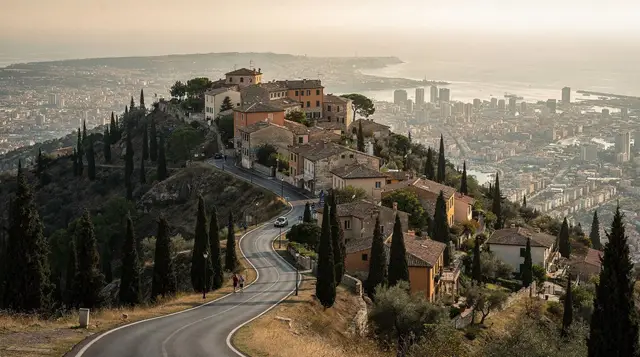
The working port that gets everyone to the Aeolian Islands
Milazzo sits on Sicily’s north coast, on a narrow peninsula reaching out toward the Tyrrhenian Sea, and its main function for most visitors is entirely practical: it is the principal port for ferries and hydrofoils to the Aeolian Islands — Lipari, Vulcano, Salina, Stromboli, Panarea and Filicudi — with far more frequent departures than the alternative ports at Palermo or Messina. Most people arrive in Milazzo with a booked crossing already in mind and see the town itself only in passing, between a parking garage and the hydrofoil dock.
That’s a defensible way to treat it on a tight schedule, but Milazzo has its own layered history worth an hour or two if there’s time before a crossing, or if a departure gets pushed back — a real possibility here, since Aeolian crossings are genuinely weather-dependent and can be delayed or cancelled when the sea is rough, regardless of how firm the printed timetable looks.
Milazzo’s own beaches, on the peninsula’s sheltered eastern side facing the Aeolian Islands, are a lower-key alternative to the more commercialized stretches near Messina or Taormina, popular mainly with locals and travelers who’ve arrived a day early for a ferry rather than beach tourists specifically targeting the town.
The citadel: layers of fortification going back to the Greeks
Above the modern port town, on the peninsula’s high ground, sits Milazzo’s Cittadella — a fortified complex with a Greek acropolis at its base, Arab and Norman-era walls, and a Spanish castle built over the top in the 16th and 17th centuries, all stacked on the same hill. It’s a genuinely underrated site relative to its visibility in most Sicily itineraries, offering sweeping views over the town, the harbor and, on a clear day, several of the Aeolian Islands themselves.
A walking tour of the fortified citadel and town center covers the layered fortifications with the historical context that makes the site legible, since the different building phases are not always obvious without explanation.
Garibaldi’s battle, and Milazzo’s role in Italian unification
Beyond its ancient and medieval layers, Milazzo holds a specific place in modern Italian history: the Battle of Milazzo in 1860, fought here between Giuseppe Garibaldi’s volunteer forces and Bourbon troops during the Expedition of the Thousand, was a decisive engagement in the campaign that eventually led to Sicily and southern Italy joining the unified Kingdom of Italy.
The battle is commemorated locally with monuments and street names referencing the event, and it’s a detail that gives the town a specific significance in the national story that its current reputation as a ferry port doesn’t obviously suggest. Visitors interested in this period of Sicilian history will find the Cittadella’s own displays touch on the battle alongside the site’s older fortification layers.
Capo Milazzo and the marine protected area
Beyond the citadel, the tip of the peninsula — Capo Milazzo — is a small nature reserve with clear water, sea caves and a lighthouse walk, protected as a marine area partly for its underwater visibility. A boat tour through the protected area or a more activity-focused promontory tour with guided snorkeling are the two most straightforward ways to see this side of the peninsula from the water, and both are realistic half-day additions for anyone with time before or after a ferry.
What Capo Milazzo’s chapel and sea caves add to a visit
At the very tip of the promontory, past the lighthouse, sits a small chapel built into the rock associated with a local hermit tradition, along with a viewing platform looking directly down onto the clear water and sea caves below — a genuinely striking spot reachable on foot without needing a boat at all, though a boat tour gets considerably closer to the caves themselves and to a small natural pool at the base of the cliffs, accessible for swimming when conditions allow. This walk to the tip of the cape is a reasonable free alternative or complement to a paid boat excursion for travelers with limited time or budget before a ferry.
The ferries and hydrofoils: weather rules, not the printed schedule
Milazzo’s port has multiple operators running both slower car ferries and faster passenger-only hydrofoils to the Aeolian Islands, with crossing times ranging from under an hour to Vulcano or Lipari up to several hours further out to Filicudi. Every one of these crossings is subject to cancellation or delay in poor sea conditions, and this is not a rare edge case in the Tyrrhenian in autumn and winter — travelers with tight onward connections (a flight the same evening, for instance) should build in a buffer day rather than assume the schedule is fixed.
Full detail on operators, booking and how the cancellation risk actually plays out is in the wider Sicily ferries guide and the destination-specific Nebrodi and Tindari page for the inland alternative if a crossing falls through.
For visitors combining Milazzo with a look at Tindari’s clifftop sanctuary on the same day, a combined Tindari and Milazzo tour with entry tickets pairs the two sites in a single excursion.
The old town below the citadel, and Milazzo’s own food traditions
Below the Cittadella, Milazzo’s more modern town center runs along the harborfront and the main shopping streets, with a genuinely local, non-touristed feel for most of the year outside the peak Aeolian-crossing season. The town is known regionally for its swordfish and for a strong tradition of granita and pastry shops that predate the ferry-driven tourism the town now depends on economically. Prices here run closer to Catania’s than to Taormina’s, reflecting Milazzo’s identity as a working port town rather than a resort destination in its own right — most restaurants cater to a mix of residents, ferry passengers with time to kill, and Aeolian-bound tourists rather than being built purely around visitor spending.
Choosing between Milazzo, Messina and Palermo for an Aeolian crossing
Milazzo is not the only Sicilian port serving the Aeolian Islands — Messina and, less commonly, Palermo also run connections, though with fewer daily departures and, in Palermo’s case, considerably longer crossing times to most of the archipelago.
For travelers building an itinerary around a specific island or a return to a specific mainland base, this matters: Milazzo’s frequency and shorter crossings make it the default choice for most visitors, while Messina can make sense for travelers already routed through that city for other reasons, and Palermo mainly suits those already based there without wanting to backtrack east first. See the wider Aeolian Islands: choosing between seven guide for how island choice and port choice interact.
An overnight in Milazzo before an early crossing
Because many hydrofoil departures to the Aeolian Islands run early in the morning, particularly in shoulder season when frequency drops, an overnight in Milazzo the night before is a common and sensible strategy rather than an inconvenience — it removes the risk of a delayed train or early-morning traffic causing a missed departure. Accommodation near the port is plentiful and priced well below anything on the islands themselves or in Taormina, making a Milazzo overnight a reasonable, low-cost way to de-risk the start of a multi-island trip.
Getting there, and where to park
Milazzo is reached by car via the A20 motorway from Messina, or by regional train to Milazzo’s station followed by a short bus or taxi to the port, which sits a few kilometers from the town center itself. Long-stay parking near the port is available for visitors leaving a car behind for a multi-day Aeolian trip — worth booking or at least researching in advance in peak season, when spaces near the dock fill early. See driving in Sicily for the wider picture on renting and parking across the region.
From Catania Fontanarossa airport, Milazzo is reachable by direct bus services timed to hydrofoil departures during peak season, or by a combination of train and local transfer outside that window — worth checking current schedules directly rather than assuming a same-day airport-to-island connection will work smoothly on short notice, particularly for early morning or late evening flights.
When to go, and when crossings get riskier
Late spring through early autumn offers the calmest seas and most reliable crossings. Autumn and winter bring a real, non-trivial chance of cancelled or delayed sailings due to wind and swell — a genuine consideration for anyone planning a tight Aeolian side trip outside the main season. August brings the heaviest crossing demand of the year alongside the general regional heat and Ferragosto effects covered in Sicily in August; booking hydrofoil tickets well ahead in that month is worth doing rather than assuming space will be available same-day.
Frequently asked questions about Milazzo
Is Milazzo worth visiting beyond just catching a ferry?
Yes, if there’s spare time — the fortified citadel and Capo Milazzo are both worthwhile, though most visitors reasonably treat the town primarily as a transit point to the Aeolian Islands.
Can ferry and hydrofoil crossings from Milazzo really be cancelled?
Yes. Crossings are genuinely weather-dependent, and rough seas — more common in autumn and winter — can delay or cancel sailings regardless of the printed timetable.
Is Milazzo or Messina the better port for reaching the Aeolian Islands?
Milazzo, for most routes — it has more frequent departures and shorter crossing times to Lipari, Vulcano and the closer islands than Messina does.
How long should you allow at Milazzo before a hydrofoil departure?
At least 30-45 minutes for parking, ticketing and boarding, more in peak summer when the port gets busy with same-day traffic.
Is the Cittadella worth the climb from the port?
Yes — it’s a genuinely layered historical site with Greek, Arab, Norman and Spanish-era construction on the same hill, and the views over the harbor and islands are a bonus.
Can you day-trip to the Aeolian Islands from Milazzo without staying overnight?
Yes, to the closer islands like Vulcano and Lipari, though weather-related delays mean it’s worth building in flexibility rather than booking a same-day return with no margin.
Is it better to sail from Milazzo, Messina or Palermo for the Aeolian Islands?
Milazzo, for most itineraries — it has the highest frequency of departures and the shortest crossing times to the closer islands. Messina and Palermo are workable alternatives mainly for travelers already based near those ports.
Should you stay overnight in Milazzo before an early ferry?
It’s a reasonable precaution, particularly outside peak summer when departure frequency drops and an early morning slot may be the only realistic option — an overnight removes the risk of a delayed train or traffic causing a missed boat.