A clifftop sanctuary, and the mountains most visitors never see
Tindari and the Nebrodi sit on Sicily’s northeastern coast and the mountainous interior directly behind it, and they are two genuinely different kinds of destination that happen to share this page because they’re commonly visited together from a base in Messina or Milazzo.
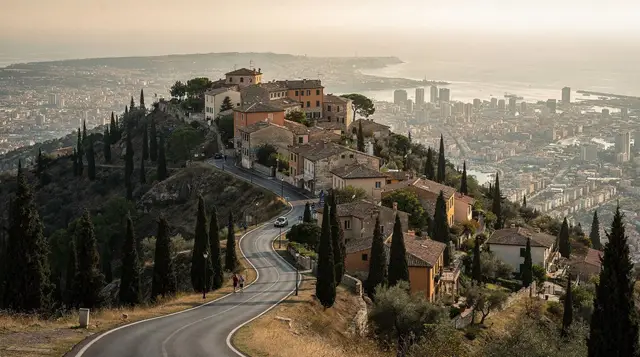
Tindari itself is a single, striking site: a clifftop sanctuary and archaeological zone looking straight down onto the Marinello lagoons, a shifting series of sandbars and pools that visibly change shape over the years as currents redeposit sediment — one of the more unusual coastal views in Sicily. The Nebrodi, stretching inland behind Tindari, is an entire mountain range and Italy’s largest connected forest south of the Alps, protected as a regional park and almost entirely bypassed by standard Sicily itineraries.
Together they represent a slower, less commercialized version of eastern Sicily than Taormina or the Etna crowds — worth the detour for travelers who’ve already covered the coast and want genuinely different terrain, rather than a first-time visitor’s top priority.
Tindari: the sanctuary, the ruins, and the lagoon below
The Santuario della Madonna Nera di Tindari sits at the edge of the cliff, housing a dark-wood Byzantine-style statue of the Black Madonna that has drawn pilgrims for centuries and remains an active site of devotion, not merely a historical curiosity. Immediately below and around it lie the ruins of ancient Tyndaris, a Greek colony founded in the 4th century BC, with a well-preserved theatre, a basilica and city walls still traceable through the site.
The combination of active pilgrimage site and archaeological ruin, both looking down onto the same dramatic lagoon view, is what makes Tindari worth the stop. A guided tour of Tindari and its archaeological zone covers both the sanctuary and the ruins with historical context that’s easy to miss visiting independently.
The Marinello lagoons below the cliff are reachable by a path down from the town and are a genuinely pleasant, uncrowded beach stop distinct from the more commercialized beaches further along the coast, though facilities are minimal.
Tyndaris itself was founded relatively late among Sicily’s Greek colonies, in 396 BC by Dionysius I of Syracuse — the same ruler whose destruction of Naxos, on the opposite side of the island, is covered on the separate Giardini Naxos destination page. The site’s Roman-era basilica, actually a later structure built over Greek foundations and long misidentified purely as a Roman gymnasium, is one of the better-preserved examples of Roman-period construction on this coast, and the theatre still occasionally hosts performances during the summer festival season, echoing the more famous version at Taormina on a smaller, far less crowded scale.
The Nebrodi: Sicily’s least-visited mountains
Behind Tindari, the Nebrodi mountains rise into beech, oak and pine forest that few foreign visitors ever see, despite the range covering a larger area than the better-known Madonie further west. The park is home to a semi-wild population of Sanfratellano horses, roaming in herds across high pastures, along with wolves that have recolonized parts of the range in recent decades — genuinely rare wildlife sightings by Sicilian standards, though not guaranteed on any given visit. Small hilltop towns scattered through the park, largely untouched by tourism infrastructure, offer a version of rural Sicily that contrasts sharply with the coast an hour’s drive away.
A full-day 4x4 tour of the Nebrodi departing from Cesarò, one of the park’s main gateway towns, covers the forest interior and high pastures in a single organized excursion — a practical option given the limited public transport and often unmarked forest roads inside the park.
A shorter half-day version of the same route suits a tighter schedule, and for a genuinely different experience, a night tour through the park targets wildlife more active after dark. For the wider comparison between the Nebrodi and Sicily’s other major mountain park, see the Madonie and Nebrodi parks guide and Sicily’s parks and nature reserves.
The legend of the Black Madonna, and a miracle attributed to the sea
Local tradition holds that the statue of the Black Madonna at Tindari was carved in the Byzantine east and arrived in Sicily by ship, surviving a shipwreck that claimed the rest of the vessel’s cargo — an origin story that, factual or not, explains why the sanctuary has drawn continuous pilgrimage for centuries and remains one of the most visited religious sites in this part of Sicily, alongside its archaeological and scenic draw.
A Latin inscription on the statue’s base, translating roughly to “black I am, but beautiful,” is often cited by visiting pilgrims and has become closely associated with the site’s identity locally. The sanctuary’s feast day in September draws considerably larger crowds than a typical visit, worth knowing if travel dates happen to coincide.
The Nebrodi’s small towns, and a different Sicily than the coast
Towns scattered through the Nebrodi — Cesarò, San Fratello, Alcara Li Fusi among them — see a fraction of the visitors that Taormina or Cefalù receive in a single day, and they preserve a version of rural Sicilian life built around agriculture, forestry and, in San Fratello’s case, a distinct Gallo-Italic dialect tracing back to medieval Lombard settlers rather than standard Sicilian — a linguistic curiosity unique to a handful of towns in this part of the island.
Local cuisine in the Nebrodi leans on the black pig (suino nero dei Nebrodi), a native breed raised semi-wild in the forest and considered a genuine culinary specialty distinct from anything found on the coast, along with mushroom and chestnut dishes tied to the forest’s seasonal produce. Visiting these towns requires patience with limited tourist infrastructure — this is not a region set up for easy visitor logistics — but it offers a version of inland Sicily that the coastal itineraries entirely miss.
Getting there, and why a car (or a tour) really matters here
Tindari is reachable by regional bus from Milazzo or Messina with a walk up from the coastal highway, making it doable without a car for a focused half-day visit. The Nebrodi interior is a different proposition — public transport into the park itself is sparse, roads inside it are winding and sometimes unpaved, and a rental car or an organized 4x4 tour is genuinely necessary to see more than the fringes. See driving in Sicily for the wider driving context, and note that the general ZTL cautions relevant to town centers elsewhere in Sicily are not a factor in this largely rural area.
Tindari and the Nebrodi are most commonly visited from Messina or Milazzo — see the Messina destination page and Milazzo destination page for those bases — and pair naturally with a longer loop through Sicily’s north coast toward Cefalù, covered on the separate Cefalù destination page.
The contrast between Tindari’s crowded clifftop viewing terrace in peak season and the near-total solitude of the Nebrodi interior an hour’s drive away is one of the more striking gaps in visitor density found anywhere in eastern Sicily, and it’s worth experiencing both within the same trip precisely for that contrast.
Lake Biviere, and the Nebrodi’s hiking trails
Within the park, Lake Biviere di Cesarò is one of the Nebrodi’s most distinctive natural features — a mountain lake and protected wetland reserve that draws migratory birds and offers walking trails around its shoreline considerably gentler than the steeper forest routes elsewhere in the range. It sits close to Cesarò itself, making it a practical stop for visitors already using that town as a gateway into the park via an organized 4x4 tour or a self-driven route.
Beyond the lake, the Nebrodi has a genuine network of marked hiking trails through beech and oak forest, ranging from short, gentle walks near the gateway towns to longer routes climbing toward the range’s higher points, none of which reach the crowds found on Etna’s more famous trails. Trail markings and maintenance vary by section, and this is not a park with the polished visitor infrastructure found in more heavily marketed nature reserves elsewhere in Italy — a local guide or a clearly downloaded offline map is worth having rather than relying on trail signage alone. See the wider hiking in Sicily: the routes that are worth it for how Nebrodi routes compare to Sicily’s other hiking destinations.
When to visit
Late spring and September offer the most comfortable conditions for both the exposed Tindari clifftop and the Nebrodi’s hiking trails. Summer in the mountains is cooler than the coast and a reasonable escape from the regional heat described in Sicily in August, though the forest interior can still be warm at midday. Winter brings snow to the Nebrodi’s higher elevations, closing some roads and trails, while Tindari itself remains accessible year-round.
Frequently asked questions about Tindari and the Nebrodi
Is Tindari worth visiting for the sanctuary alone, without the Nebrodi?
Yes — the sanctuary, ruins and lagoon view form a complete half-day visit on their own, reachable without a car via bus from Messina or Milazzo.
Do you need a car to explore the Nebrodi mountains?
Effectively yes, or an organized 4x4 tour — public transport into the park’s interior is sparse and many of the best areas sit along unmarked forest roads.
Are the wild horses and wolves in the Nebrodi guaranteed sightings?
No — both exist in the park in real, documented populations, but sightings depend on timing, location and some luck, similar to wildlife viewing anywhere.
How does the Nebrodi compare to the Madonie mountains further west?
The Nebrodi is larger and less visited, with denser forest cover; the Madonie has more developed hiking infrastructure and slightly easier access from Palermo. See the dedicated comparison guide for a fuller picture.
What are the Marinello lagoons below Tindari?
A series of shifting sandbars and pools at the base of Tindari’s cliff, formed by coastal currents that visibly reshape the lagoon’s outline over time — reachable by a path down from the town.
Can Tindari and the Nebrodi be visited in a single day?
A rushed version is possible with a car, but the Nebrodi’s interior rewards more time; most visitors treat Tindari as a half-day stop and the Nebrodi as a separate day trip or overnight.
What is Lake Biviere di Cesarò?
A mountain lake and protected wetland within the Nebrodi park, near the gateway town of Cesarò, offering gentler shoreline walking trails and drawing migratory birds — a practical, lower-effort stop alongside a 4x4 tour of the park’s interior.
Is the Nebrodi black pig worth trying?
Yes, for anyone interested in genuinely regional food — suino nero dei Nebrodi is a native, semi-wild pig breed raised in the forest and considered a distinct culinary specialty of this area, unlike anything found on the coast.