The village that’s more Godfather than Taormina itself
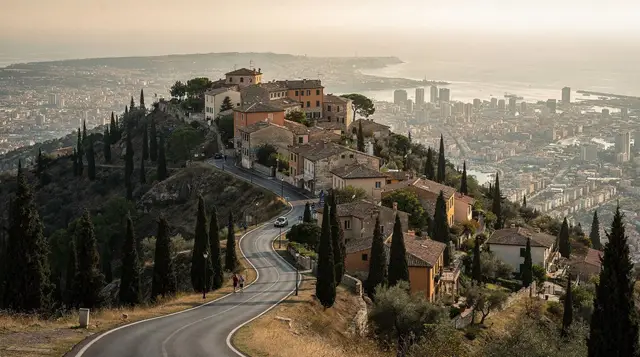
Savoca is a small hilltop village a short drive inland and uphill from the coast between Taormina and Messina, and it is the actual location for most of the Sicily-set wedding scenes in Francis Ford Coppola’s original Godfather film — not Taormina, which is more commonly (and often incorrectly) assumed by visitors reading a guidebook quickly. Savoca’s medieval streets, largely unchanged since filming in the early 1970s, and its genuinely modest year-round population make it feel more like a preserved location than a working tourist set, despite decades of film pilgrims passing through.
The village sits at the end of a winding road climbing from the coastal town of Santa Teresa di Riva, and it pairs naturally with neighboring Forza d’Agrò, another hilltop village used for filming, as a single half-day excursion from Taormina, Giardini Naxos or Messina.
The climb into Savoca itself, on foot from any parking area at the village edge, is a genuine part of the experience — narrow stepped lanes between stone buildings that have hosted continuous village life since the medieval period, with almost no concession to modern development visible from the main approach.
Bar Vitelli: the real location, still serving
Bar Vitelli is Savoca’s single most visited spot — the café used in the film for the scene where Michael Corleone asks Apollonia’s father for permission to court her. It remains a functioning bar and café today, with photographs and film memorabilia on display, and it is worth ordering something simple and sitting at one of its tables rather than treating it purely as a photo stop.
It is, unusually for a film location this famous, still a normal village bar rather than a recreation built for visitors, and locals who remember the filming (or whose parents did) are sometimes around to talk about it. A photo-focused tour built specifically around the film’s key locations covers Bar Vitelli and the church used for the wedding scene in a structured route, useful for visitors who want the references explained rather than guessed at.
The church, the crypt, and what most visitors miss
The Chiesa di Santa Lucia, used for the film’s wedding ceremony scene, sits a short walk from Bar Vitelli through the village’s narrow main street. Less visited, and easy to miss without knowing to look for it, is the crypt beneath one of Savoca’s other churches, which holds mummified remains of local notables from past centuries, preserved through a natural process aided by the crypt’s ventilation — a genuinely striking and under-visited sight relative to how well-known the Godfather locations are. It is a smaller, less elaborate version of the mummification tradition also found at Palermo’s Capuchin Catacombs, and worth the short detour for visitors interested in that history.
Forza d’Agrò: the second filming village
A short drive from Savoca, Forza d’Agrò is another hilltop village used in the film, notably for scenes set at what’s presented as the Corleone family’s ancestral village. It has a smaller, more residential feel than Savoca and considerably fewer visitors, making the two villages a natural pair for anyone making the drive up from the coast rather than visiting either alone. A private tour covering both Savoca and Forza d’Agrò is the standard way to see both without needing to navigate the connecting roads independently.
Beyond the Godfather: what Savoca was before the film
Savoca’s history predates its screen fame by many centuries — the village was an important medieval settlement in this part of Sicily, with a fortified position that made it strategically significant long before Hollywood arrived. The village’s medieval castle ruins, sitting above the main streets, offer a further viewpoint over the surrounding hills and the coast below, and are worth the short additional climb for visitors not solely focused on the film locations.
Several of Savoca’s churches and palazzi predate the 1970s filming by centuries, and the village’s overall layout — narrow stepped streets following the natural contour of the hill — reflects defensive medieval town planning rather than anything designed with tourism or film crews in mind.
This deeper history is easy to miss on a rushed Godfather-focused visit, but it’s part of what makes Savoca convincing as a filming location in the first place: Coppola’s crew chose a village that was already, visibly, a genuine centuries-old Sicilian hill town rather than dressing up something more generic.
Getting there, and why most visitors don’t drive themselves
Savoca and Forza d’Agrò are reachable by car via winding roads climbing from the coastal highway, but parking in the villages themselves is limited and the roads are narrow enough that many visitors prefer an organized tour or private driver rather than self-driving.
A Vespa tour combining the film locations with the ride itself is a more distinctive way to make the approach for visitors comfortable on two wheels, and a tour including lunch in the village extends the visit into a fuller half-day. General driving cautions that apply across inland Sicily — narrow roads, limited signage in places — are covered in driving in Sicily.
Savoca is most commonly visited as a day trip from Taormina, Giardini Naxos or Messina — see the Taormina destination page and Messina destination page for those bases, and day trips from Taormina for how it typically fits alongside other stops on the same day.
Fitting Savoca into a wider eastern Sicily itinerary
Savoca’s position between Taormina and Messina makes it a natural add-on rather than a destination requiring its own dedicated overnight — most visitors fold it into a day that also includes Taormina’s theatre, or combine it with a broader look at the Ionian coast heading toward Messina. Because the village itself is compact, a well-organized half-day covers Savoca and Forza d’Agrò comfortably alongside lunch, leaving the rest of the day free for a beach stop at Giardini Naxos or a return to Taormina for the evening.
For travelers building a longer eastern Sicily loop, Savoca fits logically alongside Etna and the Alcantara Gorges as one of several half-day detours from a Taormina or Giardini Naxos base — see the eastern Sicily in 5 days itinerary for how this typically slots in.
The wider Godfather trail across Sicily
Savoca and Forza d’Agrò are the two most significant on-location sites from the original film shot in Sicily, but Godfather tourism has grown into its own small industry across the island, with tours referencing locations of varying authenticity. For the fuller picture of what’s genuinely tied to the film versus what’s marketing embellishment, see the wider Godfather tour: what is real and what is not and the dedicated Savoca and Forza d’Agrò guide.
Taormina’s own, separate cinematic association with The White Lotus is covered on the Taormina destination page and in The White Lotus in Taormina, and shouldn’t be confused with Savoca’s Godfather connection despite both towns sitting on the same stretch of coast.
Eating in Savoca, and why lunch here is part of the appeal
Beyond Bar Vitelli’s coffee and pastries, Savoca has a small number of trattorie serving straightforward, unpretentious Sicilian food at prices well below the coastal towns below, largely because the village’s economy still depends more on residents than on tourist turnover despite its cinematic fame. A slow lunch here, with views back down toward the coast, is a reasonable centerpiece for the half-day trip rather than an afterthought squeezed in around the film locations. Almond granita and local pastries are a specialty worth trying at Bar Vitelli itself or one of the smaller shops nearby, distinct from but comparable to the wider Sicilian granita tradition covered in granita and brioche.
Photography: timing the light on the village’s stepped streets
Savoca’s narrow stone streets and stepped alleys photograph best in the earlier and later parts of the day, when low-angle light picks out the texture of the stonework rather than flattening it under the harsh midday sun typical of inland Sicily in the warmer months. The viewpoint from the castle ruins above the village offers the best wide shot of the surrounding hills and coastline, particularly in the late afternoon when the light comes in from the sea. Bar Vitelli’s own courtyard, where the film’s key scene was shot, is small enough that peak-season crowds can make an uncrowded photograph difficult around midday — an early visit avoids this more reliably than any other single tip.
When to visit
Spring and autumn give the most comfortable temperatures for the uphill walking involved in both villages, which have almost no shade on their main streets. Summer is workable but hot, particularly at midday; an early morning or late afternoon visit avoids the worst of it. Villages this size have limited opening hours for the church and crypt outside peak tourist months, so confirming timing before making the drive is worth doing, especially off-season.
Frequently asked questions about visiting Savoca
Was The Godfather really filmed in Savoca rather than Taormina?
Yes — most of the film’s Sicily wedding sequence was shot in Savoca, including at Bar Vitelli and the Chiesa di Santa Lucia. Taormina’s own screen fame is more recent and tied to The White Lotus.
Is Bar Vitelli a real, functioning bar or a recreation for tourists?
It’s a real, still-operating café that happened to be used as the filming location and has kept its film-era character and memorabilia rather than being rebuilt as a set.
Can you visit Savoca without a car?
Yes, via an organized tour or private driver from Taormina, Giardini Naxos or Messina — self-driving is possible but the approach roads are narrow with limited parking in the village itself.
Is Forza d’Agrò worth visiting alongside Savoca, or is one village enough?
Most visitors combine both in a single half-day trip, since they’re a short drive apart and each has a distinct filming connection and character.
What is the mummy crypt in Savoca, and is it worth seeking out?
A lesser-known crypt beneath one of Savoca’s churches holding naturally preserved remains of past local notables — a smaller-scale version of Palermo’s Capuchin Catacombs, and worth the short detour for visitors interested in that history.
How much time should you set aside for Savoca and Forza d’Agrò?
Half a day is typical, including the drive up from the coast, both villages, and a stop at Bar Vitelli or for lunch.
Is there more to Savoca than the Godfather connection?
Yes — the village has genuine medieval history, including castle ruins and centuries-old churches, and was a strategically important hill settlement long before its filming fame in the 1970s.
What’s the best time of day to photograph Savoca?
Early morning or late afternoon, when low-angle light suits the village’s stone streets better than the flat, harsh midday sun typical of inland Sicily. Early visits also avoid peak-season crowds at Bar Vitelli’s courtyard.