A city defined by an earthquake and a strait
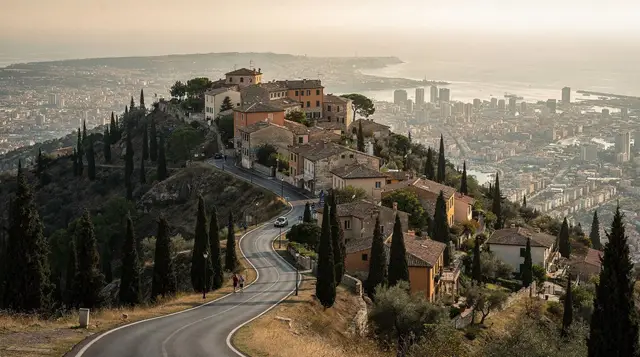
Messina sits at Sicily’s northeastern tip, separated from mainland Calabria by the Strait of Messina — at its narrowest, only about 3 kilometers of water, close enough that the mainland coast is clearly visible from Messina’s own waterfront on a clear day. For most visitors, Messina is the arrival or departure point for ferries connecting Sicily to the Italian mainland, rather than a planned stop in its own right, and that’s a defensible way to treat it on a tight itinerary.
What surprises first-time visitors is how modern much of central Messina looks compared to Catania, Palermo or Taormina. The reason is a catastrophic 1908 earthquake and tsunami that killed an estimated 60,000-100,000 people in the city and surrounding area — one of the deadliest natural disasters in modern European history — and destroyed most of the historic center. What stands today was largely rebuilt in the following decades in a lower, earthquake-resistant style, which means Messina has less of the dense baroque fabric found in Catania or the Val di Noto towns, but its own distinct, more open 20th-century character.
Messina today is often unfairly skipped by itineraries built purely around Taormina and Catania, treated as a logistics problem rather than a place, which is a pity given how directly its rebuilt cityscape reflects one of the defining disasters of modern Italian history.
The Duomo and its astronomical clock
Messina’s Duomo, itself rebuilt after the 1908 earthquake (and again after WWII bombing damage), houses what is claimed to be the largest astronomical and mechanical clock tower in the world, installed in the 1930s. At noon each day, the clock tower puts on a short mechanical show — bronze figures move, a lion roars, a rooster crows — animating scenes tied to the city’s patron saints and civic history.
It draws a modest crowd daily and is worth timing a visit around if passing through, since it is Messina’s single most distinctive free attraction. A guided city highlights walking tour typically times its route to include the noon clock show alongside the Duomo interior and the nearby fountains.
A port city for two thousand years, and why it looks the way it does
Messina’s position at the narrowest crossing point between Sicily and mainland Italy has made it a strategically vital port since antiquity, fought over and rebuilt repeatedly by Greeks, Romans, Byzantines, Arabs, Normans and successive kingdoms, each leaving fragments now largely buried beneath the 20th-century reconstruction.
This layered, largely invisible history is part of why Messina rewards a visitor willing to look past its unglamorous modern surface — the city’s museums and a handful of surviving older structures preserve what the earthquake and subsequent bombing didn’t erase, even though the streetscape itself reads as considerably younger than its actual age would suggest. The Fontana di Orione, a 16th-century fountain in the main piazza near the Duomo, is one of the more visible pre-earthquake survivals, worth a look alongside the cathedral itself.
What else is worth an hour or two
Beyond the Duomo, Messina’s Museo Regionale holds two paintings by Caravaggio, painted during his time in Messina fleeing legal trouble in Malta — a detail that surprises visitors who don’t associate the city with the artist. The waterfront promenade offers direct views across the Strait to Calabria, close enough to watch ferries and the occasional Italian Navy vessel cross in real time. A street food tour combined with the astronomical clock show is an efficient way to cover both the food and the sightseeing side of a short stop in a single booking.
For a view of the Strait itself from the water, a panoramic boat excursion toward Capo Peloro covers the narrowest point of the Strait and the lighthouse at Sicily’s northeastern tip, an area with its own current-driven whirlpool phenomena that gave rise to the ancient legends of Scylla and Charybdis.
Where to stay if a crossing forces an overnight
Most visitors don’t plan to sleep in Messina, but ferry schedules, missed connections or a late arrival sometimes force the issue, particularly for anyone routing through on public transport rather than a private car. The area around the train station and the Duomo has the highest concentration of reasonably priced hotels, all within walking distance of both the ferry terminal and the main sights, making an unplanned overnight here considerably less disruptive than it might first seem. Prices run well below Taormina or even central Catania, another small upside of Messina’s more workaday reputation among Sicilian cities.
Scylla and Charybdis, and why sailors feared this stretch of water
The Strait of Messina’s currents are genuinely unusual, driven by the meeting of the Tyrrhenian and Ionian seas through a narrow, deep channel, producing tidal whirlpools and current reversals strong enough to have generated their own mythology. The ancient legend of Scylla, a monster on the Calabrian side, and Charybdis, a whirlpool on the Sicilian side, both threatening ships trying to pass through the strait, is generally understood to be a mythologized account of these very real navigational hazards, which continued to challenge shipping well into the modern era before better charts and engine power reduced the risk.
Modern ferries and hydrofoils cross routinely and safely, but the crossing still has a noticeably different feel from a calm-water harbor crossing elsewhere in Sicily — a faster current and a more perceptible sense of moving water beneath the hull, particularly on the smaller hydrofoil craft.
A long-standing and still periodically revived proposal to build a bridge across the Strait, connecting Sicily to the Italian mainland by road and rail for the first time, has been debated in Italian politics for decades without construction ever beginning — a detail Messina locals will discuss with a mix of skepticism and resignation, having heard the announcement before.
Ferries: to Calabria, and why they matter for this whole region
Messina is the primary hub for ferries and hydrofoils crossing to Villa San Giovanni and Reggio Calabria on the mainland, a crossing that takes as little as 20-30 minutes by hydrofoil, longer by car ferry. This is also, separately, the departure point some travelers use for reaching the Aeolian Islands via connections further along the coast, though Milazzo, covered on its own Milazzo destination page, is the main port for that route specifically.
As with any sea crossing in this region, schedules and crossings are subject to cancellation in poor weather — see the wider Sicily ferries guide and ferries to Sicily from the mainland for how crossings, timetables and cancellation risk actually work in practice.
Tindari and the Nebrodi as day trips from Messina
Messina makes a workable base for reaching the sanctuary of Tindari, with its Greco-Roman ruins and clifftop basilica, and the Nebrodi mountain range further west — both covered in full on the separate Nebrodi and Tindari destination page.
A guided tour of Tindari and its archaeological zone is the most straightforward way to see the site without a rental car. Savoca and Forza d’Agrò, the Godfather filming villages, are also reachable from Messina — see the Savoca destination page and Savoca and Forza d’Agrò guide.
Eating in Messina: pesce spada and a different pastry tradition
Messina’s cuisine leans heavily on the strait’s own catch, particularly pesce spada (swordfish), prepared here in ways distinct from the rest of the island — involica di pesce spada, thin swordfish rolls stuffed and grilled, is a genuinely local specialty worth seeking out rather than the more generic grilled swordfish steak found across Sicily’s coastal towns.
The city also has its own pastry identity within the broader Sicilian tradition, including pignolata, a pastry of fried dough balls coated half in chocolate and half in lemon icing, distinct from the pastries more commonly associated with Palermo or Catania. Messina’s cannoli and granita follow the general Sicilian pattern covered in the wider pastry guide and granita and brioche guide, without a strongly distinct local variant.
A university city with more going on than the ferry terminal suggests
Like Catania, Messina has a significant student population tied to its long-established university, and this shapes the city in ways a rushed transit visit misses entirely — a genuine café and aperitivo culture around the university district, prices that stay reasonable for anyone eating where students eat rather than near the tourist-facing waterfront, and an evening street life that has little to do with ferry schedules. Visitors basing themselves here for more than a quick stop, whether by choice or necessity, will find considerably more going on than the transit-hub reputation suggests, particularly outside the summer months when the university is in full session.
Getting around, and the ZTL and driving reality
Messina’s center is walkable from the ferry terminal and main train station, both located close to the Duomo area. Drivers passing through toward Taormina or Catania on the A18/A20 motorways will find Messina mostly a through-city rather than a destination requiring a long stop, though the same ZTL cautions that apply across Sicilian city centers apply here too — see the ZTL and parking guide and driving in Sicily for the wider picture.
Regional trains connect Messina south to Taormina and Catania, and west along the Tyrrhenian coast toward Milazzo and Cefalù — a useful option for travelers without a car working this side of the island; see Sicilian trains: what works and what does not.
Messina fits naturally at the start or end of an eastern Sicily route — see day trips from Messina and the eastern Sicily in 5 days itinerary for how it typically slots into a longer trip.
When to visit
Spring and autumn offer the most comfortable conditions for walking the waterfront and center. Messina’s climate is generally slightly cooler and windier than Catania or Taormina due to the Strait’s exposure, which can be an advantage in peak summer heat — see Sicily in August for how the coast compares regionally.
Frequently asked questions about visiting Messina
Is Messina worth a stop, or should you just pass through on the ferry?
For a short trip, passing through is reasonable. If time allows even an hour or two, the noon astronomical clock show at the Duomo and the Strait waterfront are worth the detour.
Why does Messina look so much more modern than other Sicilian cities?
A catastrophic 1908 earthquake and tsunami destroyed most of the historic center, killing tens of thousands. What stands today was largely rebuilt in the following decades in a lower, earthquake-resistant style.
How do you get from Messina to Calabria on the mainland?
By ferry or hydrofoil across the Strait of Messina, a crossing of 20-30 minutes by hydrofoil from the city center, longer by car ferry from the port areas north of the city.
Is Messina a good base for reaching Tindari and the Nebrodi?
Yes — both are reachable as day trips from Messina, either independently by car or via organized tours covering the Tindari archaeological site and sanctuary.
Can you see Messina’s astronomical clock show every day?
Yes, it runs daily at noon, with a shorter version outside peak season and an expanded version on Sundays and holidays in some periods — worth confirming locally on the day.
Is a car needed to see central Messina?
No — the center is walkable from the ferry terminal and train station. A car becomes useful mainly for day trips to Tindari, the Nebrodi or Savoca.
Are the currents in the Strait of Messina genuinely dangerous?
For modern ferries and hydrofoils, no — crossings run safely and routinely. The strait’s unusually strong currents, which inspired the ancient legends of Scylla and Charybdis, made the crossing far riskier for older sailing vessels than for today’s engine-powered ferries.
What should you eat in Messina that isn’t found elsewhere in Sicily?
Involtini di pesce spada (stuffed, rolled swordfish) and pignolata, a fried pastry iced half in chocolate and half in lemon, are both distinctly associated with Messina rather than the island’s more commonly exported specialties.