Savoca and Forza d'Agrò
Can I visit Savoca and Forza d'Agrò in one day?
Yes, and most visitors do. The two villages are about 15 minutes apart by car and both sit roughly 40-50 minutes above Taormina or Messina on narrow hill roads. A half-day covers Bar Vitelli, the Church of Santa Lucia in Savoca, and a walk through Forza d'Agrò's lanes and castle ruin.
Two villages that were postcards before they were a film set
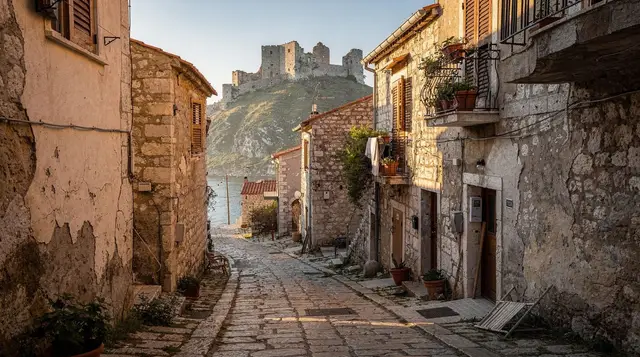
Long before a Hollywood crew found them, Savoca and Forza d’Agrò were simply two of the small hill towns strung along the ridge above the Ionian coast near Taormina and Messina - built for defence against raiders, not tourism, and largely bypassed by the coastal development that transformed Taormina itself.
That is exactly why they still look the way they do: narrow stone lanes, a handful of churches, and views back down to the sea that have changed very little in decades. This guide covers both villages as places in their own right, beyond the two specific film locations covered in The Godfather tour: what is real and what is not - what else there is to see, how to get between them, and how to plan a half-day that does not feel rushed.
Savoca beyond Bar Vitelli
Savoca’s centre is compact enough to walk end to end in twenty minutes, but it rewards a slower pace. Beyond the two sites everyone comes for, the village has a genuinely interesting medieval core: the Chiesa Madre (Santissimo Salvatore), a Franciscan monastery with catacombs holding mummified remains of local notables from past centuries, and a scattering of noble houses along the main street with weathered stone doorways worth a second look.
The catacombs beneath the Cappuccini convent are less visited than the film sites and rarely appear in tour itineraries at all, which makes them one of the more overlooked things to do here - mummified bodies preserved in a technique similar to Palermo’s better-known Capuchin Catacombs, on a much smaller and quieter scale. If macabre history interests you more than film trivia, allow time for this stop specifically; it is easy to walk past its unmarked entrance without noticing it.
The village also affords some of the better coastal views in this part of Sicily, since it sits at roughly 300 metres above sea level with an open outlook toward the Ionian Sea and, on clear days, back toward Taormina’s headland. Vespa Tour of Savoca the Godfather Experience and Bar Vitelli takes visitors through the village at a walking pace on a scooter-and-foot combination, which suits Savoca’s scale better than a coach that has to park at the edge of town regardless.
Forza d’Agrò: castle, convent, and quieter lanes
A 15-minute drive from Savoca, Forza d’Agrò sits on its own separate hilltop and has a different character - fewer visitors, and a more clearly medieval street plan of stepped lanes climbing toward a ruined Saracen-era castle at the summit. The climb to the castle ruin is on foot, uneven underfoot in places, and rewards the effort with a genuinely wide panorama over the coast and, on a clear day, as far as the Calabrian mainland across the Strait of Messina.
The Chiesa Madre di San Agostino anchors the lower part of the village, and the former convent of Sant’Agostino nearby has period features that survive from well before the film crew’s brief visit. Forza d’Agrò does not have a single headline attraction the way Savoca has Bar Vitelli; its appeal is the accumulation of quiet, unrestored streets and the view from the top, best appreciated by walking rather than driving straight up and back down.
For visitors arriving by cruise ship into Messina rather than basing themselves in Taormina, From Messina: Savoca Taormina Shore Excursion is built specifically around that timing constraint, covering both villages within a shore-excursion window and returning to the port with a buffer before departure - worth checking the return-time margin against your ship’s all-aboard time before booking any Messina-based tour.
How the two villages fit together in one visit
Because they sit only about 15 minutes apart on the same ridge road, nearly every operator and most independent visitors treat Savoca and Forza d’Agrò as a single half-day rather than two separate trips. A sensible order is Savoca first - Bar Vitelli, the Church of Santa Lucia, the Cappuccini catacombs if you have the extra 20 minutes - followed by the short drive to Forza d’Agrò for the castle climb and a slower walk through its lanes before heading back down to the coast.
Godfather Private Tour of Savoca and Forza d'd'Agrò from Messina departs from Messina and follows roughly this order with a private driver, useful if you would rather not navigate the switchback roads yourself, while The Legend of the Godfather Private Tour of Savoca and Forza d'd'Agrò with a Typical Lunch builds in a full Sicilian lunch between the two stops - a genuine convenience given how limited Savoca’s dining options are at peak hours. il Padrino in Savoca and Taormina Tour is aimed specifically at visitors who want a guided, unhurried session at each film location for photographs rather than a fast walkthrough, worth considering if the visual side of the trip matters more to you than covering both villages in full.
Driving there yourself
Both villages are reachable by rental car from Taormina, Messina or Catania, and neither has a ZTL restriction of the kind that catches drivers out in Palermo, Catania or Syracuse - covered generally in ZTL zones and parking in Sicilian cities. The roads themselves are the real consideration: narrow provincial roads with frequent switchbacks climb roughly 300-400 metres in a short horizontal distance, which takes longer than the map distance suggests and is uncomfortable for anyone prone to car sickness on winding roads. Small car parks sit at the edge of each historic centre, since neither village’s core streets take vehicles.
If you are hiring a car for this specific trip, general guidance is in Renting a car in Sicily and Driving in Sicily: what nobody warns you about; both are worth reading before tackling these particular roads, which are typical of the hill-town driving found across eastern Sicily.
Without a car
Public transport to either village is limited to infrequent local buses that do not run on a schedule suited to a single afternoon visit, and there is no rail link. For visitors without their own car, a half-day tour or a private driver is the realistic option rather than an inconvenience - the driving time and road conditions make a self-organised bus trip more trouble than it is worth for most travellers. Day trips from Taormina and Day trips from Messina cover the wider range of options from each base, including operators that combine Savoca and Forza d’Agrò with other stops on the same day.
Food and practicalities
Both villages are small enough that dining choices are genuinely limited - a handful of family-run trattorie in each, plus Bar Vitelli itself in Savoca, which serves simple food alongside its coffee and granita. Neither village has the restaurant density of Taormina or Messina, so arriving with a plan, or booking a tour that includes lunch, avoids competing with coach groups for the same few tables around 1pm. Outside of the main midday window, both villages are considerably quieter, and an early-morning or late-afternoon visit gives a noticeably calmer experience of the same streets.
Neither village has significant accessibility accommodations - cobbled, sloped lanes and steps are the norm in both, particularly the climb to Forza d’Agrò’s castle - so travellers with mobility limitations should expect to see Bar Vitelli and the lower parts of each village rather than the full circuit. General notes on this are covered in Accessible travel in Sicily.
Two villages built for defence, not for views
Both villages sit where they do for the same historical reason: a hilltop position that made them harder to reach and easier to defend against the raiders - Arab, Norman and later Ottoman corsairs at various points - that troubled Sicily’s coastline for centuries. The views back toward Taormina and the Ionian coast that visitors now come for were, in their original context, a defensive advantage rather than a scenic one - a lookout point rather than a photo opportunity.
This shared origin is why so many of Sicily’s most visually striking hill towns, Savoca and Forza d’Agrò included, occupy positions that are dramatic to look at but genuinely inconvenient to reach, a trade-off worth keeping in mind when the drive up feels longer than expected.
Combining with the Alcantara Gorges
Travellers with a full day rather than a half-day, and comfortable with a longer overall drive, can reasonably combine a morning at Savoca and Forza d’Agrò with an afternoon at the Alcantara Gorges, a basalt river canyon inland from the coast in the opposite direction from the two villages. This works better as a full, well-paced day than an attempt to add a third stop on top of the two villages, given how much of the day the winding hill roads already consume. Families should note that the gorges involve cold water and slippery rock rather than a dry walk, a different physical demand from the villages’ cobbled lanes.
Choosing the season and the hour
These are villages that change with the weather and the time of day more than most. Spring and autumn are the kindest seasons for climbing stepped lanes and a castle path, and the light on the Ionian side is at its best then; the reasoning behind that is laid out in Best time to visit Sicily, with season-by-season notes in Sicily in spring and Sicily in autumn. In high summer the same climb is a very different proposition: stone lanes hold the heat, shade is patchy, and the midday coach rush coincides with the hottest hours. If August is the only month you have, Sicily in August explains how to bend the day around the heat, which here means going early and leaving the castle for the cooler end of the afternoon.
Whatever the month, the pattern that works is the same: start in Savoca while the lanes are quiet, let the coach groups pass through the square, and use the middle of the day for the drive and lunch rather than for sightseeing. Forza d’Agrò is the better late-afternoon stop, when the light softens over the coast and the lanes empty out. Wear shoes with proper grip, since the old paving is worn smooth, and take the items suggested in the Sicily packing list - water and a hat matter more here than anywhere on the coast below.
Reading the villages as a film location, and as something else
Visitors who arrive for the cinema connection tend to leave talking about something different. The film locations here are real, but the honest version of the story is the one told in the Godfather tour guide: some scenes were shot here, others were shot elsewhere and sold under the same name. Seeing Savoca and Forza d’Agrò with that in mind makes the visit better, because you stop hunting for a perfect match with the screen and start noticing the places for what they are.
If the screen-tourism angle interests you more broadly, Sicily has several other circuits that work differently. Cinema Paradiso locations follows a gentler, more nostalgic film trail, Montalbano locations covers the television detective’s southeast, and the White Lotus guide to Taormina looks at the most recent wave of visitors. Each has its own rhythm, and none of them asks for the same kind of walking as these two hilltops.
What to do back on the coast
A half-day in the hills leaves the late afternoon free, and the coast below offers an easy contrast to the climb. Taormina is the obvious base, and the ancient theatre and the lanes around it make a natural follow-up; see the Taormina ancient theatre guide for how to approach it. For something slower, Isola Bella gives a seaside counterpoint to the stone and dust of the hill villages, and Giardini Naxos sits just along the shore for a quieter evening than Taormina’s busiest streets.
Those based in Messina can fold this trip into a longer sweep of the Strait and the surrounding coast, while visitors staying around Catania will find the villages reachable as one of the more rewarding options in Day trips from Catania. In every case the logic is the same: the hills are the effort, the coast is the reward, and the day feels balanced when you plan it that way round.
Eating and drinking the way the locals do
The food around here is simple, and that is the point. A granita at Bar Vitelli is as much a part of the visit as the film connection; if you have never had the Sicilian version, the notes in Granita and brioche explain what you are ordering and why locals eat it the way they do. For the rest of the meal, the habits described in Sicilian food etiquette and Tipping and etiquette in Sicily apply as much in a hill trattoria as in a city restaurant, and knowing them avoids the small awkward moments that tourists tend to create without noticing.
Because tables are few, the practical advice is to treat lunch as a decision rather than an afterthought. Either book a place in advance, choose a tour that includes a meal, or plan to eat before or after the busiest window. For a wider view of where to eat across the island, see Where to eat in Sicily by city.
Travelling with children, or with less energy
The two villages can work for families, with some caveats. Lanes are steep and uneven, there is little in the way of railings, and the castle path at Forza d’Agrò is not buggy territory. Children who enjoy exploring will usually find the ruin and the stepped lanes more fun than the film sites, while those who tire quickly are better served by seeing Savoca only. The general advice in Sicily with kids applies, and the macabre catacombs may be a talking point or a step too far depending on the child; the context in the Palermo catacombs guide is a useful way to decide beforehand.
Choosing between driving, a driver and a tour
The decision comes down to how much you want to manage. A rental car gives the most freedom and the cheapest flexibility, but the hill roads demand attention and patience. A private driver removes the driving and lets you look out of the window, which is worth thinking about on roads this winding; Private drivers in Sicily explains how that option works. A group or shared tour removes planning altogether but fixes your time at each stop.
If you are still weighing the options, Car or public transport in Sicily frames the trade-off for the island as a whole, while Sicily’s bus network and Sicily by train explain why neither is a good fit for these particular villages. Whichever option you pick, stay alert for the small scams and overcharges described in Scams to avoid in Sicily, which tend to target visitors who look unsure of the arrangements rather than those who clearly have a plan.
Where this fits in a wider trip
A half-day here pairs naturally with a Taormina-based stay, alongside time at Taormina itself, the ancient theatre of Taormina, or a look at Savoca as a standalone destination profile. For the full context on which scenes were actually filmed where, and how this pairs with Sicily’s other screen-tourism circuits - Montalbano’s southeast and The White Lotus’s Taormina among them - see Sicilian film tours compared. Travellers mapping this onto a longer route around the island can see where a half-day here sits within a full week in Sicily in 7 days, or in the more focused Eastern Sicily in 5 days, which keeps the whole trip on this side of the island.
The two villages reward roughly three to four unhurried hours combined - enough time for the two well-known film locations in Savoca, the quieter catacombs most visitors miss, and the climb to Forza d’Agrò’s castle for the view that neither film location can quite match.
Film location tours on GetYourGuide
Verified deep-linked GetYourGuide tours. Book through these links and we earn a small commission at no cost to you.
Photo: our own image of the location, not the operator’s product photo.