Inspector Montalbano filming locations
Where is Inspector Montalbano actually filmed?
The long-running Italian series is filmed across the Val di Noto in southeast Sicily. Scicli's town hall stands in for the Vigàta police station, Punta Secca supplies Montalbano's seafront house, Donnafugata Castle is used as the Balbo family villa, and Ragusa Ibla and Modica appear repeatedly as street backdrops.
A fictional town built from four real ones
For close to three decades, the Italian television series based on Andrea Camilleri’s novels has followed Inspector Salvo Montalbano through the fictional town of Vigàta and his equally fictional seafront home in Marinella. Neither place exists on a map. What does exist is a cluster of real towns in the Val di Noto, southeast Sicily’s UNESCO-listed Baroque region, that the production has used and reused across hundreds of episodes to build Vigàta out of real streets, real piazzas and one very real town hall. This guide separates the show’s fictional geography from the actual towns behind it, so a location-hunting visit lands somewhere real rather than nowhere at all.
Scicli: the town hall that became the police station
The single most consistent location across the series is Scicli’s town hall, the Palazzo Comunale on Via Francesco Mormino Penna, whose exterior and parts of its interior have stood in for the Vigàta police station - the “commissariato” where Montalbano and his team work - since the show’s first season. It remains a genuine working municipal building, not a set dressed for tourists, so exterior viewing is straightforward but interior access depends on the building’s normal opening arrangements and any events taking place on a given day.
Beyond the town hall, Scicli’s centre supplies a great deal of the series’ street-level footage: its late Baroque churches and townhouses, largely untouched by the kind of redevelopment that changed other Sicilian towns, give the production a consistent period backdrop without much need for set dressing. For the town’s own architectural story, independent of the series, see Modica and Scicli: the quieter Baroque.
Punta Secca: the house at Marinella
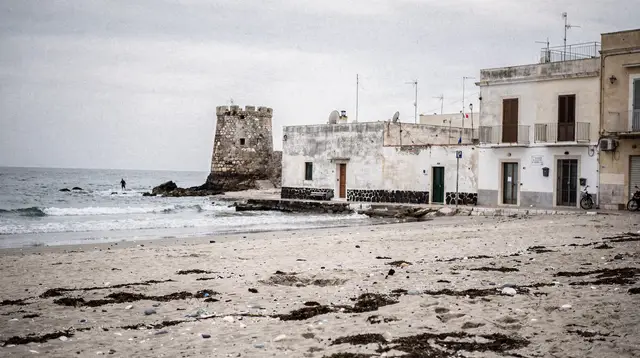
A short drive south of Scicli, the small coastal settlement of Punta Secca near Santa Croce Camerina supplies the exterior of Montalbano’s fictional seafront home at Marinella - a modest house directly on the sand, next to a small lighthouse that appears in the show’s opening sequence in several seasons. It is a real, occupied stretch of coastline rather than a preserved film set, and Punta Secca itself functions as an ordinary, low-key seaside town outside of its screen fame, with a narrow public beach and a handful of places to eat nearby.
Because the house’s exact current access arrangements change from year to year - it has at times operated with limited public visiting hours and at other times been closed to visitors entirely - check current status before building a visit specifically around going inside; viewing from the beach or the public path is reliably possible regardless. From Catania: Inspector Montalbano Day Tour with Audio Guide includes Punta Secca alongside Scicli in a single guided day, with an audio component explaining which scenes were shot where as you go, useful for matching what you are looking at to specific episodes rather than guessing.
Donnafugata Castle: the Balbo family villa
A short drive from Ragusa, Castello di Donnafugata is used in several episodes as the residence of the fictional Balbo family, its elaborate 19th-century facade and maze-like interior rooms providing a grander setting than the show’s usual small-town streets. The castle stands entirely on its own merits as one of southeast Sicily’s more unusual noble residences - built up from an older structure by the Arezzo family in the 1800s, with a distinctive lace-like stone balustrade on its roofline and a labyrinth in the grounds - and is open to visitors as a heritage site regardless of any television connection.
From Catania: Southeast Sicily Inspector Montalbano Tour is one of the few itineraries that combines Donnafugata with the Scicli and Punta Secca stops in a single day from Catania, which makes sense of the driving distances involved - the castle sits closer to Ragusa than to the coastal locations, and covering all three independently would otherwise mean a longer, more disjointed day.
Ragusa Ibla and Modica: the recurring backdrops
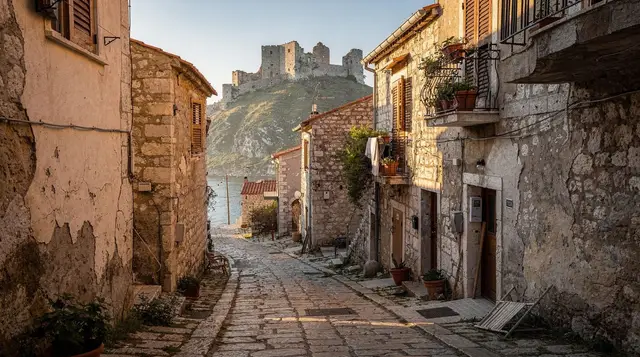
While Scicli anchors the police-station storyline, Ragusa Ibla and Modica recur throughout the series as general street and piazza backdrops - stone stairways, Baroque church facades, and the kind of layered hill-town streetscape that all three towns share as members of the Val di Noto’s UNESCO-listed group. Neither functions as a single dedicated “Montalbano location” the way Scicli’s town hall or Punta Secca’s house do; instead they contribute atmosphere across many episodes rather than one identifiable scene.
For visitors who want the architecture on its own terms, Ragusa Ibla: the staircase town covers Ibla independently of the series, and the wider baroque context for all eight Val di Noto towns - Noto, Modica, Ragusa, Scicli, Catania, Caltagirone, Militello and Palazzolo Acreide - is in The Val di Noto: eight Baroque towns, one earthquake. Tour of Detective Montalbano's Sicily weaves through all three towns across a full day, aimed specifically at fans wanting to recognise as many individual shots as possible rather than a single headline stop.
Vigàta and Marinella: nowhere you can drive to
It bears repeating because it catches visitors out: Vigàta and Marinella are Camilleri’s inventions, composites built from footage of Scicli, Ragusa Ibla, Modica and Punta Secca edited together across decades of filming. No signpost anywhere in Sicily reads “Vigàta,” and no map will get you there, because the town as shown on screen is a construction rather than a single physical place. Any tour or operator implying otherwise - promising “a day in Vigàta” as though it were one town you could walk around - is describing the composite experience of visiting the real towns behind it, which is a fair way to sell the day as long as the traveller understands what they are actually seeing.
Comparing the tours
Operators differ mainly in which combination of the four real locations they cover and where they depart from. Exclusive Montalbano Tour from Syracuse is the practical choice for visitors based in Syracuse or Ortigia rather than Catania, cutting the driving distance to the Val di Noto towns significantly compared with a Catania departure. Montalbano Audio Guided Tour from Catania uses a self-paced audio format rather than a live guide, which suits travellers who prefer to linger at Punta Secca’s beach or Scicli’s town hall square at their own speed rather than moving with a group.
Before booking any of them, check specifically whether Donnafugata Castle is included as a stop or only mentioned in passing - some day tours cover Scicli and Punta Secca thoroughly but treat the castle as a drive-by, given how much further out it sits relative to the coastal locations.
Getting there without a tour
All four core locations sit within a manageable radius for a self-driven day if you already have a rental car - Scicli, Punta Secca and Ragusa Ibla form a fairly tight triangle in the southeast corner of the island, with Donnafugata a short additional drive from Ragusa. None of the four imposes a meaningful ZTL restriction on visitors, covered generally in ZTL zones and parking in Sicilian cities, though Scicli and Ragusa Ibla’s historic centres are largely pedestrian, so expect to park at the edge and walk in. General driving notes for the region are in Driving in Sicily.
Rail access is patchy - Scicli and Ragusa both have stations on the regional line, but Punta Secca and Donnafugata are not directly served, making a car or a private driver the more practical choice for covering all four locations in a single day. Day trips from Syracuse covers the wider range of southeast Sicily day-trip options for travellers without their own car.
Choosing a base for the Montalbano country
The four core locations sit in the southeast corner of the island, and where you sleep decides how much of the day goes on the road. Ragusa puts you closest to Ibla and to Donnafugata, and its lower and upper towns reward an evening stroll once the day-trippers have left. Modica and Scicli are smaller and quieter, which suits anyone who wants to wake up inside the streets they recognise from the screen rather than drive to them. Noto is a little further along, but its honey-coloured Baroque avenue is a worthy companion to the Montalbano circuit, and the Noto walking guide shows how to see it in a slow half day.
If you would rather stay on the east coast, Syracuse and Ortigia work as a base, as does Catania, which is where several of the guided departures begin. The trade-off is simply more time in the car or on the coach in exchange for a livelier choice of restaurants and evenings. For help weighing the options across the island, where to stay in Sicily compares the main bases.
Pacing a self-guided Montalbano day
A location-hunting day goes best when it is built around two or three real stops rather than every corner of the series. Start at Scicli, because the town hall and the streets around it are the most recognisable part of the show and are best seen before the heat and the crowds build. Move on to Punta Secca for the seafront, then decide whether Ragusa Ibla or Donnafugata deserves the afternoon. Trying to tick off all four with equal attention leaves everyone tired and the photographs indistinguishable.
It helps to watch a few episodes before you go, or at least to look at stills of the scenes you most want to find. The towns are far more rewarding when you can match a staircase, a doorway or a piazza to a particular moment in an episode. Wear comfortable shoes, because the hill towns are built on steps and slopes, and keep a hat and water in the bag, since several of the stops offer little shade.
Anyone who hesitates between driving and booking a seat on a coach should read car or public transport in Sicily and the practical notes on car rental in Sicily. A guided day removes the parking and navigation worries, while a rental car gives you the freedom to stay as long as you like in the places you enjoy. Private drivers in Sicily are a third option for a small group that wants the flexibility without the driving.
Eating and stopping along the way
The southeast has some of the island’s most distinctive food, and a Montalbano day is a good excuse to sample it. The detective’s own appetite is a running joke in the series, with long, serious lunches of fish and local specialities, and the real towns reward the same attitude. Modica is the home of its grainy, old-fashioned chocolate, covered in the Modica chocolate guide. For something sweet and cold, the traditions explained in granita and brioche are a morning ritual worth building into the day, and cannoli and Sicilian pastry covers the counters worth a detour.
For lunch, Sicilian seafood explains what to order on the coast near Punta Secca, and where to eat by city points you towards reliable choices in the bigger towns. Local etiquette around the table, including the cover charge, is set out in Sicilian food etiquette, so nothing on the bill comes as a surprise.
When to go
The same honesty that applies elsewhere on the island applies here. Spring and autumn give the best light and the most comfortable walking, and the guides to Sicily in spring and Sicily in autumn explain why those seasons suit a day of walking through stone towns. The height of summer is harder: Punta Secca is a seaside place and fills with holidaymakers, the hill towns hold the heat, and the shadeless stretches become tiring. If summer is the only option, see Sicily in August and Sicily weather month by month, and plan the outdoor stops for the early morning. The overall picture is in the best time to visit Sicily.
More screen Sicily
Montalbano is only one of the island’s film circuits, and the others pair naturally with it on a longer trip. The villages used for The Godfather are covered in the Godfather tour guide and in Savoca and Forza d’Agrò, while the village of Cinema Paradiso is described in the Cinema Paradiso locations guide. Fans of the recent hotel drama will want the White Lotus Taormina guide. Each of these trades on a very different Sicily from the quiet Baroque hill towns of Montalbano, which is part of what makes combining them rewarding.
A show that ran far longer than most visitors expect
Andrea Camilleri’s Montalbano novels began appearing in the early 1990s, and the television adaptation, starring Luca Zingaretti in the title role, ran across close to three decades of production - an unusually long run for a single detective series, and one of Italian television’s best-known cultural exports internationally, alongside a considerable domestic following.
Camilleri himself died in 2019, partway through the show’s run, and the series continued production for several years afterward, drawing on his existing novels and stories. This longevity is part of why the southeast’s real towns carry such a dense layer of screen association today: with hundreds of hours of footage accumulated across the show’s run, nearly every recognisable corner of Scicli, Ragusa Ibla and Modica has appeared on screen at some point, whether or not any single scene is individually famous.
Visiting Punta Secca without the crowds
Punta Secca’s fame as Marinella has turned what was previously an unremarkable stretch of coast into a genuine, if modest, visitor draw, and the house and immediate seafront can feel busy around midday in peak season, particularly when a tour bus arrives at the same time as independent visitors. An early morning or later afternoon visit gives a noticeably calmer version of the same view, and the lighthouse and beach are worth the short extra walk beyond the house itself rather than treating the stop as a single photograph and a return to the car. The town’s few restaurants fill quickly around standard lunch hours in summer, so eating slightly earlier or later avoids the main rush tied to tour-bus schedules.
Fitting this into a wider trip
A full day covering all four Montalbano locations pairs naturally with a longer stay in Ragusa or Syracuse, and fits well alongside the architectural focus of Syracuse and the Val di Noto in 4 days. For the wider picture of Sicily’s screen-tourism circuits - the Godfather’s Savoca, The White Lotus’s Taormina, and Cinema Paradiso’s Palazzo Adriano among them - see Sicilian film tours compared, which sets out how the different regions and time commitments compare before you commit a full day to any one of them.
Film location tours on GetYourGuide
Verified deep-linked GetYourGuide tours. Book through these links and we earn a small commission at no cost to you.
Photo: our own image of the location, not the operator’s product photo.