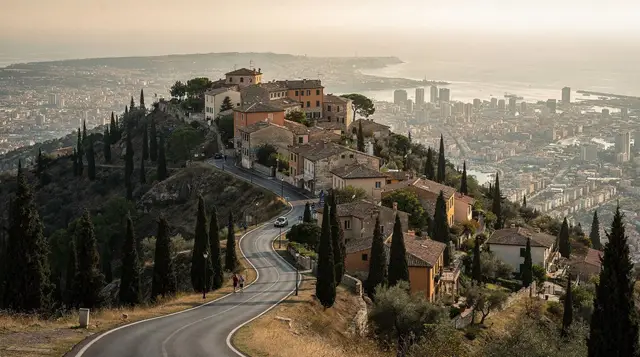
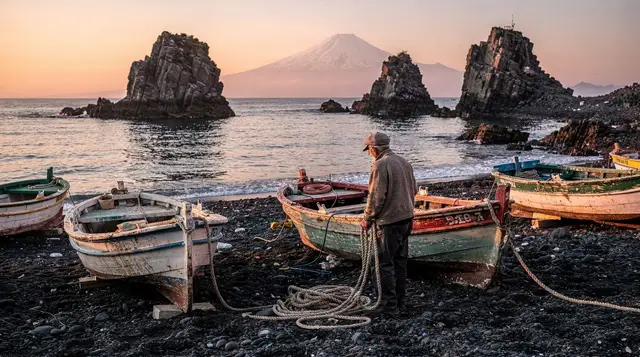
A port city that never bothered to charm you, and doesn’t need to
Most visitors meet Catania through its airport, Fontanarossa, and many never come back into the city at all — they collect a rental car and drive straight for Taormina or the Val di Noto. That is a mistake, or at least an incomplete plan. Catania is Sicily’s second-largest city, built almost entirely from black lava stone quarried from Etna’s own flanks, and the volcano is visible, weather permitting, from the top of via Etnea on most clear mornings. The center is grimier and less photogenic than Taormina or Ortigia — nobody is claiming otherwise — but it is a real working city, not a stage set, and that is exactly why the food is better and the prices are lower.
The historic core sits between the Duomo, via Etnea and the Pescheria fish market, and it is small enough to cover on foot in a long morning. What makes Catania worth a dedicated stop rather than a drive-through is the combination: baroque architecture rebuilt after the 1693 earthquake, a market culture that starts before 7am and is mostly finished by early afternoon, and the fact that it is the only city in Sicily where you can be standing in a cathedral square at 9am and hiking a lava trail on Etna by 11am, without a car.
Piazza Duomo, the elephant, and how the city rebuilt itself in stone
Piazza Duomo is the obvious starting point, centered on the Fontana dell’Elefante — a lava-stone elephant, probably ancient in origin and reworked over centuries, that has become Catania’s unofficial mascot. Locals call it “u Liotru.” Behind it stands the Cattedrale di Sant’Agata, dedicated to the city’s patron saint, whose February festival is one of the largest religious processions in Italy and genuinely disruptive to normal life in the center for several days — worth knowing if travel dates happen to overlap.
The Duomo and much of central Catania were rebuilt after the 1693 earthquake that flattened most of southeastern Sicily, in the same wave of reconstruction that produced the baroque towns of the Val di Noto. Catania’s version of that baroque is heavier and darker than Noto’s honey-colored stone, because the local building material is lava rock rather than limestone — hence the nickname “the black and white city,” referring to the volcanic stone facades trimmed with white limestone details.
A short guided walk through the center makes this legible in a way that wandering alone often does not, since the earthquake-rebuilding logic is not obvious from street level. A private walking tour with a local guide covers this ground in about two hours and is a reasonable way to orient yourself on a first morning before exploring independently.
Via Etnea, the main shopping street, runs from Piazza Duomo north toward Etna itself, and on a clear day the volcano frames the far end of the street — one of the more striking urban views in Sicily, free of charge, no ticket required.
La Pescheria: the fish market that defines the city
If Catania has one unmissable sight, it is La Pescheria, the fish market just behind Piazza Duomo. It runs roughly from dawn until early afternoon, Monday through Saturday, and it is loud, wet underfoot, and completely unstaged — this is where the city’s restaurants and households actually buy fish, not a tourist recreation of one. Swordfish, tuna, sea urchins and whatever came in that morning are laid out and shouted about in Catanese dialect that even Italian speakers from elsewhere in the country find hard to follow.
Go early, before 10am, both to see the market at its most active and because much of it packs up by early afternoon. A number of small trattorie sit right at the market’s edge and serve what was bought that morning; this is one of the few places in Sicily where “catch of the day” is not a marketing phrase.
For a structured introduction, a market tour that ends with lunch removes the guesswork of which stalls and counters are worth it. For something less formal, a street food tour through the center covers arancini, the local version of the rice ball snack argued over across Sicily, along with other stalls in the surrounding streets.
Note that the market is a working commercial space with narrow aisles and wet stone floors — not somewhere to bring a stroller comfortably, and pickpocket awareness is reasonable in the denser sections, as in any crowded market.
The theatre, the monastery, and what the earthquake spared
Not everything in Catania was rebuilt from nothing. The Roman amphitheatre near Piazza Stesicoro survives in fragmentary form, wedged into the modern street grid — a reminder that Catania’s history predates the 1693 disaster by well over a thousand years. The Benedictine Monastery of San Nicolò l’Arena, one of the largest in Europe, is a separate and less-visited stop that rewards the walk, particularly for the cloisters and the scale of the building, which is now partly used by the university.
Catania is a university city, and this matters for a visitor: it means the center has a genuine evening life that is not purely tourist-driven, more bars and lower prices for a casual dinner than in Taormina, and a livelier late-night scene, especially around via Montesano and the areas near the market. It also means some of the honest-answer travel advice applies: Catania has real urban character, including areas that feel unpolished after dark, and normal city awareness — well-lit streets, not flashing valuables — is the right level of caution rather than either paranoia or naivety.
Using Catania as an Etna base
For a visitor without a rental car, Catania is the single most practical launch point for Mount Etna. Organized excursions to the Rifugio Sapienza area on Etna’s south side depart from Catania daily, typically taking in the cable car and 4x4 jeep sections partway up the mountain, alongside a wine-tasting stop at one of the volcanic vineyards on the lower slopes.
None of these day trips promise the summit craters — access above roughly 2,900 meters is regulated by volcanic activity and requires a licensed alpine guide, and any operator implying otherwise is worth being skeptical of. For the fuller picture of how the mountain’s access actually works, see the dedicated Mount Etna guide and the comparison of Etna tours, plus the separate destination page for Etna itself.
Catania Fontanarossa airport (CTA) is a short taxi or bus ride from the center — see the dedicated Catania airport guide for transfer options and realistic timings. If picking up a rental car here, note that the historic center has ZTL (limited traffic zone) restrictions like most Sicilian cities; details on where those zones sit and how the automatic cameras work are in the ZTL and parking guide and the wider driving in Sicily guide.
Day trips within easy reach
Catania’s location makes it a workable base for more than Etna. The Aci Trezza and Acireale coastline, with its black volcanic sea stacks tied to the legend of the Cyclops, is a 20-30 minute drive or bus ride north — covered on the separate Acireale and Aci Trezza page.
A boat tour along that coast with swimming stops is a reasonable half-day addition if the weather is warm. Taormina is roughly an hour north by train or car (see the Taormina destination page), and Syracuse is under an hour south. For a fuller rundown of what fits into a single day from the city, see day trips from Catania.
Travelers building a longer trip around the region often combine Catania with Etna and the coast in a single loop — the Catania and Etna in 3 days itinerary and the broader eastern Sicily in 5 days itinerary both use Catania as the anchor point.
Eating in Catania beyond the market
Street food is a serious tradition here, not a novelty for visitors. Arancini (or arancine — the name itself splits along regional lines, and Catania has its own view) come pointed here rather than round, said to represent Etna’s cone. Pasta alla Norma — tomato, fried eggplant, ricotta salata and basil — was named for Catania’s own Vincenzo Bellini and his opera, and it is on nearly every menu in the center, with wildly varying quality; a dish that costs €8 in one place and €16 two streets over is not automatically worth double.
For context on arancini’s regional politics and other street food staples across the island, see arancini explained and the wider Pescheria market guide.
Granita with brioche col tuono for breakfast is a genuine local habit rather than a tourist ritual, though it’s more strongly associated with the coast further north; the granita and brioche guide explains the etiquette. Cannoli here are reliably good, but so is the case for restraint — the pastry guide flags which shops are worth a detour and which are coasting on foot traffic.
Where to stay: which part of the center actually suits you
Most first-time visitors default to somewhere near Piazza Duomo or via Etnea, and that’s a reasonable instinct — it puts the Pescheria, the cathedral and the main shopping street within a five-minute walk, and it’s the easiest area for arriving by taxi from the airport without navigating narrower side streets. The area around Piazza Bellini and the Teatro Massimo Bellini opera house is a quieter, slightly more residential alternative, still close enough to walk everywhere, with fewer late-night bars beneath the windows. Staying right at the market’s edge sounds appealing on paper but means genuinely early noise from around 5am, six days a week — worth knowing before booking a room that lists “Pescheria views” as a selling point.
Budget travelers sometimes look at accommodation near the train station instead, since prices run lower there than in the historic center; it’s a workable choice for a short stay focused on early departures, though the immediate station area is less atmospheric and slightly less safe late at night than the center proper.
Markets, shopping and everyday life beyond the sights
Via Etnea covers the conventional shopping — chain stores, a scattering of local boutiques, and the kind of Sicilian ceramics and ceramics-adjacent souvenirs sold across the island, some genuinely handmade in Caltagirone or Santo Stefano di Camastra, some mass-produced and imported regardless of what a shop sign claims. The covered arcades and smaller streets just off via Etnea hold more independent shops than the main strip itself, worth a slower wander for anyone shopping rather than sightseeing. For a broader view of what’s actually worth bringing home from Sicily, and what to be skeptical of, see what to bring back from Sicily.
Catania’s daily rhythms are worth knowing before arrival: most shops close for a few hours at midday, a habit that persists here more strongly than in some more tourist-adapted towns further along the coast, and Sunday sees much of the center’s non-restaurant commerce closed entirely. Coperto — a small per-person cover charge at sit-down restaurants, typically €1-3 — is standard and not a scam; it’s listed on the menu and covers bread and table service rather than being an unexplained add-on, a distinction covered more fully in eating in Sicily: hours, coperto and tipping.
Catania after dark
The university population gives Catania a genuine bar and aperitivo scene that runs later and feels less staged for tourists than Taormina’s evening offering, concentrated particularly around via Montesano, via Teatro Massimo and the streets just south of Piazza Duomo. Aperitivo culture here follows the standard Italian pattern — a drink bought in the early evening typically comes with a modest spread of snacks included in the price, making it a reasonable, inexpensive way to eat lightly before a later dinner. For a fuller picture of where this scene concentrates and how it compares to Palermo’s, see Catania nightlife: from the Pescheria to the Riviera.
When to come, and when to think twice
April through June and September through October give the most comfortable walking weather for a city with almost no shade in its main squares. July and August routinely push past 35°C, with spikes above 40°C inland, and via Etnea’s black lava paving holds heat aggressively into the evening. August also brings Ferragosto (15 August), when a portion of the city itself decamps to the coast and some family-run businesses close for a week or two — annoying if a specific trattoria was the whole point of the stop.
See Sicily in August for what actually stays open. Winter is mild and workable for the city itself, though Etna access changes seasonally — the Etna north versus south side guide covers how snow affects the mountain side of the trip.
Frequently asked questions about visiting Catania
Is Catania safe?
Yes, in the way any mid-sized Italian city is safe: normal precautions around bags and phones in crowded areas like the market and the train station, and reasonable caution in unlit side streets late at night. It is not notably more dangerous than Palermo or Naples, despite a reputation some travelers arrive expecting.
How many days do you actually need in Catania?
One full day covers the historic center and the Pescheria at a reasonable pace. Two to three days makes sense if using the city as a base for Etna, Aci Trezza or a Taormina day trip, since those excursions eat most of a day each.
Do you need a car in Catania itself?
No — the historic center is walkable and a car is a liability inside the ZTL. A car becomes useful only once heading out to Etna’s back roads, the Nebrodi, or towns without good train links.
Is the fish market worth it if you don’t plan to eat there?
Yes. It is worth visiting purely as a spectacle even without buying anything, though going hungry and picking a market-adjacent trattoria for lunch is the more satisfying version of the visit.
How far is Catania from Taormina and from Etna?
Taormina is about an hour by regional train or car. The Rifugio Sapienza area on Etna’s south side is roughly 1-1.5 hours by car or organized tour, depending on traffic through the foothill towns.
Is Catania airport a good place to start a Sicily trip?
Yes — Fontanarossa has more low-cost connections than Palermo for eastern Europe and northern Italy, and starting in Catania avoids the cross-island drive needed if arriving in Palermo but focusing a trip on the east coast.
Where should you stay in Catania if you don’t have a car?
Around Piazza Duomo or via Etnea, both within walking distance of the Pescheria, the cathedral and most restaurants, and both a short, flat walk from the main bus routes to the airport and to Etna day-tour pickup points.
Is Catania a good comparison point against Palermo for a first Sicily trip?
Both work as an entry point, but they suit different itineraries — Catania sits closer to Etna, Taormina and the east coast, while Palermo anchors the west and the Conca d’Oro. See Palermo or Catania for a direct comparison based on what the rest of a trip looks like.