Climbing Etna at dawn
Our guide, Salvo, met us in the Rifugio Sapienza car park at 4:15am with a headlamp already on and a tone that made clear we were behind schedule before we’d said a word. I’d booked this specifically to be above the tourist crowd, on the mountain before the cable car opened, and I got exactly that — along with a clearer sense than any guidebook gave me of how much this mountain answers to nobody’s itinerary but its own.
Before dawn: the cold nobody warns you about
Catania that afternoon had been close to 30°C. At the trailhead, at 1,900m, it was somewhere around 5°C with a wind that made it feel colder still, and I was glad I’d ignored the instinct to pack light for a Sicilian summer trip. A guided trekking tour beyond the tourist trails like the one I’d booked included a gear list beforehand — proper boots, a windproof layer, gloves — and every item on it turned out to matter within the first twenty minutes.
Walking by headlamp on loose volcanic ash is its own specific skill, one I didn’t have. Every step sank slightly and slid a little on the retreat, and the group’s pace was noticeably slower than I’d expected from the tour description. Salvo didn’t seem bothered by this; if anything, the slow pace felt deliberate, the kind of caution that comes from knowing exactly how the terrain behaves rather than optimism about how fast people can move on it in the dark.
The point where the sky actually changed
Somewhere around 2,600m, maybe forty minutes before actual sunrise, the eastern sky started shifting from black to a deep, specific blue that no photograph I’d seen had quite captured. The group stopped, not because Salvo called a break but because everyone independently slowed and turned east at roughly the same moment. Below us, the lights of Catania and the coastline were still fully lit, a whole sleeping city visible at once from a vantage point that felt entirely separate from it.
This was, without exaggeration, the single best moment of the whole trip so far — not the summit, not any specific landmark, just that particular transition of light with the volcano’s own shadow stretching impossibly long across the clouds below us to the west.
Why we didn’t go higher
I’d read, before booking, that guided routes sometimes reach 2,900-3,000m depending on conditions, and I’d quietly hoped for the upper end of that range. Salvo checked in with the park’s monitoring updates before we’d even left the car park, and partway up he told us, in the matter-of-fact tone of someone stating a fact rather than delivering disappointing news, that we’d be turning back a few hundred meters below where he’d hoped, due to gas activity in one of the summit craters that made the usual route inadvisable that morning.
Nobody in the group argued, and in retrospect I understand why the guides here treat this as completely routine rather than a failure of planning. Etna is a genuinely active volcano, not a scenic backdrop with a fixed viewing platform, and its rules change with the mountain’s own activity, not with anyone’s itinerary. Our Mount Etna guide and Etna eruptions, ash and safety both explain this more thoroughly than I appreciated before actually standing on the mountain and having a guide apply it to my own morning.
What we saw instead
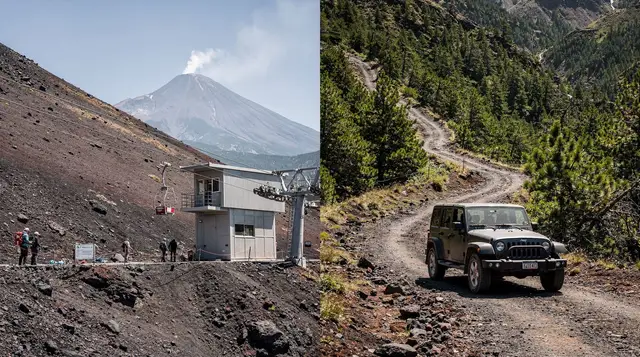
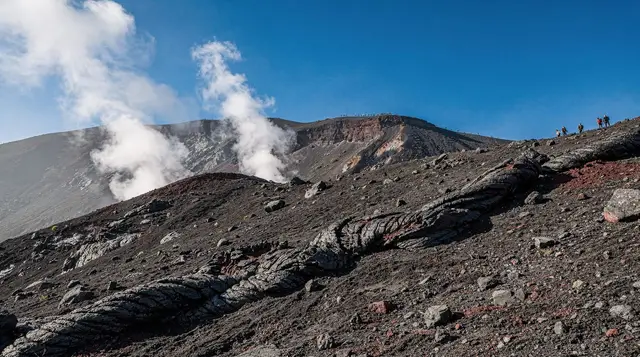
Turned back below the point Salvo had originally planned, we still reached ground genuinely striking in its own right — recent lava flows still visibly black and sharp-edged against older, more weathered rock, a scattering of small fumaroles venting thin steam from cracks in the ground, and views across to the north side’s forested slopes that most cable-car visitors on the south side never see at all. If you want the fuller comparison of what each side of the mountain offers, Etna north side or south side is worth reading before you pick a route.
The descent, and how different it felt
Coming down in full daylight after climbing up in darkness was almost like doing a different hike. Terrain that had felt uncertain and slippery underfoot by headlamp turned out, in daylight, to be entirely readable — you could see exactly where the loose ash gave way and where firmer ground held, information that would have made the ascent considerably less nerve-wracking if we’d had it from the start. I understood, walking back down, why guides insist on this specific pre-dawn timing rather than a simple daytime hike: the ascent in darkness is genuinely harder, but the payoff — that stretch of shifting sky over a sleeping coastline — doesn’t exist at any other hour.
What I’d tell someone booking this
Book the earliest departure your tour offers, not because early is inherently better but because it maximizes your buffer if the guide needs to adjust the route for conditions, which happens more often than marketing photos suggest. Pack for genuine cold regardless of the season — the 15-20°C temperature drop from the coast is real and constant.
And go in already accepting that the guide’s read of the mountain that specific morning, not your own hopes for how high you’ll get, is what determines the route. A guided trekking tour focused on the craters is a reasonable alternative booking if a pre-dawn start doesn’t suit your schedule, though I’d argue the dawn timing is worth the early alarm.
The one thing I’d do differently
I’d stop treating “reaching the summit” as the goal before I even left the car park. Nobody guiding this mountain can promise that outcome on any given morning, and holding onto it too tightly would have made a genuinely remarkable few hours feel like a letdown instead of what it actually was — a real, unpredictable encounter with an active volcano that doesn’t owe any of us a specific view.
Etna and volcano tours on GetYourGuide
Verified deep-linked GetYourGuide tours. Book through these links and we earn a small commission at no cost to you.
Photo: our own image of the location, not the operator’s product photo.