Mount Etna: the complete visitor guide
What is the best way to visit Mount Etna?
Most visitors reach around 2,900 m from Rifugio Sapienza on the south side by cable car and 4x4, with a guide for the final stretch. Access above that altitude depends on current volcanic activity and always requires a licensed guide.
An active volcano you can actually visit
Mount Etna is Europe’s tallest and most active volcano, and it sits close enough to the coast that you can have breakfast in Catania and be standing on cooled lava by mid-morning. That proximity is also the reason first-time visitors get confused: Etna is not a single fixed attraction with one entrance and one ticket price. It is a mountain roughly 3,350 m high (the exact summit elevation shifts a few metres with every significant eruption), managed as a protected park, with two separate visitor bases on opposite flanks and rules that change according to what the volcano is doing that week.
This guide covers what a realistic visit looks like, what you can and cannot promise yourself, and how the pieces — cable car, 4x4, guide, hiking boots — actually fit together. For a side-by-side comparison of tour operators, see Etna tours compared. If you are still deciding between the two access points, Etna north side or south side goes into more depth than the summary below.
The one rule that matters more than any itinerary
Etna is an active stratovolcano with frequent eruptive activity, and access to its upper slopes is regulated according to that activity, not according to a fixed schedule. The Parco dell’Etna and the guide cooperatives that manage the summit routes can and do close sections of the mountain with little notice — sometimes for a day, sometimes for weeks. Above roughly 2,900 m, a licensed volcano guide is legally required, and even guides cannot take you into the summit craters when conditions are unsafe.
What this means in practice: no operator, however good their marketing photos look, can guarantee you will stand at the true summit craters on a given date. What they can guarantee is a route to a safe, permitted altitude on the day you visit, which is sometimes the base of the summit cone at around 2,900-3,000 m, and on a good day with a guide, higher. Treat any listing that promises “the summit” with a fixed date and no conditional language as marketing, not fact. For the full picture on what changes with activity levels, read Etna eruptions, ash and safety.
Two mountains, really: south side and north side
Etna effectively has two front doors.
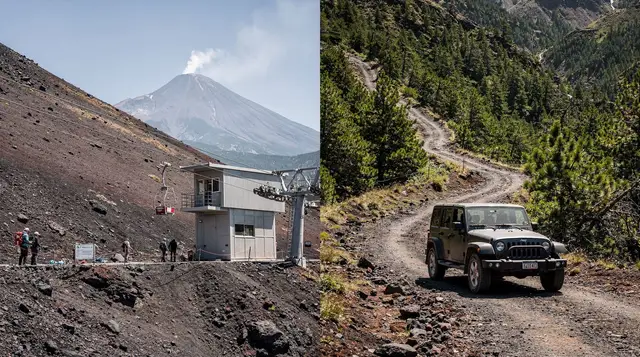
Rifugio Sapienza, on the south side, sits at about 1,900 m and is reachable in roughly 45 minutes to an hour by car from Catania, or about 1 hour to 1 hour 15 from Taormina. This is where the Funivia dell’Etna cable car operates, carrying visitors up to around 2,500 m, from where 4x4 vehicles and guided groups continue toward 2,900-3,000 m. It is the busier, more infrastructure-heavy side, with a car park, a row of restaurants and souvenir stalls, and the short, easy walk to the Silvestri craters — dormant cones from 19th-century eruptions that anyone can walk around without a guide or a ticket.
Piano Provenzana, on the north side near Linguaglossa, sits lower and feels considerably wilder: pine forest, fewer buildings, and a visitor base that was largely rebuilt after lava destroyed the original tourist village in the early 2000s. There is no cable car here — access to altitude is by 4x4 and on foot with a guide. It is a longer drive from Catania (around 1 hour 15 to 1 hour 30) but notably closer to Taormina, and it draws a fraction of the crowds of the south side.
Full comparison, including which one suits which kind of traveller, in Etna north side or south side.
What the cable car and the jeeps actually do
The Funivia dell’Etna is a genuine cable car, not a shuttle bus, and it only operates on the south side. It lifts visitors from the Rifugio Sapienza station to roughly 2,500 m in about 15 minutes. From there, altitude beyond the cable car’s upper station is covered by 4x4 vehicles staffed by the guide cooperative, followed by a guided walk of anywhere from 30 minutes to two hours depending on the package and on how far conditions allow the group to go that day.
Mount Etna: Return Funivia dell'Etna Cable Car Ticket is the standalone return ticket for travellers who want to move at their own pace and decide on the spot whether to add the jeep and guide segment at the upper station. Most travellers instead book a combined ticket that bundles cable car, jeep and guide into one price and one meeting time — see The Etna cable car and 4x4 jeeps explained for how those combined tickets are priced and what each stage covers.
On the north side, there is no cable car to compare against — the 4x4-plus-guide format is the only way up, which is one reason north-side tours tend to be marketed as more “authentic” and less rushed.
Walking to the summit craters: what is realistic
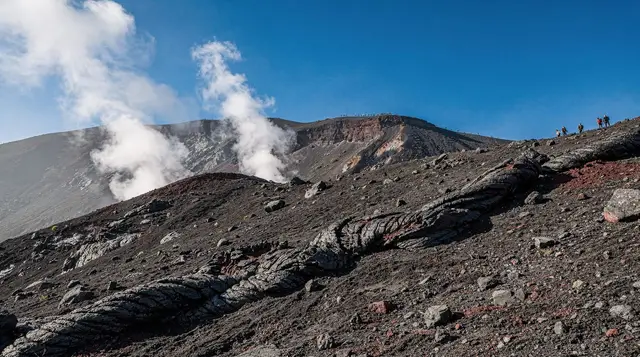
A genuine hike to the current summit craters is possible, but only as part of a guided group with a certified guide, subject to the activity restrictions above, and it is physically demanding: expect loose volcanic scree, thin air above 3,000 m, and several hours of walking round trip from wherever the 4x4 or cable car leaves you. It is not a casual add-on for anyone unused to mountain walking.
Catania: Etna Craters Hike Wine Tasting Tour is a middle-ground option that combines a guided crater hike with an Etna wine tasting afterwards, useful if you want the hike without turning the whole day into an expedition. For travellers who specifically want the highest permitted route and are prepared for a demanding day, the dedicated breakdown in Hiking to the Etna summit craters covers fitness expectations, gear and what “3,000 m” tickets really include.
Choosing a tour format
Etna tour listings multiply fast because operators repackage the same basic building blocks — cable car, jeep, guide, wine, sunset — into dozens of near-identical products. A few reference points:
- Catania: Mount Etna Sunset Jeep Tour times the ascent for late afternoon light and a cooler temperature window, useful in July and August when midday heat on the lower slopes is significant even before you reach the cold upper mountain.
- Etna: Family Tour Semi Private Tour on Etna Mt for Families is built around a gentler pace and smaller group size, covered in more depth in Visiting Etna with children.
- A north-side pickup tour covering Piano Provenzana with transport included is a reasonable option if you would rather not drive the mountain roads yourself; see Etna north side or south side for whether that side suits you.
- A quieter trekking option that moves away from the Rifugio Sapienza crowds onto less-walked paths suits travellers who have already done a standard cable car visit, or simply prefer emptier trails.
None of these formats is objectively “the best” — each solves a different problem, whether that is time pressure, a preference for cooler light, travelling with children, or wanting to avoid the busiest stretch of the mountain.
A full breakdown of price bands, group sizes and which operators overlap in what they actually deliver is in Etna tours compared. If you are weighing a guided tour against renting a car and doing the lower mountain independently, see Etna: guided tour or on your own.
What to wear and bring
The single most common mistake visitors make is dressing for Sicilian summer and nothing else. Above roughly 2,000 m, wind is near-constant and temperatures can run 15-20°C cooler than the coast, even in August. Bring:
- A proper windbreaker or light shell jacket — not just a T-shirt, whatever the forecast for Catania says.
- Closed, sturdy shoes with grip. Volcanic gravel and ash are loose and abrasive; sandals or thin trainers will not hold up, and most guided groups will turn away visitors in unsuitable footwear.
- Sunglasses and sun protection for exposed high-altitude sun, alongside the windbreaker for cold — both conditions happen on the same day.
- A refillable water bottle; there is very little shade or shelter once you are past the lower stations.
Getting there and combining Etna with a day out
Most visitors base themselves in Catania or Taormina and treat Etna as a half-day or full-day excursion rather than an overnight trip. From Catania, the south side entrance is a straightforward drive of under an hour; public transport options are limited, which is one reason organised tours with pickup are popular even among travellers who are comfortable renting a car elsewhere in Sicily. See Getting around Sicily and Renting a car in Sicily if you plan to self-drive, and Catania Fontanarossa airport if Etna is your first stop after landing.
Etna pairs naturally with a Baroque town or the coast for a fuller day. Travellers based in Catania often combine it with the city itself; see Day trips from Catania and Day trips from Taormina for combinations. Multi-day travellers building a full itinerary can look at Catania and Etna in 3 days or the broader Eastern Sicily in 5 days.
Beyond the volcano itself, the surrounding towns of Bronte and Randazzo sit within the Etna wine and pistachio belt, and are worth a stop if you are driving the mountain roads rather than joining a coach tour. Wine specifically is covered in The Etna wine road: Contrade and cantine.
Etna beyond the tourist route
Two things surprise first-time visitors who only expected “volcano tour” content. First, Etna DOC is a serious wine region in its own right, with a growing reputation among European wine writers — worth building into a visit even if you have no particular interest in volcanoes.
Second, Etna is not the only active volcano within reach of a Sicily trip: Stromboli and Vulcano, both in the Aeolian Islands, offer very different kinds of volcanic experience — Stromboli for its near-constant nighttime eruptions seen from a boat, Vulcano for its sulphurous mud baths and short crater walk. If Etna leaves you wanting more, the Aeolian Islands are the natural next stop, reachable from Milazzo or Catania; see Ferries and hydrofoils around Sicily for how to get there.
Best time of year to visit
Etna is a year-round destination, but the experience changes considerably with the season. Summer (June to August) offers the most reliable access and the longest daylight for a full itinerary, at the cost of the busiest trails and car parks, particularly on the south side from mid-morning onward. Spring and autumn tend to combine decent access conditions with noticeably thinner crowds, and are generally the most comfortable months for the demanding summit hike specifically, since neither the heat of the lower slopes nor the coldest mountain wind are at their extreme.
Winter brings snow to the upper mountain — genuinely striking, and popular with a smaller number of visitors specifically for that reason, including some winter-specific tours that adapt the route accordingly, but access can be more weather-dependent and some higher routes close more often. For the broader seasonal picture across Sicily, see The best time to visit Sicily and Sicily in August and Ferragosto, since Etna in peak summer intersects with the wider crowding and heat patterns that affect the whole island in that month.
What a day actually costs
Pricing on Etna scales with how much of the mountain you access and how it is arranged. A standalone cable car return ticket sits at the more affordable end. Adding the 4x4 jeep segment and mandatory guide for the continuation above the upper station costs meaningfully more, reflecting the vehicle and the legally required guide. Private tours, and anything bundling transport from Catania or Taormina, food, or wine tasting, cost more again once all of those pieces are priced in separately.
As a rough guide, budget for a self-drive visit with cable car and jeep to run into the low hundreds of euros per person, and a fully bundled private tour with transport, guide and food to cost more on top of that. Treat a listing that undercuts comparable options significantly as a sign that something is missing — a shorter route, a lower maximum altitude, or transport not actually included — rather than an unusually good deal on an identical product. For a fuller breakdown of how prices vary by tour format specifically, see Etna tours compared, and for what a week in Sicily costs more broadly, What a week in Sicily actually costs.
Common mistakes first-time visitors make
The single biggest mistake is dressing for the coast rather than the mountain — arriving in sandals and a T-shirt because it was 32°C in Catania that morning, then being cold, sore-footed and underdressed within twenty minutes of leaving the car park. The second is assuming a fixed summit altitude from a listing title, then feeling short-changed when the guide reasonably stops at a lower, currently permitted point — the honest answer is that nobody, including the operator, controls this in advance.
The third is underestimating drive time: Etna from Catania is genuinely under an hour by car, but combined with the cable car, jeep segment, guided walk and the return drive, a “half-day” Etna visit routinely fills five to six hours door to door, which catches out travellers trying to squeeze in a second major stop the same day. The fourth is skipping food and water, assuming the base stations will have more available than they do — Rifugio Sapienza has restaurants at the entrance, but very little once you are on the mountain itself.
Etna for repeat visitors
If you have already done the standard south-side cable car visit on a previous trip, Etna still has more to offer on a second stay. The north side at Piano Provenzana is different enough in character — wilder, quieter, and reached by a different drive — to feel like a genuinely separate excursion rather than a repeat of the same experience; see Etna north side or south side for the comparison.
Wine is the other underused angle: the contrade of the north and east slopes rarely feature on a first-time volcano-focused visit, and deserve a dedicated day of their own — see The Etna wine road: Contrade and cantine. Fit hikers who did the standard cable-car-and-jeep route the first time around might also consider the full guided summit crater trek on a return visit, covered in Hiking to the Etna summit craters, which reaches higher and covers more ground on foot than the standard format.
The honest bottom line
Etna delivers on its reputation: it is genuinely impressive, genuinely active, and genuinely unlike anywhere else in Sicily. The honest caveats are that you cannot lock in a summit visit months in advance regardless of what a listing promises, that the mountain is colder and windier than the coast suggests, and that a day trip built around Etna alone, without factoring in drive time and altitude acclimatisation, tends to run longer than visitors expect. Build in the buffer, dress for the wind rather than the season, and check current access conditions with your chosen operator before you commit to a specific route.
Etna and volcano tours on GetYourGuide
Verified deep-linked GetYourGuide tours. Book through these links and we earn a small commission at no cost to you.
Photo: our own image of the location, not the operator’s product photo.