Etna eruptions, ash and safety
Is it safe to visit Mount Etna during an eruption?
Generally yes for the standard visitor routes, since access to affected areas is closed by the park authority when activity increases. Etna's eruptions are mostly effusive lava flows or ash emissions rather than sudden explosive events, and access rules are designed around that pattern.
Etna is genuinely active, and that shapes every visit
Mount Etna is one of the most continuously active volcanoes in the world, and that is not a marketing line — it is the reason access rules, guide requirements and even airport schedules on this side of Sicily are all built around monitoring its behaviour in real time. This does not mean a visit is dangerous by default; it means the whole system of cable cars, jeep routes and guided hikes exists specifically to manage that activity safely. This guide explains what actually happens during different levels of activity, so you can plan sensibly rather than either ignoring the volcano’s nature or cancelling a trip unnecessarily. For the general visitor guide, see Mount Etna: the complete visitor guide.
What “eruption” usually means in practice
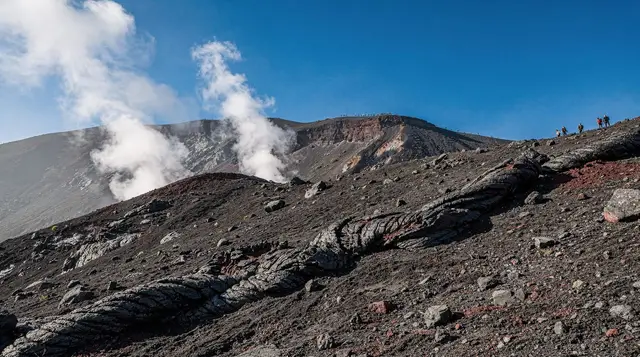
Etna’s activity spans a wide range, from near-constant minor gas and steam venting, to periodic lava fountaining episodes at the summit craters, to occasional larger effusive lava flows down the flanks. Genuinely explosive, sudden events are rare; most Etna activity develops over hours or days and is closely tracked by INGV, Italy’s national geophysics and volcanology institute, whose monitoring data feeds directly into decisions about which mountain sections stay open. This is a meaningfully different risk profile from an explosive stratovolcano with little warning — it is part of why guided access to Etna’s upper slopes remains possible as often as it does.
How access actually changes with activity
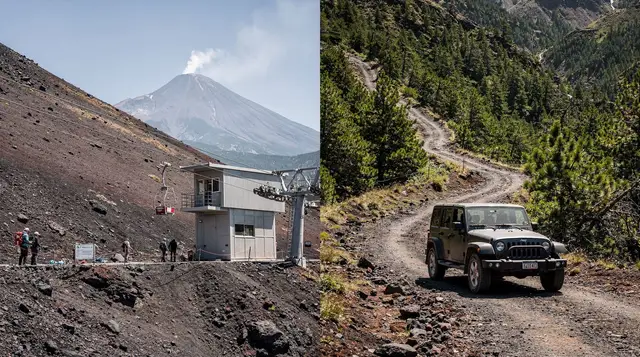
When activity increases, the park authority and the guide cooperatives that manage the upper routes close the affected sections — sometimes a specific trail, sometimes the entire summit-area segment above roughly 2,900 m — while lower routes, the cable car and the Silvestri craters typically remain open. This is why no tour operator can promise a fixed summit altitude months in advance: the specific route on your visit day depends on where things stand that week. See Hiking to the Etna summit craters and The Etna cable car and 4x4 jeeps explained for what the different stages involve when everything is running normally.
Reputable operators reroute to whatever altitude is currently permitted rather than pushing into a closed zone, and will rebook or refund if a tour cannot run safely at all that day. Catania: Mount Etna Adventurous Tour with a Volcano Guide and Etna: Summit Craters Trekking with Volcano Guide 3350mt both operate with certified guides who are the ones actually applying these restrictions on the ground, which is the practical reason a licensed guide is legally required above the regulated altitude in the first place — it is not a bureaucratic formality but the mechanism that keeps visitors out of genuinely unsafe zones.
Ash and the airport
The most likely way an ordinary visitor experiences Etna’s activity is not on the mountain itself but at Catania Fontanarossa airport, which sits directly downwind of the volcano on many days. Heavier ash emission episodes have closed the airport for several hours, and occasionally a full day, a handful of times most years — ash on runways and in the air is a genuine flight safety issue, not an overcautious measure.
If you are flying into or out of Catania during a period of heightened activity, build in some schedule flexibility and check your airline’s status directly; see Catania Fontanarossa airport for more on this specifically. Ash can also occasionally affect nearby towns with light dust fall, generally more of a cleanup nuisance for residents than a hazard for visitors passing through.
What reputable operators actually do
A well-run Etna tour operator will not oversell a guaranteed summit visit, will monitor conditions day to day rather than following a fixed script, and will substitute a lower or alternative route rather than proceed somewhere the guides know is currently restricted. Catania: Mt Etna Winter Edition Half Day Tour is one example of a route explicitly adapted to a specific season’s conditions rather than a generic year-round product — the kind of adaptation to look for more broadly when comparing operators. For a wider comparison of tour formats and how to judge quality, see Etna tours compared.
Signs an operator is cutting corners
Be cautious of listings that promise a specific summit altitude with no conditional language at all, guides who are not visibly certified or affiliated with the official guide cooperatives, or any operator willing to continue toward a route that other groups nearby are visibly avoiding. None of this is common — Etna’s guiding system is well established and generally professional — but it is worth knowing what a red flag looks like given how much of the value of a guided Etna tour rests on the guide’s judgement about where it is actually safe to go that day.
The wider picture: Etna is not unusual in Sicily for this
Sicily sits in a genuinely active volcanic and seismic zone more broadly — the Aeolian Islands include two more active volcanoes covered elsewhere on this site, Stromboli and Vulcano, each with its own access rules and safety considerations. None of this should be read as reason for undue alarm about a Sicily trip generally; see Is Sicily safe? An honest answer for the broader safety picture, of which volcanic activity is one specific, well-managed factor rather than a dominant concern.
How monitoring actually works
INGV (Istituto Nazionale di Geofisica e Vulcanologia) maintains a network of seismic sensors, gas monitoring stations, thermal cameras and satellite data covering Etna continuously, tracking changes in ground deformation, gas emission and seismic activity that typically precede a change in eruptive behaviour. This data feeds public bulletins and directly informs the park authority and guide cooperatives on what access is currently safe. It is worth knowing this system exists mainly so you understand that access decisions on Etna are not arbitrary or overly cautious guesswork — they are grounded in ongoing scientific monitoring specific to this volcano, updated far more frequently than a typical tourist would assume.
What to do if activity increases during your stay
If you are in the area when Etna’s activity visibly increases — audible explosions, visible ash plumes, or news of restricted access — the sensible response is straightforward: follow your tour operator’s guidance, avoid any restricted zones regardless of how tempting a closer view might seem, and check for updates on flight status if you are flying via Catania in the following days.
Nearby towns are very rarely evacuated as a direct result of typical Etna activity, and daily life in Catania, Taormina and the surrounding area continues largely unaffected even during a period of heightened summit activity. Treat local news and your accommodation host’s guidance as more useful in the moment than assumptions carried over from more explosive volcanoes elsewhere in the world, since Etna’s typical pattern of activity is genuinely different.
Etna’s activity compared with other volcanoes
Visitors sometimes arrive with expectations shaped by more explosive, less predictable volcanoes covered in international news, and it is worth resetting those expectations specifically for Etna. Its most common activity — strombolian-style small explosions, lava fountaining episodes, and effusive flows that move slowly enough to be tracked and avoided — develops far more gradually than the sudden, high-casualty eruptions that dominate global volcano coverage. This is not a claim that Etna carries zero risk, but a genuine difference in eruption style that is precisely why guided tourism on an active summit remains viable here in a way it would not on many other active volcanoes worldwide.
Insurance and practical considerations
Standard travel insurance policies generally do not treat a volcanic access restriction on Etna as grounds for a claim, since it typically results in a tour rebooking or refund from the operator rather than a cancelled trip. Where travel insurance becomes more relevant is flight disruption from ash-related airport closures at Catania — check whether your policy covers delay or rebooking costs in this specific scenario if you are relying on a tight connection through Fontanarossa. It is a minor consideration for most trips, but worth five minutes of attention if your itinerary has little slack built in around your Catania flights.
Where to check current conditions before you travel
For visitors wanting to check conditions ahead of a planned Etna visit, INGV publishes regular public bulletins on Etna’s status, and most reputable tour operators communicate proactively if a booked tour needs to change due to activity. Local news coverage in the Catania area is generally a faster and more specific source of day-to-day updates than international media, which tends to cover Etna only during unusually dramatic episodes rather than routine activity. If you have a specific concern about your travel dates, a direct message to your chosen tour operator in the days before your visit is usually the most practical way to get an accurate, current answer rather than relying on outdated online information.
Safety on the mountain beyond volcanic activity
It is worth separating volcanic risk from the more mundane safety considerations that apply to any mountain visit: uneven, loose terrain that causes twisted ankles more often than any volcanic hazard, sudden weather changes at altitude, sun exposure on exposed slopes, and cold exposure for underdressed visitors. In practice, these ordinary hazards are responsible for far more visitor injuries on Etna than volcanic activity itself, which is precisely why proper footwear and layered clothing, covered in Mount Etna: the complete visitor guide, matter as much as understanding the eruption-related access rules covered here.
How this affects trip planning beyond Etna itself
None of Etna’s activity should meaningfully change how you plan the rest of a Sicily trip. Catania, Taormina and the wider region function normally through the vast majority of Etna’s activity cycles, and the mountain’s eruptions rarely make national or international headlines precisely because they are so routine by the volcano’s own standards. The one practical planning adjustment worth making is building a little slack around any tight flight connections through Catania, particularly if your trip falls in a period when Etna has been more active than usual in recent local news — a rare precaution rather than a standard one.
What guides wish visitors understood
Ask any certified Etna guide what they wish first-time visitors understood better, and altitude restrictions come up more than almost anything else — specifically, those visitors who arrive having booked based on a listing title promising a specific summit number, only to be disappointed when the guide, following the day’s actual access rules, stops short of it. Guides consistently report that visitors who understand in advance that the final altitude depends on current conditions have a considerably better experience than those expecting a fixed outcome regardless of what the volcano is doing that week. This guide exists largely to pre-empt that exact mismatch between expectation and reality.
Etna’s activity and the towns that live alongside it
Unlike a volcano ringed by evacuated exclusion zones, Etna has towns and vineyards sitting on its lower slopes that have coexisted with its activity for centuries — Bronte, Randazzo, Nicolosi and others sit close enough to the summit that their history is directly shaped by past lava flows, yet they remain permanently inhabited, agricultural communities rather than at-risk settlements evacuated during every active phase.
This long coexistence is itself a useful signal about the nature of the risk: Etna’s activity, while genuine and worth respecting, has historically allowed dense human settlement on its flanks in a way that would be unthinkable near a more explosively dangerous volcano. Visiting the wine towns covered in The Etna wine road: Contrade and cantine means walking through communities that have made exactly this calculation for generations.
Sicily’s other active volcanic areas, briefly
Etna is the most visited but not the only active volcanic feature accessible from a Sicily trip. The Aeolian Islands hold two more: Stromboli, whose frequent small eruptions are viewed by design rather than avoided, and Vulcano, whose crater and fumaroles are dormant enough for a regulated walking visit but still monitored for gas activity.
Each has its own separate access rules and monitoring regime, distinct from Etna’s, covered in their respective guides. None of this should read as Sicily being an unusually hazardous destination — active volcanism is simply a well-managed, well-understood feature of this part of the Mediterranean, not a reason for particular alarm on an otherwise ordinary Sicily trip. See Is Sicily safe? An honest answer for how this fits the bigger safety picture.
Questions worth asking your tour operator directly
Before booking, especially if you are visiting during a period when Etna has featured in local news for increased activity, a few direct questions are more useful than relying on the listing text alone: what is the current maximum permitted altitude on this route, has the route changed in the past few weeks, what is the operator’s policy if the tour cannot run as planned on the day, and does the guide hold current certification with the relevant guide cooperative. A good operator will answer all of these plainly and without hesitation; vague or dismissive answers to direct safety questions are a reasonable reason to look elsewhere.
A reminder that Etna shapes more than the summit
Even visitors who never set foot above Rifugio Sapienza or Piano Provenzana encounter Etna’s influence throughout the region: the dark volcanic stone used in Catania’s Baroque buildings, covered in Catania in black and white: Vaccarini’s Baroque, comes directly from historic Etna lava flows, and the fertile volcanic soil across the surrounding countryside supports the wine and pistachio production covered elsewhere on this site. The volcano’s activity, in other words, is not just a hazard to be managed during a summit visit — it is the reason much of this corner of Sicily looks and tastes the way it does, worth keeping in mind as context rather than treating eruptions purely as a logistical inconvenience.
The bottom line
Etna’s activity is closely monitored, and the access system built around it — guide requirements, altitude restrictions, route closures — exists specifically to keep visitors on the right side of that activity, not to create bureaucratic friction.
Book with an operator who talks about conditions honestly rather than promising a fixed outcome, keep half an eye on ash-related flight disruption if you are flying via Catania during a period of higher activity, and treat any access restriction on the day of your visit as the system working as intended, not a failure of your trip. Go in informed rather than anxious: Etna’s activity is part of what makes the mountain worth visiting in the first place, and the whole apparatus of guides, monitoring and access rules exists to let you experience it without unreasonable risk.
Etna and volcano tours on GetYourGuide
Verified deep-linked GetYourGuide tours. Book through these links and we earn a small commission at no cost to you.
Photo: our own image of the location, not the operator’s product photo.