Morgantina and the Aidone museum
What is Morgantina, and why is it paired with the small town of Aidone?
Morgantina is the archaeological site of an ancient city in Sicily's interior, first inhabited by the native Sicel population and later heavily Hellenised, with well-preserved public buildings including an agora and theatre. Aidone, a few kilometres away, holds the museum where the site's finds are displayed, most famously a marble and limestone cult statue known as the Venus of Morgantina, returned to Sicily in 2011 after decades in a museum abroad.
The site most visitors to Sicily never hear about
Of everywhere on this list, Morgantina is the one most likely to be new even to visitors who have already done the Valley of the Temples and Segesta. It sits well inland, past Piazza Armerina, with no coastal drama and no single postcard monument to anchor a tour-bus stop — no complete Doric temple, no theatre framing a volcano. What it has instead is something rarer on this island: a genuinely legible ancient townscape, where you can walk from a public square into residential streets and see how an actual Sicilian community, built up over Sicel and then Greek phases, was laid out and lived in.
Sicels, then Greeks: a site built in layers
Before Greek colonisation reached the Sicilian interior, Morgantina was a Sicel settlement — the Sicels being one of several indigenous populations of the island, distinct from the Sicanians further west and the Elymians around Segesta and Erice. Over the following centuries the site became increasingly Hellenised, with Greek-style public buildings, an agora, and eventually a theatre built alongside or over the earlier Sicel town, without the population necessarily being displaced or replaced outright.
That layering — native Sicilian culture absorbing and adapting Greek forms over generations, rather than a clean conquest-and-replacement story — is part of what makes Morgantina archaeologically valuable, and it is a useful counterweight to the more common narrative of Greek colonists simply founding cities from nothing on empty ground.
What survives on site: agora, theatre, granary
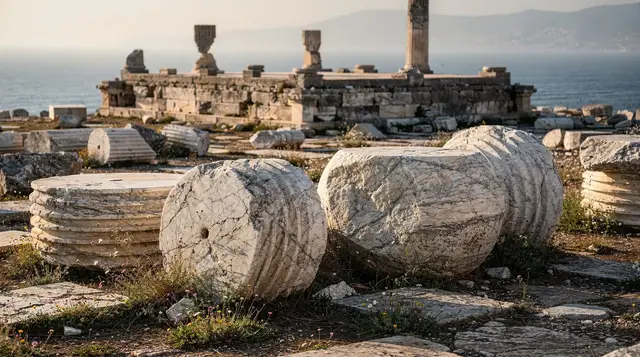
The excavated area preserves Morgantina’s agora, a stepped public square that also served as informal theatre seating before a dedicated theatre was built nearby, along with residential quarters where house foundations and street patterns are still traceable, and a large granary complex reflecting the site’s role in the agricultural economy of Sicily’s interior. None of it has the singular visual impact of a standing temple, but taken together it gives a clearer sense of ordinary ancient town life — streets, storage, civic space — than the monument-focused sites along the coast, which tend to preserve religious and ceremonial buildings far better than domestic ones.
A guided tour of the Greek city of Morgantina is worth having here specifically because the site’s value is in its layout and its Sicel-Greek layering, neither of which is self-explanatory from information boards alone.
The Venus of Morgantina: looted, sold, and eventually returned
The site’s most famous individual object never left in one piece, or rather, it left illegally and came back decades later. The Venus of Morgantina is a large cult statue, likely depicting Aphrodite or a closely related goddess, made of marble for the head and limbs and limestone for the draped body, dating to around the fifth century BC. It was looted from the Morgantina site, almost certainly in the 1970s, and passed through the illicit antiquities trade before being acquired by the J. Paul Getty Museum in Los Angeles in the 1980s for a substantial sum.
Following years of investigation into the statue’s origins — including scientific analysis of the limestone that helped tie it back to Sicily, and mounting evidence about its illegal excavation and export — the Getty agreed in 2010 to return the statue to Sicily, and it went on permanent display at the Museo Archeologico di Aidone in 2011. It is now the centrepiece of the museum’s collection, alongside another notable repatriation: a set of 16 silver ritual vessels, the so-called Morgantina silver, also looted from the site and returned by the Metropolitan Museum of Art in New York.
The Aidone museum: small, but genuinely worth the stop
Aidone itself is a modest hill town, and its Museo Archeologico is correspondingly compact, but it holds material found nowhere else — the Venus, the Morgantina silver, and a broader collection of finds from the Sicel and Greek phases of the site that give context the ruins alone cannot. Given how much of Morgantina’s actual portable heritage was removed and then fought over for decades, seeing it back in a museum a few kilometres from where it was found carries a certain weight that a purely archaeological site visit does not.
Planning the visit: timing and getting there
Budget roughly 60 to 90 minutes at the Morgantina site itself and another 45 minutes to an hour at the Aidone museum, plus a short drive between the two. By car, Morgantina and Aidone sit around 30 to 40 minutes from Piazza Armerina and the Villa Romana del Casale, making a combined day realistic without excessive driving. A combined tour covering the Roman villa and the Aidone museum handles the logistics of both stops in one booking.
The interior of Sicily has thin public transport, so a car is close to essential here — see getting around Sicily and renting a car in Sicily. There is little shade at the site itself, so the usual rule applies: bring water and avoid the middle of a summer day if possible, though Morgantina’s relative lack of crowds makes timing slightly less critical here than at more visited sites.
Combining it with Villa Romana del Casale and the wider interior
Most visitors reach Morgantina as an extension of a day built around Villa Romana del Casale, since both sit in the same inland area and neither alone fills a full day. A tour of the UNESCO-listed Roman villa combined with an afternoon at Morgantina and Aidone makes reasonable use of a day that would otherwise involve a long drive into the interior for a single, shorter stop. Enna and Caltagirone are both within reach of the same general area if you want to extend further into Sicily’s interior.
A tour from Syracuse covering Villa Romana del Casale and the interior is a practical option if you are based on the east coast rather than driving in from Agrigento or Palermo.
Fitting it into a longer trip
Morgantina and Aidone work best folded into Baroque towns and Greek temples in 5 days or a longer Sicily in 7 days itinerary that already includes an interior day for Villa Romana del Casale — treat it as an addition to that day rather than a separate standalone trip, since the driving distance from the coast on its own is hard to justify for Morgantina alone, however worthwhile it is once you are already in the area.
Two hills, one city: Cittadella and Serra Orlando
Morgantina’s occupied area actually spans two adjoining hills across different periods of its history: an earlier phase on the hill known as Cittadella, associated with the pre-Greek Sicel settlement and the site’s earliest occupation, and a later, more extensively excavated phase on the neighbouring Serra Orlando ridge, where the agora, theatre and most of the Hellenistic-period public buildings visible today were built as the city’s centre shifted and expanded under increasing Greek influence. Walking between the two gives a physical sense of how the settlement itself moved and grew over centuries rather than simply been built once and left unchanged, which is a useful corrective to how static most ruined sites can otherwise feel.
The city also had its own mint, producing distinctive silver and bronze coinage during its Hellenistic-period prosperity in the fourth and third centuries BC — a detail that confirms Morgantina functioned as a genuinely significant, economically independent city in its own right during this period, not merely a minor inland settlement overshadowed by the coastal Greek colonies. Some of this coinage, along with other small finds from daily life at the site, is displayed alongside the Venus and the Morgantina silver at the Aidone museum.
Practical logistics and the town of Aidone
Aidone itself is a small hill town with limited tourist infrastructure compared to somewhere like Piazza Armerina, so plan food and any longer stops around Piazza Armerina rather than assuming Aidone will have a wide range of options — a quick coffee or light lunch is realistic, a full restaurant scene is not.
Parking at both the Morgantina site and near the Aidone museum is generally straightforward and free or low-cost, in contrast to the more heavily managed paid parking at higher-traffic sites like Agrigento or Taormina. Opening hours at both the site and the museum can vary by season, with reduced hours common outside the summer months, so check current times before building a tight schedule around a same-day combination with Villa Romana del Casale.
Why a Sicel city built like a Greek one
Morgantina’s transformation from a Sicel settlement into an increasingly Hellenised city was not a story of conquest or replacement so much as gradual cultural adoption, likely driven by trade, intermarriage and the practical advantages of adopting the dominant regional culture’s architectural and civic forms as Greek influence spread across the island’s interior through the fifth and fourth centuries BC.
This pattern — a native population absorbing Greek civic architecture, religious practice and eventually language while remaining, in some sense, distinct from the coastal Greek colonies themselves — mirrors what happened at Elymian Segesta on the opposite side of the island, and the comparison is worth holding in mind if you are visiting both: two very different native populations arrived at broadly similar architectural solutions once exposed to the same wider Greek cultural pressure.
Best season for visiting the interior
Sicily’s interior, including Morgantina, Aidone and the wider Enna area, runs noticeably cooler than the coast in winter and can be genuinely cold and occasionally foggy in the depths of the season, while summer heat inland can be more intense and less tempered by sea breeze than coastal sites experience. Spring and early autumn are generally the most comfortable windows for a site with as little shade and as much open walking as Morgantina involves, mirroring the advice for most archaeological sites on this list, though the interior’s slightly more extreme temperature swings compared to the coast are worth factoring in separately when planning what to wear and how much water to bring.
The residential quarters and daily life at Morgantina
Beyond the agora and theatre, Morgantina’s excavated residential blocks give an unusually clear picture of ordinary domestic life in a Hellenistic Sicilian town, with house foundations showing courtyard layouts, storage areas and, in some cases, surviving floor mosaics of a much simpler, geometric character than the elaborate figural scenes at Villa Romana del Casale, reflecting the more modest means of Morgantina’s private citizens compared to the villa’s later, exceptionally wealthy owner.
This domestic detail is part of what distinguishes Morgantina from the more purely religious and civic focus of sites like Segesta or Selinunte, where residential quarters, while present, are considerably less extensively excavated and displayed for visitors.
Combining with Enna and the wider interior
Beyond Piazza Armerina, the town of Enna, perched at one of the highest points in Sicily’s interior and traditionally associated with the myth of Persephone’s abduction discussed in the wider context of Greek Sicily explained, sits within a further 30 to 40 minutes of Morgantina and Aidone, and its hilltop Lombardia Castle offers panoramic views across a large stretch of the island’s interior.
For visitors with a full day and a specific interest in Sicily’s less-visited interior region, combining Enna with Morgantina and Aidone builds a fuller picture of this part of the island than either site alone, though it does add meaningfully to total driving time and is best treated as a separate day from the Villa Romana del Casale combination rather than folded into the same one.
Why the Sicilian interior is worth the extra driving
Morgantina sits within a part of Sicily that receives a fraction of the visitor numbers drawn to the coastal sites and towns, despite holding archaeology, landscape and a slower pace of travel that many visitors specifically say they wish they had built more time for once they have already committed most of a trip to the coast.
The interior’s relative lack of crowds is not a sign of lesser significance, as the Venus of Morgantina’s international fame and the sheer scale of the Sicel-to-Greek settlement at Morgantina itself demonstrate; it mainly reflects thinner transport links and less marketing relative to headline coastal destinations like Taormina or Agrigento’s coastline. For visitors willing to build in the extra driving time, the interior — Morgantina, Aidone, Piazza Armerina, Enna and Caltagirone together — offers a genuinely different, quieter version of ancient and rural Sicily than the coastal itinerary most first-time visitors default to.
A site best understood slowly
Morgantina lacks a single dramatic monument to anchor a quick visit around, and visitors expecting a Segesta-style highlight often leave underwhelmed if they rush through in under an hour. Its value is cumulative — the agora, the theatre, the residential blocks and the Aidone museum together build a picture that no single stop provides on its own, which makes it a poor candidate for a rushed add-on and a genuinely rewarding one for anyone willing to slow down and treat the whole area, site and museum together, as a single unhurried half-day rather than a box to tick on the way to somewhere else.
Who Morgantina tends to suit best
Visitors drawn to Segesta or Selinunte specifically for their scale and drama may find Morgantina quieter than expected; visitors who came away from Villa Romana del Casale wanting more of the human, domestic side of ancient Sicily, or who were struck by the Venus of Morgantina’s own repatriation story before ever reaching Aidone, tend to be the ones who rate Morgantina most highly among the sites covered on this list.
Fuel and facilities before you go
Aidone and the Morgantina site itself have minimal fuel, food and restroom facilities compared to larger towns, so plan to fill up on fuel and eat properly in Piazza Armerina either before heading further into the interior or after returning from it, rather than assuming these will be readily available at either stop.
A final note on expectations
Come without expecting a single dramatic ruin and Morgantina delivers more than most visitors anticipate; come expecting a compact highlight comparable to a Doric temple ridge and it can feel underwhelming on first impression, right up until the Aidone museum’s Venus makes the whole detour worthwhile in a single room.
What to actually plan for
Do not skip Aidone assuming the site itself is the whole story — the Venus and the Morgantina silver, both restored to Sicily after decades of legal wrangling, are a significant part of why this place matters, and neither is visible at the archaeological site itself. Do not expect facilities or much shade at Morgantina; treat it as a rural site with minimal infrastructure. And do not plan Morgantina as a standalone day trip from the coast — its real value comes from being folded into a day that already includes Villa Romana del Casale or the wider interior, not as a long solo detour of its own.
Greek and Roman site tours on GetYourGuide
Verified deep-linked GetYourGuide tours. Book through these links and we earn a small commission at no cost to you.
Photo: our own image of the location, not the operator’s product photo.