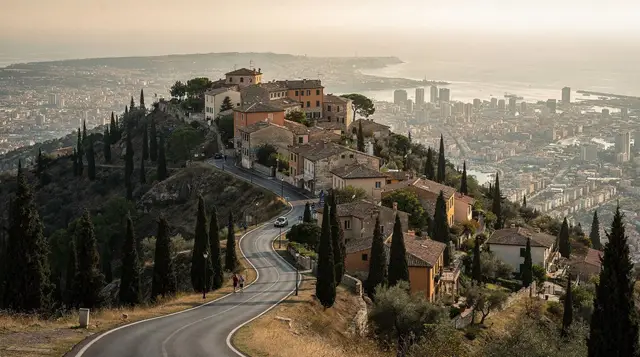
A village that sits above the weather
Erice does not look like the rest of west Sicily, and that is because it is not really part of the same climate. Perched at 750 metres on a triangular peak above Trapani, the town catches cloud and fog that never reach the coast below, sometimes for hours at a stretch even on days when the salt pans are baking in full sun. Locals treat this as normal; first-time visitors who arrive expecting the panoramic views from every postcard sometimes find themselves walking cobbled streets inside a wet grey cloud instead, unable to see ten metres past the nearest wall.
This is worth knowing before you go, not to discourage the trip but to set the right day for it. Check the forecast for Erice specifically, not for Trapani — a clear morning down at sea level says nothing about conditions on the hilltop. When the fog does lift, or on a genuinely clear day, the views stretch from the Trapani salt pans to the Egadi Islands and, on the best days, as far as Tunisia’s coast on the horizon.
The fog itself is not simply an inconvenience to work around; it is part of why Erice looks the way it does. Centuries of visitors have described the same cloud rolling in over the same grey stone streets, and the town’s aesthetic — muted colours, damp cobbles, an almost monastic quiet in the early morning — is inseparable from the weather that produces it. Photographers who time a visit for the moment cloud breaks apart over the rooftops, rather than avoiding fog altogether, often come away with the more distinctive images of the trip.
Getting up, and getting around once there
The funivia (cable car) from Trapani’s Via Capua station is the easiest and quickest way up: a few minutes of ascent replaces what would otherwise be a switchback drive of thirty to forty minutes. It runs year-round but closes in high wind, a real limitation on an exposed mountaintop rather than a rare exception, so check operating status before committing a whole morning to the trip. Driving up is the fallback — the road is well maintained but narrow with tight turns, and parking inside the walled town itself is limited, so most visitors leave the car at a lot near the gates and walk in.
Once inside, Erice is entirely a walking town. The medieval street plan is a maze of grey stone paving and stepped alleys, deliberately irregular by design — historically believed to confuse and disorient invaders, and it still manages to disorient a modern visitor without a map. It is small enough that getting mildly lost costs a few extra minutes, not an afternoon.
A Vespa tour through Erice’s medieval streets is a more novel way to cover the layout for visitors who want a guided introduction with a bit of theatre, though on foot remains the more practical choice for most of the town’s narrowest lanes.
The castle and the site’s older history
Erice’s hilltop position made it a fortress and sanctuary long before the medieval town took shape. The Normans built the Castello di Venere on the site of a much older sanctuary dedicated to Venus Erycina, a fertility cult with roots going back to the Elymians and Phoenicians who first settled the peak — the temple itself is gone, but the castle that replaced it, and the views it commands over the coast and the Egadi Islands, are reason enough to make the walk to the eastern edge of town.
The Chiesa Madre (Erice’s main church), with its detached bell tower, and the Giardino del Balio gardens near the castle round out the core sights, all within a compact enough footprint that a first visit covers them in two to three hours without rushing. For the deeper archaeological context of the peoples who occupied this coast before the Greeks and Romans, Mozia, Motya and Phoenician Sicily and Greek Sicily explained fill in what a single hilltop visit cannot.
Maria Grammatico and Erice’s pastry tradition
Erice’s food reputation rests almost entirely on one thing: almond pastry, and specifically the legacy of Maria Grammatico, who trained as a girl in a convent kitchen and later opened her own pasticceria using recipes the nuns had guarded for generations. Her book and her shop turned Erice into a genuine pilgrimage site for anyone serious about Sicilian sweets — marzipan fruit, almond biscuits, and pastries built on the same almond-and-sugar base that runs through Sicilian confectionery generally, but executed with a precision that the town has built its identity around.
A private tour of Erice that includes a stop at the Maria Grammatico pasticceria is the most efficient way to combine the walking tour with the pastry pilgrimage in one booking, useful if your time on the hilltop is limited to a half-day. For an evening version, a night tour of Erice with pastry tasting shows the town after the day-trip crowds have gone back down the funivia, when the narrow streets and lit stonework read very differently.
The broader pattern behind Erice’s pastry reputation — convent kitchens as the origin point for Sicily’s most refined sweets — repeats across the island, from the marzipan fruit associated with Palermo’s nuns to the almond pastes underlying much of Sicilian confectionery generally. What sets Erice apart is less the technique itself than the fact that a single named baker made the convent tradition public and documented it, rather than letting it stay behind closed doors as it did in most other towns. Cannoli, cassata and Sicilian pastry covers the wider landscape of what Sicily’s pastry tradition actually includes beyond Erice’s almond-based specialities.
Fog, cold, and what to actually pack
Because Erice sits so much higher than the coast, the temperature difference is real and often underestimated. Even in summer, evenings can be noticeably cooler than Trapani below, and a light jacket that seems unnecessary at sea level earns its place in a bag heading up the funivia. In shoulder season and winter, fog and wind can make a visit genuinely uncomfortable without proper layers — this is not a town where a light dress and sandals cover every scenario, unlike most of coastal west Sicily.
An e-bike tour from Trapani up into the village of Erice is worth considering for visitors who want the physical challenge of the climb without committing to it on a standard bicycle, though it is a serious undertaking regardless of assistance and not a casual afternoon option.
The origin of Venus Erycina and why the site mattered
Long before the Normans built anything, the peak that Erice now occupies was known across the ancient Mediterranean for the sanctuary of Venus Erycina — a fertility and love cult so significant that Roman writers recorded Roman senators making pilgrimages here, and both Carthaginian and Roman authorities took direct interest in maintaining the temple regardless of who currently controlled the surrounding territory. The cult likely predates the Elymians who are usually credited with founding the settlement, drawing on even older Sicilian and Phoenician fertility worship, later syncretised with the Greek Aphrodite and then the Roman Venus as successive powers passed through.
Almost nothing of the physical temple survives above ground today — the Norman castle was built directly on and from its remains, a common pattern across Sicily, where later structures absorbed earlier ones rather than existing alongside them. What is left is largely inference: written accounts, scattered stonework reused in later walls, and the position itself, chosen for the same reasons that make it a viewpoint today. For visitors interested in piecing together this layered history across the island more broadly, Greek Sicily explained: who built what, and when is a useful companion, since Erice’s story does not fit neatly into a single ancient civilisation the way some other Sicilian sites do.
Erice’s other churches and quieter corners
Beyond the Chiesa Madre, Erice holds a genuinely high concentration of churches for its small size — a legacy of a period when the town supported multiple religious orders simultaneously, each maintaining its own chapel within a walking radius of a few hundred metres. Many are no longer in regular use and some open only intermittently, which rewards visitors who wander rather than follow a fixed route; a half-open door on a quiet side street is as likely to reveal something worth seeing as a marked attraction on a map.
The town’s three historic quarters — San Giuliano, San Rocco and the area around the Chiesa Madre — each have a slightly different character, from residential and quiet to more geared toward the day-trip shops selling ceramics and local sweets. Walking a loop through all three, rather than making a beeline for the castle and back, is the difference between an hour in Erice and an afternoon that actually earns the climb.
How Erice compares with Sicily’s other hilltop towns
Sicily has no shortage of towns built defensively on high ground, but few combine Erice’s specific mix of altitude, medieval preservation and coastal panorama in one place. Piazza Armerina and Enna sit higher into the island’s interior, with views over agricultural hill country rather than the sea; Ragusa and the Val di Noto Baroque towns further southeast are built on similarly dramatic terrain but in a wholly different architectural language, rebuilt after the 1693 earthquake in ornate late-Baroque stone rather than preserving a medieval street plan.
Erice’s closest cousin in feel is arguably its own neighbour on the map rather than a distant comparison — the general pattern of a fortified summit town looking down over a working coastal city is echoed, on a larger scale, by Taormina above the Ionian coast far to the east, though Taormina’s Greek theatre and considerably larger tourism infrastructure make for a busier, more built-up experience than Erice’s quieter lanes.
For visitors trying to decide how much of this “hilltop town” experience to build into a Sicily itinerary, doing Erice on the west coast and one Val di Noto town in the southeast covers meaningfully different versions of the same idea without repeating either.
Erice as part of a wider day
Erice pairs naturally with Segesta and Trapani itself in a single day, since all three sit within a compact triangle in the province’s northwest corner — a temple and theatre in the morning, the hilltop village at midday or for a late lunch, and Trapani’s old town or salt pans to close the day. It is a common combination on guided day trips from Palermo as well, given the driving distance is comparable to several other single-day excursions from the capital.
For itinerary planning, Western Sicily in 5 days treats Erice as a half-day stop attached to Trapani, and The best time to visit Sicily is worth reading before fixing dates, since Erice’s weather sensitivity makes shoulder-season timing more consequential here than in most of the region.
Where the visit can disappoint
The most common disappointment is entirely about weather, not about the town itself: arriving on a foggy day and getting none of the panoramic payoff that draws people up the mountain in the first place. There is no way to guarantee clear conditions, but checking Erice’s specific forecast the morning of a planned visit, rather than trusting a sunny reading from Trapani or Palermo, at least avoids an avoidable disappointment.
The other predictable letdown is treating Erice as a five-minute photo stop rather than a place to actually walk. The funivia makes it tempting to pop up, take a picture from the first viewpoint, and head back down within the hour — but the castle, the gardens, and the pastry shops sit a genuine ten-to-fifteen-minute walk further in, and skipping that leaves most of what makes the town worthwhile unseen.
Frequently asked questions about Erice
How long does the funivia take?
A few minutes each way, covering the roughly 750-metre climb from Trapani. It is by far the fastest option compared with driving the switchback road, when it is running.
What happens if the funivia is closed?
Driving is the practical fallback, on a well-maintained but narrow road with tight turns; parking is limited near the gates, so plan on walking the last stretch into town regardless of how you arrive.
Is Erice worth visiting if the forecast shows fog?
It depends what you are going for. The medieval streets, the castle grounds, and Maria Grammatico’s pastries are still there in fog — only the long-distance views disappear. If the panorama is the main draw, wait for a clearer day if your schedule allows it.
Can Erice be combined with Segesta in one day?
Yes. Both sit close to Trapani, and a morning at Segesta followed by an afternoon in Erice is a standard, comfortably paced day for visitors based in or near Trapani.
Is there anywhere to stay overnight in Erice itself?
Yes, a handful of small hotels and guesthouses operate within the walled town, and staying a night is a genuine way to see Erice once the day-trip funivia traffic empties out in the evening — a noticeably different experience from a rushed half-day visit, with the narrow streets quiet and the temperature dropping further than most visitors expect.
Are Maria Grammatico’s pastries sold anywhere else, or only in Erice?
Some products travel and are stocked in a limited number of outlets elsewhere in Sicily, but the original pasticceria in Erice remains the point of reference, both for the range on offer and for the shop’s own history, which is as much a part of the visit as the pastries themselves.
How much walking is actually involved in a visit to Erice?
More than the compact map suggests, since the town’s charm is in its stepped, irregular streets rather than a single flat route between sights. Comfortable, grippy footwear matters — the stone paving is smooth and can be slick in fog or after rain, a genuine consideration given how often the town sits inside cloud cover.