Selinunte: Europe's largest archaeological park
Why are Selinunte's temples known only by letters, and how big is the site?
Excavators in the 19th century could not confirm which deity most of the temples were originally dedicated to, so they labelled them Temple A through Temple O in the order they were catalogued, and the names stuck. The park spans roughly 270 hectares across two temple areas and a fortified acropolis, making it the largest archaeological park in Europe by area — plan half a day, and use the internal shuttle rather than walking the whole site.
A city, not a monument
Selinunte, ancient Selinus, was founded around 628 BC by Greek colonists from Megara Hyblaea, on Sicily’s east coast near modern Syracuse, and grew into one of the wealthiest and most architecturally ambitious cities in the Greek west before Carthage destroyed it in 409 BC.
What survives is not a single monument but an entire ancient city footprint: two separate temple groups, a fortified acropolis with its own residential quarter, city walls, a sanctuary to Demeter Malophoros outside the walls at Gaggera, and the remains of the harbour installations below. At roughly 270 hectares, it is the largest archaeological park in Europe by area, and that scale is the first thing to plan around — this is not a site you casually walk end to end without a plan.
Why the temples are just letters
Unlike Agrigento’s Temple of Concordia, which kept a name (however inaccurate) through continuous use as a church, none of Selinunte’s temples had a securely attested ancient dedication by the time serious excavation began in the 19th century. Rather than assign disputed names, archaeologists labelled them alphabetically — A, B, C, D, E, F, G, O — roughly by excavation sequence and location within the eastern group and the acropolis.
A few have since gained tentative scholarly attributions (Temple E is usually linked to Hera, Temple C possibly to Apollo), but the letters remain the working names everyone uses on site and in the literature. It is worth knowing this before you arrive so the labelling does not read as an accident or an oversight — it is the deliberate, honest result of genuinely not knowing.
The eastern temple group: C, D, E, F and G
The eastern hill holds five temples, the most striking of which is Temple E, partially re-erected in the 1950s and 1960s and now the most photogenic complete structure at Selinunte, its Doric columns standing in a clear row against open sky and, on a clear day, the sea beyond. Temple G, close by, tells the opposite story: intended to be one of the largest Doric temples ever attempted anywhere in the Greek world, on a scale comparable to the unfinished Temple of Olympian Zeus at Agrigento, it was left incomplete and later toppled, almost certainly by an earthquake.
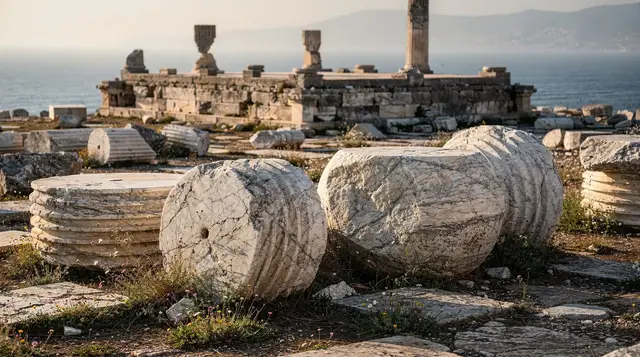
What is left is an extraordinary field of massive fallen column drums, some of the largest cut stone blocks from the ancient Mediterranean, lying scattered largely where they fell over two millennia ago. Walking through this field, rather than looking at a standing structure, is one of the most physically striking things to see at any ancient site in Sicily — the sheer size of the individual blocks is hard to register until you are standing next to one.
The acropolis: temples A, B, C, D and O, and a fortified city
A separate hill, closer to the sea and the ancient harbour, held the acropolis proper — the fortified core of the city, including more temples (A, B, C, D and O), city walls with gates still traceable, and residential quarters where ordinary Selinuntines lived rather than just the ceremonial buildings. This is the part of the site that best conveys Selinunte as a functioning ancient city rather than a temple row, and it is also where the fortification walls, rebuilt and reinforced multiple times as the city faced growing Carthaginian pressure through the fifth century BC, are most visible.
The sanctuary at Gaggera: Demeter Malophoros
Outside the main city walls, a short distance to the west, the sanctuary of Demeter Malophoros (“bearer of fruit” or “bearer of sheep,” the exact meaning is debated) was a major cult site with its own sacred precinct, separate from the temple groups inside the city. It sees far fewer visitors than the eastern group or acropolis and is a genuinely quiet corner of the park if you want a break from the more visited areas — worth the walk if you have the extra half hour.
Carthage and the end of Selinus
Selinunte’s location put it on the frontier between Greek and Carthaginian Sicily, and it paid for that position: in 409 BC, during renewed conflict between Carthage and the Sicilian Greeks, Carthaginian forces besieged and sacked the city, and ancient accounts describe massacres and enslavement on a large scale. The city was resettled afterward on a reduced footprint under Carthaginian oversight, but it never recovered its earlier wealth or building ambition, and by the Roman period it had faded into relative obscurity — which, as with several sites on this list, is part of why so much survived without later construction overwriting it.
For the wider context of how Carthage, Greece and the native Elymian and Sicanian populations divided the island, see Greek Sicily explained and Mozia and Phoenician Sicily, Carthage’s own stronghold further along the same coast.
Planning the visit: shuttle, timing, heat
Given the distances involved — the eastern group, the acropolis and the Gaggera sanctuary are spread across a site with very little continuous shade — most visitors use the internal shuttle to move between the main areas rather than walk the full distance in summer conditions. Walking is entirely possible, and some visitors specifically choose it for the coastal views along the way, but plan significantly more time and more water if you go on foot throughout.
A private guided walking tour is a reasonable option here specifically because of the site’s size and the amount of context — the letter system, the Carthaginian siege, the unfinished Temple G — that is easy to miss without someone explaining what each area represents. Budget at least half a day for a proper visit; a rushed version can be done in two to three hours but skips most of the acropolis and all of Gaggera.
Book a private tour of the archaeological park if you would rather set your own pace than join a fixed-time group.
Getting there and combining with Segesta or Mazara del Vallo
Selinunte sits on the southwest coast, roughly an hour from Segesta by car, which makes combining the two realistic if you start early and treat one as a shorter stop — Segesta at 90 minutes to two hours, Selinunte at half a day. A full-day tour from Trapani covering both sites removes the self-driving logistics if you would rather not manage two archaeological visits and the roads between them in one day.
Mazara del Vallo, with its Arab-founded Casbah quarter and the celebrated Dancing Satyr bronze statue in its own museum, is about 25 minutes further southeast and pairs naturally as an afternoon stop after a morning at Selinunte — a combined Selinunte and Mazara del Vallo tour covers both without arranging separate transport. See Trapani and Marsala for the wider western Sicily area, and getting around Sicily for public transport realities in this part of the island, where a car is close to essential.
Fitting it into a longer trip
Selinunte works well inside Western Sicily in 5 days, alongside Segesta, Erice and Marsala, or as one stop on the full Sicily road-trip loop if you are circling the whole island. It is a long detour from eastern Sicily, so pair it with the west rather than trying to add it onto a Syracuse- or Taormina-based trip.
Rediscovery and restoration: how Temple E came to stand again
For much of the medieval and early modern period, Selinunte’s ruins lay largely forgotten, overgrown and unexcavated, known mainly to local farmers rather than scholars, which is itself part of why the site avoided the piecemeal later building that erased or buried so many other ancient Sicilian settlements. Serious archaeological interest began in the 19th century, with British and later Italian excavators progressively uncovering the eastern temple group and the acropolis over the following century.
The most visible result of that long restoration effort is Temple E, whose columns were re-erected using anastylosis — a conservation technique that reassembles a structure from its own surviving original stone wherever possible, adding only the minimum modern material needed for stability — completed in stages through the mid-20th century. Temple E’s standing colonnade today is therefore both genuinely ancient stone and a considered modern reconstruction decision, a distinction worth knowing before assuming every standing column across Sicily’s Greek sites has simply survived untouched since antiquity.
Practical logistics: entrances, bikes and food
Selinunte has entrances at both the eastern temple group and near the acropolis and Marinella di Selinunte, the small seaside town adjoining the site, and which entrance you use affects how you experience the internal shuttle route — check current arrangements when you arrive, since access points and shuttle routing have changed over the years as the park’s management has evolved.
Some visitors rent bicycles locally to cover the distance between the temple areas at their own pace rather than relying on the shuttle or walking the full distance, which works well outside the hottest summer months given the site’s flat, open terrain. As noted, there is little food or drink available inside the archaeological area itself; Marinella di Selinunte, immediately adjacent, has small restaurants and cafés suited to a lunch stop before or after the visit, while Castelvetrano, the larger town a short drive inland, has a fuller range of options if you are passing through anyway.
The ancient harbour and the river valleys
Selinunte’s original prosperity depended on its position between two rivers, the Modione (ancient Selinos, which gave the city its name, after the wild celery, selinon in Greek, that reportedly grew along its banks) and the Cottone, which provided fresh water, defensible boundaries and access to a natural harbour used for trade across the Mediterranean, including with Carthaginian North Africa despite the two powers’ recurring conflicts — commercial relationships and military rivalry coexisted more often in the ancient Mediterranean than a simple narrative of permanent hostility suggests.
Traces of the ancient harbour installations survive near the acropolis, though considerably less well preserved than the temples themselves, having been more exposed to erosion, silting and centuries of coastal change than the inland temple structures.
Visiting with children, and what a guide adds
Selinunte’s scale, which is a genuine planning challenge for adults, tends to work differently for children: the shuttle rides between temple areas function almost like a ride in their own right, and the field of enormous fallen blocks at Temple G, some larger than a car, tends to make a stronger impression on younger visitors than a row of intact standing columns would. A guide adds particular value at a site this large and this spread out, since the letter-based naming system, the Carthaginian destruction, and the distinction between the eastern temples and the fortified acropolis are all easy to lose track of without a clear narrative thread tying the different areas together as you move between them.
Conservation challenges: coastal erosion and earthquakes
Selinunte’s coastal position, an asset for the ancient city’s trade and harbour access, is also a long-term conservation challenge for the site today: sea spray, coastal erosion and periodic seismic activity, in a region of Sicily that has experienced significant earthquakes historically, all place ongoing pressure on structures that have already stood, in various states of ruin, for roughly 2,500 years.
Temple G’s massive toppled blocks are themselves widely attributed to earthquake damage rather than deliberate destruction, illustrating how seismic risk has shaped the site’s condition across both antiquity and the modern conservation era. Current restoration and stabilisation work is ongoing in various parts of the park at any given time, which occasionally means specific areas are temporarily fenced off or under scaffolding — treat any such closures as a normal part of an active, still-evolving archaeological site rather than a sign of neglect.
A quieter alternative to Sicily’s more visited ruins
Selinunte consistently receives fewer visitors relative to its size than the Valley of the Temples or Segesta, partly due to its distance from major towns and partly because its scattered, less monumentally singular layout does not photograph into one iconic image the way Concordia or Taormina’s Etna view does. For visitors who have already done the more crowded sites and want a comparable archaeological experience without the same density of tour groups, Selinunte is consistently the site locals and repeat visitors recommend — the trade-off is simply that you need to bring your own narrative structure, ideally through a guide, since the site does not funnel visitors toward a single obvious highlight the way more compact sites do.
The landscape around the ruins
Selinunte’s setting is as much a coastal and river landscape as an archaeological one: the Belice valley behind the site and the stretch of largely undeveloped coastline in front of it support a range of birdlife and Mediterranean scrub vegetation that gives the park a genuinely different feel from the more urban surroundings of sites closer to major towns. Visitors interested in nature as well as archaeology sometimes combine a Selinunte visit with a walk along the adjacent coast, particularly outside the hottest summer months when the open ground between temple areas is more comfortable to explore at a slower pace than the shuttle alone allows, taking in the landscape as much as the ruins themselves.
A site that rewards a second visit
Given its size, most first-time visitors to Selinunte see perhaps two-thirds of what the park actually holds, typically the eastern temple group and part of the acropolis, while the Gaggera sanctuary and the full extent of the fortification walls go unseen for lack of time. Repeat visitors and residents of the surrounding area consistently name Selinunte as one of the few Sicilian archaeological sites that genuinely rewards a second, more deliberately paced visit rather than a single comprehensive pass — worth knowing if your first visit ends up feeling incomplete, since that is closer to the normal experience here than a sign you missed something you should have caught the first time.
Setting expectations before you arrive
Arrive expecting scale and open landscape rather than a single unmissable photograph, and Selinunte tends to exceed expectations; arrive expecting something as instantly iconic as Concordia at Agrigento or Taormina’s Etna view, and it can initially feel less immediately rewarding, even though it ultimately covers more ground and more genuine history than either.
What to actually plan for
Do not underestimate the walking distance between the eastern group and the acropolis if you skip the shuttle — this catches out visitors who assume it is a compact site because they are comparing it to Segesta. Do not expect much shade or food inside the park; bring water and plan a proper meal in Marinella di Selinunte or Castelvetrano before or after. And do not treat the Gaggera sanctuary as optional if you have the extra half hour — it is the quietest, least crowded part of the whole park and gives a genuinely different sense of ancient religious life than the temple rows do.
Greek and Roman site tours on GetYourGuide
Verified deep-linked GetYourGuide tours. Book through these links and we earn a small commission at no cost to you.
Photo: our own image of the location, not the operator’s product photo.