The Valley of the Temples: a full visitor guide
What is the Valley of the Temples and how much time do you need?
It is a ridge of Greek temples above Agrigento, built between roughly 510 and 430 BC, and it is the largest archaeological park of its kind outside Greece. Budget two to three hours for the main ridge, closer to four if you add the Kolymbethra garden, and go early morning or evening — there is almost no shade.
Why Agrigento has more standing Greek temples than Athens
Ancient Akragas was founded around 580 BC by Greek settlers from Gela and Rhodes, and within a couple of generations it was rich enough — largely on grain, wine and olive oil — to build a row of monumental temples along the ridge south of the city, facing the sea so ships arriving from Africa would see them first. What survives today, known since a mistranslation as the Valley of the Temples, is the single largest concentration of Doric temple architecture anywhere outside mainland Greece, and it covers roughly 1,300 hectares, most of it archaeological park rather than open museum.
The site works as a single ridge with two main entrances — the Temple of Juno end and the Temple of Concordia/Temple of Heracles end — connected by the Via Sacra, the ancient processional road. Most people walk it in one direction, roughly 1,300 metres end to end, and either backtrack or arrange transport at the far side. There is very little shade anywhere on that walk, which matters more here than at almost any other site in Agrigento: this is limestone and gravel with no tree cover for long stretches, and midday sun bounces back off the stone.
If this is your only stop in southern Sicily, it earns the detour on its own. If you are also doing the wider story of Greek Sicily, this is the site that makes the other ruins make sense — everything at Segesta and Selinunte is a variation on what you see completed here at Concordia.
The Temple of Concordia: the one that survived by accident
Start with the reason people come. The Temple of Concordia, built around 430 BC, is one of the best-preserved Doric temples anywhere in the Greek world, rivalling the Theseion in Athens. It owes its condition to an accident of religious history: in 597 AD the bishop of Agrigento converted it into a Christian basilica dedicated to saints Peter and Paul, cutting arches into the cella walls to make a nave. Being a working church for over a thousand years meant nobody quarried it for stone, which is exactly what happened to most of its neighbours. It was deconsecrated and restored to something like its ancient form in the 18th century, and the arches were removed, though you can still see where they were cut.
The name Concordia is itself a coincidence — it comes from a Latin inscription found nearby that has nothing to do with the temple’s original dedication, which is unknown. Nobody actually knows which god or goddess it was built for.
Temple of Juno: fire damage that is still visible
A short walk east along the ridge, the Temple of Juno (also called the Temple of Hera Lacinia, another borrowed and probably wrong name) sits on the highest point of the ridge, with the best sea views of the whole site. It was damaged by fire, likely during the Carthaginian sack of 406 BC, and you can still see reddish discoloration on some of the column drums where the heat altered the stone. Twenty-five of its original 34 columns are still standing, several of them without their upper sections, which gives a clearer sense of how a Doric temple was actually assembled — drum by drum, not as a single block.
Temple of Heracles: the oldest, and the one that fell down
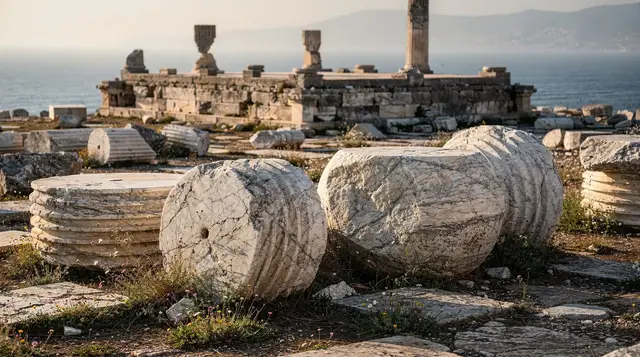
At the western end, past Concordia, the Temple of Heracles (Hercules) is thought to be the oldest of the group, dating to the late sixth century BC. An earthquake brought down most of its columns in antiquity, and eight of them were re-erected in the 1920s by a British archaeologist and diplomat, Alexander Hardcastle, who funded much of the early 20th-century excavation work here out of his own pocket. The rest of the temple survives as a long field of toppled column drums lying where they fell, which is oddly more informative than a fully standing structure — you can see the internal fluting and the bronze dowel holes that once held the drums together.
Temple of Olympian Zeus: what was never finished
Set slightly apart, near the second entrance, the Temple of Olympian Zeus would have been the largest Doric temple ever attempted, roughly 113 by 56 metres, had it been completed. It was begun after a Greek victory over Carthage at the Battle of Himera in 480 BC, funded partly by Carthaginian prisoners of war who are said to have been used as forced labour on the site. Work stopped when Carthage sacked the city in 406 BC and was never resumed.
What remains is a field of massive fallen blocks, plus a full-size reconstructed telamon — one of the giant stone figures that stood between the temple’s outer columns, arms raised as if supporting the entablature. The original fragments of these telamones, discovered in pieces over two centuries of digging, are now split between the site and the Museo Archeologico Regionale in Agrigento; the composite figure lying on the ground here gives the scale, at roughly 7.5 metres if it were standing.
Temple of the Dioscuri: four columns and a postcard
The four re-erected columns of the so-called Temple of the Dioscuri (Castor and Pollux) are the most photographed thing in the park and also the least reliable as archaeology: the columns actually belong to different buildings from different periods, assembled into a single picturesque corner during 19th-century restoration. It is a fabrication with real ancient stone, and worth knowing that before you build your idea of the temple around it.
The Kolymbethra garden: shade, water and citrus
The Giardino della Kolymbethra sits in a ravine below the main ridge and is the one part of the site with real tree cover — lemon, orange, almond, pistachio and olive, irrigated by a network of underground channels (qanat) built during the Arab period on top of an ancient Greek reservoir originally used for irrigation and possibly fish farming. It is managed separately by the FAI (Fondo Ambiente Italiano) trust rather than the main archaeological park authority, and needs its own ticket, sold at its own entrance near the Temple of Heracles side. If the heat on the main ridge gets to be too much, this is the escape, and it also happens to be genuinely good — a working orchard threaded with 2,500-year-old engineering, not a garnish garden.
Book Kolymbethra garden entry if you want to guarantee a slot, since access is sometimes capped in high season.
Planning the visit: heat, timing and tickets
This is a shadeless limestone ridge in a part of Sicily that regularly passes 35°C from June through August, and the walk between the two entrances takes 45 minutes to an hour at a normal pace before you factor in stopping anywhere. Go at opening time or in the last two hours before closing. Midday in summer is not just uncomfortable, it is the version of the visit you will remember for the wrong reasons.
Standard entry covers the temple ridge; Kolymbethra and the Archaeological Museum are separate tickets, and a combined ticket exists but is not always the cheapest option depending on what you actually want to see — check current pricing at the ticket office or through an official reseller rather than assuming. Skip-the-line tickets remove the queue at the main entrance, which in July and August can run to 30–45 minutes in direct sun with nowhere to wait out of it.
Check current skip-the-line guided tour options or, if you prefer to go at your own pace, an audio guide ticket covers the same ground without a fixed group schedule.
In summer, the park often runs an evening or night opening with the temples floodlit, which is both cooler and visually different — Concordia in particular reads differently under artificial light than under a flat midday sun. A night tour with skip-the-line entry is worth booking ahead in high season, since evening slots sell out faster than daytime ones.
Getting there and parking
By car from Palermo, the SS189 takes just under two hours; from Syracuse or Catania, plan closer to two and a half hours via the SS640 and A19. There are paid car parks at both the Piazzale dei Templi (west) end and near the Museo Archeologico (east) end, and because the site is walkable point to point, many visitors park at one end, walk the ridge, and take a short taxi back rather than retrace the whole route on foot in the heat.
By train or bus, Agrigento Centrale station connects to Palermo (roughly two hours) with a change sometimes required, and local buses run from the town centre down to the site entrances — check current timetables locally since Sicilian rural bus schedules shrink outside peak season. See getting around Sicily and renting a car in Sicily for the wider picture, and remember Agrigento’s historic centre, like most Sicilian towns, has ZTL restrictions — read ZTL zones and parking in Sicilian cities before driving into the old town itself, as opposed to the archaeological park, which sits outside it.
Combining it with the rest of Agrigento and the south coast
The Museo Archeologico Regionale di Agrigento, at the eastern end of the site, holds finds from the temples and the wider Akragas excavations, including original telamon fragments, and is worth an hour if you have not already seen enough stone for one day — see the archaeological museums worth your time for how it compares to Palermo’s Salinas museum and Syracuse’s Paolo Orsi museum.
Scala dei Turchi, the white marl cliffs, is around 20 minutes away and pairs naturally with an early-morning temple visit followed by a late-afternoon coast stop — see day trips from Agrigento for other combinations, including the town of Sciacca and the Torre Salsa nature reserve.
For a wider itinerary, Sicily in 7 days and Baroque towns and Greek temples in 5 days both build a day around this site, usually paired with the Val di Noto towns or Piazza Armerina’s Villa Romana del Casale a couple of days later or earlier.
The lesser temples: Vulcan, Asclepius and the Oratory of Phalaris
Beyond the five main temples, the park holds several smaller, easily overlooked structures worth knowing about even if they do not justify a special detour on their own. The Temple of Vulcan (Hephaestus), near the western end of the ridge close to the Temple of Heracles, survives as little more than a few column bases and scattered blocks, but it confirms that the ridge held more dedications than the five headline buildings suggest.
Down near the Akragas river, outside the main defensive walls and the ticketed ridge itself, the Temple of Asclepius (Aesculapius) was a small Ionic-influenced structure associated with a healing cult — ancient sanctuaries to Asclepius were typically sited outside city walls, near water, reflecting the god’s association with purification and health, and this one is no exception. It sees very few visitors given its distance from the main entrances and is easy to miss entirely unless you are specifically looking for it.
Closer to the eastern entrance, a small Hellenistic-Roman structure known as the Oratory of Phalaris sits incorporated into the walls of a later medieval tower, its actual date and original function debated — the name links it, almost certainly inaccurately, to the notorious early tyrant Phalaris, who ruled Akragas roughly a century before most of the standing temples were even built. Treat the name as tradition rather than established fact; the structure itself likely postdates Phalaris by a considerable margin.
Where to stay: Agrigento town or San Leone
Most visitors base themselves either in Agrigento’s own hilltop historic centre, a short drive or bus ride from the archaeological park, or in San Leone, the town’s seaside district a few kilometres south, which puts you closer to the coast and to Scala dei Turchi while adding a short drive back up to the temples each day. Agrigento town has the advantage of restaurants, the cathedral and the Museo Archeologico all within walking distance of each other, along with more evening life; San Leone trades that convenience for beach access and a marginally shorter run out to the coast in the afternoon. Neither is objectively better — it depends on whether your day is built primarily around the ruins or split evenly with the sea.
Best time of day for photography and comfort
Early morning, in the first hour or two after opening, gives the softest light on the temples’ warm limestone and the smallest crowds anywhere on the ridge, particularly around Concordia, which draws the heaviest visitor traffic of any single structure in the park. Late afternoon, in the two hours before closing, offers a similar advantage with the added benefit of longer shadows that make the fluting on the surviving columns easier to see and photograph.
Midday sun, by contrast, flattens the stone’s colour and removes most of the shadow definition that makes Doric architecture legible in photographs — it is the worst time to visit for both comfort and images, which is a rare case where the practical advice and the photographic advice point in exactly the same direction.
The so-called Tomb of Theron
Near the Temple of Heracles, at the western edge of the site, a squat, tower-like funerary monument is popularly known as the Tomb of Theron, after Theron, the powerful tyrant who ruled Akragas in the early fifth century BC and led the city to its greatest wealth and building ambition, including the victory over Carthage at Himera in 480 BC that later funded the Temple of Olympian Zeus. The attribution is almost certainly wrong: the monument’s architectural style points to a considerably later date, likely Hellenistic or early Roman, centuries after Theron’s death.
It survived the association anyway, partly because Roman-era writers and later antiquarians were drawn to connect visible ancient structures with famous historical names regardless of the archaeological evidence, a pattern repeated at other sites on this list, including the misattributed Temple of the Dioscuri nearby. It remains a minor stop rather than a highlight, but it is a useful, compact illustration of how much of what visitors are told about ancient monuments reflects centuries of later storytelling rather than confirmed fact.
What locals and repeat visitors say to skip
Do not plan to see everything in under two hours in July heat — you will rush the Temple of Zeus and skip Kolymbethra, which is usually a mistake. Do not assume the two entrances are interchangeable for parking if you are short on time; check which end has the sights you most want to see first, since walking the wrong direction under time pressure is a common complaint. And do not expect restaurants or much shaded seating inside the park itself — bring water, and plan lunch in Agrigento’s town centre either before or after, not as a break mid-visit.
Greek and Roman site tours on GetYourGuide
Verified deep-linked GetYourGuide tours. Book through these links and we earn a small commission at no cost to you.
Photo: our own image of the location, not the operator’s product photo.