Mozia, Motya and Phoenician Sicily
What is Mozia, and why is it different from Sicily's Greek sites?
Mozia (also spelled Motya) is a small island in the Stagnone lagoon near Marsala, settled by Phoenician colonists around the eighth century BC and later a major Carthaginian stronghold, destroyed by the Greek tyrant Dionysius I of Syracuse in 397 BC. It is the clearest surviving Phoenician and Carthaginian archaeological site in Sicily, distinct from the Greek temple sites elsewhere on the island, and it holds one of ancient Sicily's most celebrated sculptures, the Giovane di Mozia (Youth of Motya).
The one place in Sicily that is not Greek
Almost every other site on this list is either Greek in origin or a native population’s adaptation of Greek architectural style. Mozia is different, and that difference is the whole reason to come. A small, low island in the Stagnone lagoon near Marsala, it was settled by Phoenician colonists from the eastern Mediterranean around the eighth century BC, roughly contemporary with the earliest Greek colonies on the island’s east coast, and became one of the most important Phoenician, and later Carthaginian, settlements in Sicily.
Where Agrigento, Segesta and Selinunte tell the story of Greek Sicily and its Elymian neighbours, Mozia tells the other half — the Phoenician and Carthaginian presence that controlled the west of the island for centuries and repeatedly went to war with the Greek cities over it.
From Phoenician trading post to Carthaginian stronghold
Phoenician settlers, originally from cities in the eastern Mediterranean including Tyre, established trading posts across the western Mediterranean from the ninth century BC onward, and Mozia’s position — a defensible island close to the mainland, with easy access to salt production in the surrounding lagoon and shipping routes toward North Africa — made it a natural choice for one of the earliest and most significant Phoenician settlements in Sicily.
As Carthage, itself a Phoenician colony in North Africa, grew into the dominant power among the western Mediterranean’s Phoenician-founded cities, Mozia came under Carthaginian control and functioned as a key naval and trading base for Carthaginian operations in Sicily, directly rivalling Greek Syracuse and Selinunte for control of the island’s west.
Destruction in 397 BC: Dionysius of Syracuse’s siege
Mozia’s prosperity ended abruptly. In 397 BC, Dionysius I, the powerful tyrant of Syracuse, led a major campaign against Carthaginian Sicily and besieged Mozia by land and sea, eventually breaching the island’s defences after a prolonged and, according to ancient accounts, exceptionally brutal assault.
The city was destroyed, its population killed or enslaved in large numbers, and it was never fully rebuilt as a major settlement — survivors are generally understood to have relocated to found or reinforce nearby Lilybaeum, on the mainland, which grew into the city that is now modern Marsala. The siege is one of the clearest, best-documented instances in Sicilian antiquity of the ongoing warfare between Greek and Carthaginian Sicily directly determining a settlement’s fate, in this case ending it outright.
What survives on the island today
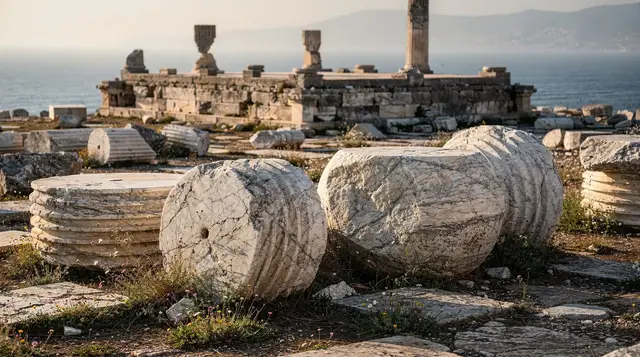
Mozia’s ruins include city walls and fortification gates, a dry dock (the Cothon) likely used for ship maintenance or possibly as a sacred pool, a tophet — a sanctuary area associated with Phoenician and Punic religious practice and, controversially in older scholarship, child burial or sacrifice, a subject still debated among archaeologists — and residential quarters showing the layout of a genuine Phoenician-Carthaginian town rather than a purely Greek or Elymian one.
Because the site was destroyed relatively abruptly rather than continuously built over across later centuries, it preserves this Phoenician-Carthaginian town plan with a clarity that is rare in Sicily, most of whose ancient settlements were later overlaid by Greek, Roman, Arab or Norman building phases.
The Giovane di Mozia: Sicily’s most argued-over statue
The island’s single most celebrated find is the Giovane di Mozia (Youth of Motya), a marble statue of a standing young man discovered in 1979, dated to around the fifth century BC. It depicts the figure in a long, close-fitting garment rendered with extraordinary technical skill, giving the impression of near-transparent fabric over the body beneath — a level of virtuoso carving that has made the statue one of the most discussed individual Greek-style sculptures to survive from anywhere in the ancient Mediterranean.
Its exact origin remains genuinely debated: whether it is a Greek import, a Carthaginian commission from a Greek workshop, or a locally made Phoenician work in thoroughly Greek style is unresolved, and that ambiguity is itself a useful illustration of how blended Sicily’s ancient cultures actually were, regardless of which political power controlled a given city at a given time.
The statue is displayed at the Museo Whitaker on the island itself, alongside other finds from the site.
Joseph Whitaker: the merchant who saved the site
The museum’s name comes from Joseph Whitaker, a member of an English merchant family whose wealth came from the Marsala wine trade — the same Marsala fortified wine that gives the nearby town its international reputation, see Marsala wine: the cantine and the tastings. Whitaker purchased the island in the early 20th century, funded significant early archaeological excavation there as an amateur enthusiast, and built the museum that still bears his family name, preserving much of what is now known about the site well before formal Italian state archaeology reached it.
Getting there: a boat, not a bridge
Mozia is a genuine island, reached only by a short boat crossing — typically five to ten minutes — from a landing point on the mainland near the Stagnone lagoon’s salt pans, a short drive from Marsala itself. A boat transfer to Mozia with museum entry included is the standard way to visit, and as with any boat access in Sicily, crossings can be affected by wind and sea conditions, so build some flexibility into the day rather than a tight fixed schedule.
A sailing tour of the Stagnone lagoon with Mozia entry combines the crossing with time on the water in the wider lagoon, which is also one of Sicily’s best-known kitesurfing and wingfoiling spots given its shallow, wind-exposed waters.
Combining Mozia with the Marsala salt pans and Trapani
The boat landing for Mozia sits within the Stagnone lagoon nature reserve, surrounded by the working salt pans that supply much of Sicily’s traditional salt production, with their characteristic windmills and pink-tinged evaporation pools — see Marsala for the fuller picture of the salt pans and wine cellars in the area.
A boat tour of the Mothia lagoon takes in both the salt pans and Mozia in a single outing. Trapani and Erice are both a short drive further along the coast, making a full day combining salt pans, Mozia and one of the two towns entirely realistic — see day trips from Trapani for other combinations in the area.
A full-day excursion from Palermo covering Mozia and the salt pans is the option worth looking at if you are based further away and would rather not self-drive the whole route.
Fitting it into the wider Phoenician and Elymian story
For the fuller picture of how Phoenician and Carthaginian Sicily related to the Greek colonies and native Elymian and Sicel populations, see Greek Sicily explained, and for the western Greek city that Mozia and Carthage repeatedly fought, Selinunte, destroyed by Carthage in 409 BC, a little over a decade before Mozia itself fell to Dionysius of Syracuse in the opposite direction.
The tophet: a debated sacred space
Among the more sensitive parts of the site is the tophet, an open-air sanctuary area found at Mozia and at other Phoenician and Punic settlements across the western Mediterranean, generally associated with votive offerings and, in older and still debated scholarship, the burial of infants who died of natural causes or, more controversially, were subject to ritual sacrifice — a practice ancient Greek and Roman writers frequently attributed to Carthaginian religion, often as part of broader anti-Carthaginian rhetoric during periods of war.
Modern archaeological and forensic analysis of remains from tophets across the Phoenician-Carthaginian world has produced genuinely mixed and contested conclusions, with some researchers arguing the sites represent conventional infant cemeteries reflecting high natural infant mortality rather than evidence of systematic sacrifice, and others maintaining that ritual sacrifice, at least in some periods and places, did occur. It is presented here as an open scholarly debate rather than a settled fact in either direction, and it is worth approaching the tophet at Mozia with that genuine uncertainty in mind rather than either extreme.
Salt, wind and the Stagnone lagoon today
The Stagnone lagoon surrounding Mozia is a shallow, sheltered body of water protected from the open sea by a chain of small islands and sandbars, conditions that have made it ideal for salt production since Phoenician times — the same evaporation-pond salt-making method, using the sun and wind to concentrate seawater in shallow basins, continues today at the working salt pans visible from the boat crossing to the island.
Those same shallow, wind-exposed conditions have more recently made the lagoon one of Sicily’s best-regarded kitesurfing and wingfoiling locations, drawing a different kind of visitor entirely from those coming for the archaeology — worth knowing if you are travelling with someone whose interests split between ancient history and watersports, since both are genuinely well served by the same stretch of coastline.
Baal, Astarte and Phoenician religious practice
Phoenician and Carthaginian religion centred on deities including Baal Hammon, a chief god associated with fertility and protection, and Tanit (sometimes linked to the earlier goddess Astarte), a major goddess whose symbol — a stylised figure sometimes called the “sign of Tanit” — appears on votive stelae found at tophet sites across the Phoenician-Carthaginian world, including at Mozia.
These deities differ substantially from the Greek pantheon that dominates most other ancient Sicilian sites, and Mozia’s religious material, sparse and different in character from the abundant Greek mythological imagery found at Selinunte or in Palermo’s Salinas museum, is one of the clearest physical reminders that ancient Sicily’s religious landscape was never uniform, even setting aside the later arrival of Christianity and Islam over subsequent centuries.
Mozia in the wider Phoenician network: Palermo and Solunto
Mozia was not an isolated Phoenician settlement. Palermo itself began as Panormus, a Phoenician and later Carthaginian port city whose ancient core underlies much of the modern city’s historic centre, and Solunto, on the coast east of Palermo, preserves its own substantial Phoenician-Carthaginian and later Hellenistic-period ruins, including residential quarters laid out on a grid plan up a hillside.
Together with Mozia, these three sites form the core of what survives from Phoenician and Carthaginian Sicily, and seeing more than one, if your trip allows, gives a considerably fuller sense of this side of the island’s ancient history than any single site can provide alone — see Palermo for how the city’s Phoenician origins sit beneath its much better-known Arab-Norman and Baroque layers.
A century of excavation, still ongoing
Formal archaeological investigation of Mozia began under Joseph Whitaker in the early 20th century and has continued since, including significant work by Italian universities and international archaeological missions that have progressively refined understanding of the site’s fortifications, religious spaces and residential quarters well beyond what Whitaker’s own early excavations uncovered.
The discovery of the Giovane di Mozia statue as late as 1979 is a useful reminder that major finds can still emerge from a site that has already been under study for the better part of a century, and ongoing research continues to refine and occasionally revise earlier interpretations, including around the tophet and its disputed function discussed above. Visiting Mozia today means seeing a site that remains an active subject of archaeological research rather than a fully closed historical question, which is part of what makes its story feel less settled, and in some ways more genuinely alive, than sites whose major discoveries all happened in the more distant past.
Trade routes and why the location mattered strategically
Mozia’s position within the Stagnone lagoon gave it more than a defensible island site: it sat almost exactly on the shipping route connecting Carthage and North Africa to the western Mediterranean’s Phoenician and later Punic settlements in Sardinia and Iberia, making it a natural waypoint for trade in metals, salt, textiles and agricultural goods moving between these regions long before Rome became a Mediterranean power at all.
Understanding this wider trade context helps explain why Syracuse under Dionysius I considered Mozia’s destruction in 397 BC strategically worthwhile despite the island’s modest size — removing it disrupted a functioning node in Carthage’s broader western Mediterranean trade and naval network, not merely a single isolated settlement.
A different kind of ancient site to end a trip on
For visitors who have already spent several days among Sicily’s Greek temples and theatres, Mozia works well as a deliberate change of register near the end of a trip — a boat crossing rather than a car park, a small, quiet island rather than a sprawling ridge or park, and a culture, Phoenician and Carthaginian, that most visitors arrive knowing considerably less about than they do the Greeks. That relative unfamiliarity is part of the appeal: Mozia rewards curiosity precisely because it resists the assumptions most people bring to ancient Sicily from the more heavily marketed Greek sites elsewhere on the island.
One island, several ways to spend the afternoon
Some visitors treat Mozia as a brisk hour-long stop between the salt pans and Marsala town; others, particularly anyone drawn to the tophet debate or the statue’s own contested history, linger for a full afternoon. Both are reasonable ways to see the island — the difference is mainly how much of the site’s genuinely unresolved archaeological questions you want to sit with rather than simply observe.
Sun, wind and what to bring
The island has little shelter beyond the museum building itself, and the surrounding lagoon amplifies both sun exposure and wind, so bring water, sun protection and a layer against the wind even on an otherwise warm day, particularly if your crossing coincides with the breezier conditions that also draw the area’s kitesurfers.
Timing the crossing around opening hours
Boat departures to the island generally run within the site’s own opening hours rather than continuously throughout the day, so check the current schedule for both the crossing and the museum before planning arrival time, particularly outside peak summer months when frequency tends to drop.
A last word on what makes Mozia distinct
Every other site on this list, however different in condition or scale, ultimately traces back to Greek architectural tradition in some form. Mozia does not, and that single fact is worth carrying into the visit itself as the main thing to look for, rather than measuring the island against the temples and theatres seen elsewhere on the same trip.
What to actually plan for
Do not treat Mozia as a quick add-on to a salt-pans visit — the boat crossing, the site itself and the Whitaker museum together need at least two to three hours to do properly, and rushing the museum in particular means missing most of what makes the Giovane di Mozia worth the detour. Do not assume the crossing runs on a fixed schedule regardless of weather; check conditions if wind is forecast, since the lagoon is shallow and exposed. And do not skip the tophet and city walls in favour of the statue alone — the site’s value as the clearest Phoenician-Carthaginian town plan in Sicily is in the layout as much as in any single find.
Greek and Roman site tours on GetYourGuide
Verified deep-linked GetYourGuide tours. Book through these links and we earn a small commission at no cost to you.
Photo: our own image of the location, not the operator’s product photo.