Segesta: the unfinished temple and the theatre
Why is the temple at Segesta unfinished, and is it still worth visiting?
The temple, built around 420 BC, was never roofed, never had its interior cella built, and its columns were never fluted — construction simply stopped, probably for political or military reasons unrelated to the building itself. It is still one of the best-preserved Doric temples in the world precisely because it stands alone on a hillside with almost nothing else built around it, and the theatre above adds a second, very different reason to come.
A temple that was never meant to look like a ruin
Most ancient sites in Sicily are ruins in the ordinary sense: buildings that stood complete for centuries and then lost their roofs, their stone, their upper courses to earthquakes, fire, or later builders quarrying them for material. Segesta’s temple is different. It was never finished in the first place.
Built around 420 BC by the Elymians — a people native to western Sicily, not Greek settlers, who nonetheless built almost entirely in the Greek architectural language of the period — the temple has 36 Doric columns still standing, a full entablature, and no interior walls, no cella, no roof, and no fluting on the columns. Whatever the Elymians intended, it stopped being built at a specific, identifiable stage, and it has stood in that arrested state for roughly 2,400 years.
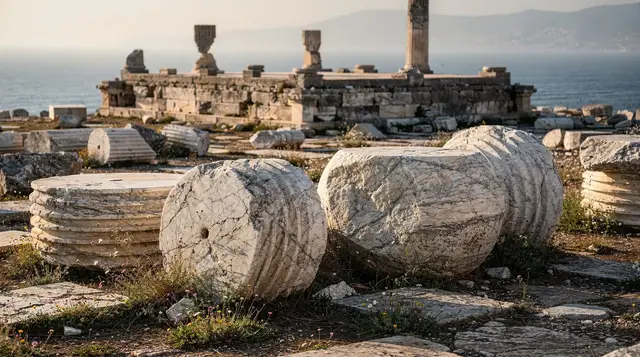
The evidence is in the stone itself. Look closely at the column drums and you can still see bosses: raised knobs of unworked stone that ancient builders used as grip points for ropes and levers while hoisting and positioning each drum, meant to be chiselled smooth as a final step once the column was in place. At Segesta, most of them never were. It is, in effect, a building frozen mid-construction, and that accident is exactly why it survives so well — there is no interior structure to have collapsed, and later generations apparently found little reason to quarry a temple that had never really been a finished, sacred space.
Why work stopped is not fully settled. Segesta was frequently at war with the neighbouring Greek colony of Selinunte over control of border territory, and the wider region was repeatedly caught up in the conflicts between Carthage and the Sicilian Greek cities through the fifth and fourth centuries BC. Any of those pressures could plausibly explain an abandoned building project; no single ancient source spells it out.
The theatre: a hilltop that was worth the climb even in antiquity
Above the temple, on the summit of Monte Barbaro, Segesta’s theatre was cut into the hillside in the third century BC and seats around 4,000 people in a semicircle facing outward — not toward a backdrop wall, as in many later Roman-influenced theatres, but toward the open landscape and, on a clear day, the Gulf of Castellammare in the distance. That siting decision is part of what makes the climb worth it independent of the archaeology: this is one of the few ancient theatres in Sicily where the view is arguably as much the point as the performance space itself.
The theatre still hosts a summer festival of classical and contemporary drama and music, a modern continuation of what these spaces were originally built for. If your visit lines up with a festival date, an evening performance in a 2,300-year-old theatre, with the same hillside view, is a different experience from a daytime archaeological walk-through — check current listings before building a trip around it, since the calendar and access arrangements shift year to year.
Getting up from the temple to the theatre is a real climb — roughly 400 metres of elevation and a fair distance on top of that — so most visitors use the shuttle bus that runs between the lower car park and a stop near the theatre. Walking it takes 25 to 35 minutes uphill on a paved path if you would rather go at your own pace, but in summer heat the shuttle is the sensible choice for most people, especially with limited water and no shade along the route.
Book entry with the shuttle included to skip working out the logistics on the day.
Who the Elymians were, and why that matters here
Segesta is the best place in Sicily to actually think about the Elymians, a group whose origins are still debated — ancient writers, including a claim repeated by later Roman sources, traced them to refugees from Troy, though modern archaeology treats that as myth-making rather than history.
What is clearer is that the Elymians controlled western Sicily before and alongside Greek colonisation, built cities like Segesta and Eryx (modern Erice), and adopted Greek temple architecture, coinage and eventually language while remaining politically and often militarily distinct from — and frequently opposed to — the Greek colonies around them, especially Selinunte to the south. The temple at Segesta is the clearest physical evidence of that cultural position: a non-Greek city building in a fully Greek architectural vocabulary, for reasons that were probably as much about status and rivalry as religion.
For the wider picture of who built what across the island, see Greek Sicily explained, which sets Segesta’s Elymian builders against the Greek colonists at Selinunte, Syracuse and Agrigento, and the Phoenician and Punic presence further west at Mozia.
Planning the visit
Segesta is a fast site by Sicilian archaeological-park standards: most visitors need 90 minutes to two hours including the shuttle both ways, less if you skip the theatre climb entirely (not recommended — it is most of the reason to come). There is very little shade on the hillside, so the same rule applies here as everywhere else on this list: go in the morning, bring water, and treat the middle of a summer day as something to avoid rather than work around.
A private guided walking tour is worth it here specifically because the unfinished-temple story and the Elymian context are easy to miss without someone explaining what you are actually looking at — a guide can point out the boss stones on the columns that most visitors walk straight past.
Getting there and combining with Erice and Trapani
Segesta sits inland, about 30 minutes from Trapani and 30–40 minutes from the hilltop town of Erice by car, which makes it the natural first or last stop on a day covering all three. A common route: Segesta in the cool of the morning, up to Erice for lunch, views over the Egadi Islands and the town’s medieval streets, then down to Trapani for the late-afternoon salt pans or an evening in town — see Marsala and its salt-pan landscape for an extension of the same day if time allows.
A full-day tour from Trapani covering both Segesta and Selinunte is the option to look at if you would rather not self-drive between two archaeological sites in one day, or if you are relying on public transport, which is thin in this part of the island.
Without a car, Segesta is reachable by bus from Trapani and Palermo on routes timed loosely around the site’s opening hours — check current timetables locally, since rural Sicilian bus frequency drops sharply outside the summer season. See getting around Sicily and renting a car in Sicily for the practicalities, and driving in Sicily for what to expect on the inland roads west of Palermo, which are generally quieter and more direct than the coastal alternatives.
Combining it into a longer itinerary
Segesta fits naturally into a western Sicily loop alongside Selinunte, Erice and Marsala — see Western Sicily in 5 days for a route that covers all four without excessive driving, or the full Sicily road-trip loop if you are covering the whole island and want the Elymian and Greek-temple sites bookended around the coast.
The castle and mosque above the theatre
The hilltop above Segesta’s theatre was not abandoned once antiquity ended. A medieval castle, built by the Normans and later modified, sits at the summit of Monte Barbaro, and near it are the foundations of a small mosque, most likely dating to the Islamic period of Sicilian history between the ninth and eleventh centuries, later converted for Christian use after the Norman conquest of the island.
It is a useful reminder that Segesta’s hilltop was valued as a defensible, commanding position for well over a thousand years after the Elymian city below it had already faded — the theatre and temple are the reason most visitors come, but the summit carries a second, much later layer of history that is easy to walk past without noticing the low stone foundations for what they are.
Further down the slope, traces of the ancient city itself — an agora, a bouleuterion (council building) partly cut into the rock, and sections of the city walls — remain only partially excavated compared to the temple and theatre, and are generally less signposted; a guide is genuinely useful here if you want to locate them rather than stumbling across low, easily overlooked foundations on your own.
Best season and photography
Spring, particularly April and May, is widely considered the best time to see Segesta: the hillside around the temple is covered in wildflowers and green growth that has usually browned off by June, and the milder temperatures make the climb to the theatre considerably more comfortable. Early morning light catches the temple’s east-facing columns first, while the view from the theatre toward the Gulf of Castellammare is generally clearest in the morning before any afternoon haze builds up over the water. Autumn offers a similar advantage to spring, with cooler temperatures returning after the summer heat, though without the same wildflower cover.
Why Segesta and Selinunte kept fighting
The rivalry between Elymian Segesta and Greek Selinunte was not an occasional dispute but a recurring, generations-long conflict over control of border territory and river valleys in western Sicily, and it repeatedly drew in outside powers on both sides. Segesta is recorded appealing to Athens for military support against Selinunte in the late fifth century BC, a request that became one of the stated pretexts for the disastrous Athenian expedition to Sicily in 415–413 BC — a campaign that ended in the near-total destruction of the Athenian invasion force at Syracuse and is among the most consequential military failures in classical Greek history.
Segesta later turned to Carthage for support against Selinunte, a decision that helped trigger the Carthaginian campaigns of 409–406 BC that destroyed Selinunte and sacked Akragas. Segesta’s temple, in other words, was being built by a city whose foreign policy repeatedly reshaped the wider balance of power across the whole island — a scale of consequence that is easy to miss standing in front of a quiet, unfinished building on an empty hillside.
Visiting with children, and what a guide adds
Segesta tends to work well for children specifically because it is compact and fast relative to larger sites like Selinunte or the Valley of the Temples — the shuttle ride up to the theatre in particular tends to hold younger visitors’ attention better than a long, shadeless walk would. The unfinished nature of the temple, with its visible lifting-boss stones, is also a genuinely accessible way to explain ancient construction methods to children in a way that a fully finished, more abstract monument does not offer as directly.
A guide adds real value here precisely because the most interesting details — the boss stones, the Elymian-versus-Greek distinction, the Athens-Segesta-Carthage political chain reaction — are easy to walk past without a specific prompt to look for them, more so than at sites with a single overwhelming visual centrepiece like Taormina’s Etna view.
Rain, wind and a shadeless hillside contingency
Segesta’s exposed hilltop position means it is also exposed to weather in the other direction: strong wind is common, particularly in the shoulder seasons, and can affect both comfort on the theatre climb and, occasionally, shuttle operations if conditions turn severe enough.
Rain is less frequent but not unheard of outside summer, and there is no significant indoor shelter on site beyond a small ticket office and café area, so a wet-weather visit here is considerably less comfortable than at a site with covered structures, like Villa Romana del Casale. If the forecast for your planned day looks poor, it is worth treating Segesta as flexible within a western Sicily itinerary and shifting it to whichever day looks clearest, rather than fixing it to a specific date regardless of conditions.
The wider Elymian territory beyond Segesta
Segesta was the largest and best-documented Elymian city, but it was not the only one. Eryx, the hilltop settlement that is now the medieval town of Erice, was another major Elymian centre, known in antiquity for a significant temple to a fertility goddess associated with Aphrodite and Astarte, reflecting the same kind of cross-cultural religious blending visible in the Elymians’ broader adoption of Greek architectural forms.
Almost nothing of the ancient temple survives visibly today, its site now occupied by a medieval castle, but Erice’s continued importance as a hilltop stronghold across Elymian, Greek, Carthaginian, Roman, Arab and Norman periods mirrors Segesta’s own long, layered occupation history, and visiting both in the same trip gives a fuller sense of the Elymians as a distinct, resilient culture rather than a footnote to the Greek colonies around them.
A stop for oil or wine on the way out
The countryside immediately around Segesta is part of Sicily’s wider olive oil and wine belt, and several small producers near the site offer tastings that make a natural, low-key way to end a visit before continuing on to Erice or Trapani — a short stop rather than a full excursion, but a reasonable way to taste the same agricultural landscape you have just been looking at from the theatre’s hilltop view. This is a good option specifically for visitors who find a single archaeological stop, however worthwhile, is enough ancient history for one morning and would rather ease into the rest of the day with something more sensory before the next town.
What the site does not tell you outright
Segesta’s information boards cover the basic chronology well but rarely spell out the political chain reaction described above in full — the appeal to Athens, the later appeal to Carthage, and how both decisions rippled outward into some of the most consequential wars of the ancient Mediterranean. Visitors relying purely on posted signage will come away with an accurate but thin picture of a nicely unfinished temple; visitors who read this history in advance, or take a guide, tend to leave with a genuinely different sense of how much a small Elymian city’s foreign policy choices shaped the fate of Greek Sicily as a whole.
What to actually plan for
Do not skip the theatre climb to save time — the shuttle removes almost all the effort, and the view and the festival history are a real part of what makes Segesta distinct from a temple-only stop. Do not expect food options at the site itself beyond a small café near the entrance; plan a proper lunch in Erice or Trapani instead. And do not assume the unfinished state of the temple means there is “less to see” than at a completed site — the opposite is often true, since the raw construction evidence is visible in a way that finished, later-modified temples like the Valley of the Temples’ Concordia simply do not show.
Greek and Roman site tours on GetYourGuide
Verified deep-linked GetYourGuide tours. Book through these links and we earn a small commission at no cost to you.
Photo: our own image of the location, not the operator’s product photo.