Day trips from Trapani
What is the best day trip from Trapani?
Erice, around 30 minutes away and usually reached by cable car, is the easiest and most dramatic. Segesta, about 30 minutes by car, and Favignana in the Egadi Islands, roughly 30 to 40 minutes by hydrofoil, are the other two that need almost no planning.
Trapani: the best base for the west, if an underrated one
Trapani sits at the western tip of Sicily, which puts it closer to Erice, Segesta and the Egadi Islands than any other city on the island, plus reasonable reach toward Marsala, Selinunte and the beaches of San Vito Lo Capo. It is also the one base on this list where a genuine island day trip — Favignana, or further out Levanzo and Marettimo — is a straightforward hydrofoil ride rather than a multi-hour ferry commitment.
Trapani itself is often treated as a stopover rather than a destination, which undersells it — the old town’s Baroque churches, the harbour where hydrofoils and fishing boats share the same quay, and a genuinely good local food scene built around tuna, couscous and swordfish make it worth a half-day of attention on its own before you head out to any of the destinations below.
The trade-off for that western position is limited fast road connections back east: getting from Trapani to Palermo or beyond takes real time, so this guide focuses on what surrounds Trapani itself rather than what lies further afield.
Costs across these routes vary with the mode of transport as much as the distance. Erice’s cable car and Segesta’s entrance fee are both modest, keeping those two among the cheapest options here. Favignana’s hydrofoil crossing plus a day’s bicycle rental costs a little more but stays reasonable, while a guided Selinunte or Egadi boat tour, given the time and logistics involved in covering a larger site or multiple islands, sits at the higher end. San Vito Lo Capo costs little beyond parking or a bus fare, since the beach itself is free to access along most of its length.
Erice: ten minutes by cable car, a different world
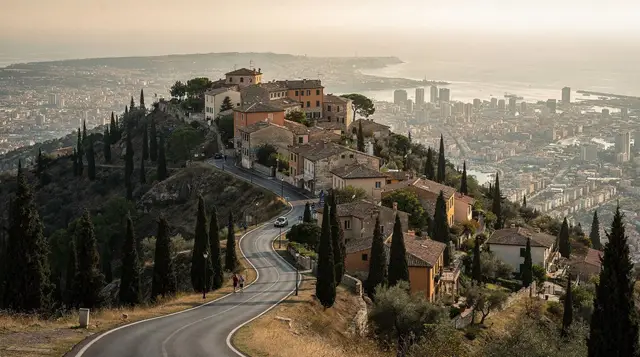
Erice sits at around 750 m above Trapani, and the cable car up from the edge of the city covers the climb in under 10 minutes — one of the shortest and most dramatic transitions to any hill town in Sicily. The alternative is the road, a series of switchbacks that takes about 30 minutes by car or taxi and offers its own views on the way up, at the cost of the cable car’s quick, effortless ascent.
On a clear day, the cable car ride itself is worth the trip: the ascent unfolds views over Trapani’s saline, the curve of the coastline, and the Egadi Islands sitting offshore, all before you have set foot in the town itself. Queues build at the base station around midday in peak season, so an early or late-afternoon ascent tends to move faster than a late-morning one.
Once up top, Erice is a walled medieval town of narrow cobbled streets, a Norman castle built on the site of a temple to Venus, and views that reach across to the Egadi Islands and, on the clearest days, toward Tunisia. Two to three unhurried hours covers the old town properly; note the ZTL restricting cars inside the walls, so park or arrive at the cable car station rather than trying to drive into the centre — see ZTL zones and parking in Sicilian cities.
Erice: Private Tour Stepping Back in Time in Sicily covers the town with a local guide, useful for picking out the details — the almond pastry shops, the specific viewpoints — that are easy to miss on a self-guided wander. For more on the town itself, see the destination page for Erice.
Erice sits noticeably cooler than Trapani thanks to its altitude, and cloud regularly settles over the hilltop even on days when the coast below is clear and hot — worth bringing a light layer whatever the forecast at sea level says. The cable car itself can close temporarily in high winds, which affect the exposed upper station more than the town below, so build in a little flexibility if wind is forecast on the day of your visit, and check whether the road alternative is a straightforward backup.
Segesta: 30 minutes, one temple, one theatre
Segesta sits around 30 minutes from Trapani by car, standing alone on a hillside with sweeping views and no surrounding town to speak of — just the unfinished Doric temple and, a shuttle bus ride up a second hill, a Greek theatre still used for performances in summer. Two hours is enough to see both properly, which makes Segesta the easiest archaeological site to fit into a Trapani day alongside something else, Erice included.
Segesta: Archaeological Park Private Walking Tour covers the site with a guide who can explain why the temple was never finished — one of Sicily’s more debated historical questions — rather than just walking the grounds solo. See Segesta: the unfinished temple and the theatre for the fuller story.
The site has almost no shade across its full extent, and the shuttle bus up to the theatre runs on a schedule rather than continuously, so budget a little waiting time either way. Outside the shuttle’s operating hours, the walk up to the theatre is manageable but steep, worth attempting only with proper shoes and water in hand, particularly in the warmer months.
Marsala: the saline and the wine houses, 30 minutes south
Marsala sits around 30 minutes south of Trapani along the coast road, past the Stagnone lagoon and its saline — shallow salt pans, some still worked by hand, with traditional windmills dotted along the shoreline that make for one of the most photographed stretches of coast in western Sicily. The city itself is known for its fortified wine, and several historic wine houses along the waterfront offer tastings that pair naturally with an afternoon in town after a morning at the saline.
This is an easy half-day add-on to Erice or Segesta rather than a full day on its own, unless a wine tasting and cellar tour is the specific goal.
The saline are at their most photogenic in the late afternoon, when the sun sits low over the shallow evaporation pools and the traditional windmills that once pumped seawater between them, some of which are still in working order today. A handful of small museums along the road explain the traditional harvesting process, worth a short stop even for visitors who are mainly there for the view rather than the history.
Selinunte: the bigger cousin of Segesta, an hour away
Selinunte sits closer to an hour from Trapani, further southwest past Marsala, and is a considerably larger site than Segesta — Europe’s largest archaeological park, spread across several temple areas along the coast, with enough ground to cover that half a day is the realistic minimum rather than the two hours Segesta needs.
Private Tour of the Selinunte Archaeological Park is the more efficient way to see the full site without missing the more scattered temple groups, since the park’s scale means a self-guided visit can easily miss sections without a map or a guide pointing the way. See Selinunte: Europe’s largest archaeological park for what each temple area covers.
The park is genuinely large enough that a shuttle or a bicycle rented on site helps cover the distance between temple groups without exhausting yourself before you reach the furthest ruins. Combined with the drive from Trapani, this makes Selinunte the single longest single-site commitment on this list — worth building the rest of your day around rather than trying to also fit in Marsala or Erice on the same date. A late-afternoon visit, timed for the hours before sunset, rewards patient visitors with warm light across the temple columns and noticeably thinner crowds than the site sees in the middle of the day.
The Egadi Islands: Favignana, a hydrofoil away
The Egadi Islands — Favignana, Levanzo and Marettimo — sit a short hydrofoil ride from Trapani’s port, with Favignana the closest and most visited at around 30 to 40 minutes each way. The island is flat and easy to explore by rented bicycle, with coves of clear water carved into old tuff quarries that rank among the more distinctive swimming spots in Sicily.
Favignana: Boat Excursion to the Egadi Islands with a Skipper covers the crossing and a guided look at the coastline by boat, a good option for a first visit before deciding whether to come back and explore by bike independently. As with any island crossing in Sicily, hydrofoils are cancelled or delayed in rough seas — check the operator’s status before building a tight schedule around the return crossing, and see Ferries and hydrofoils around Sicily for the wider picture on sea-dependent excursions. For more on choosing between the three islands, see The Egadi Islands: Favignana, Levanzo, Marettimo.
Bicycle rental stands cluster near Favignana’s port and are the easiest way to reach the island’s best coves, several of which have no road access at all and are only reachable on foot or by bike down short unpaved tracks. Bring cash, since smaller rental operators and some of the more remote snack kiosks do not always take cards. If time allows only one island, Favignana’s mix of easy cycling and swimming spots makes it the natural first choice over the wilder, harder-to-reach Marettimo or the smaller Levanzo, both of which suit a longer, less rushed visit better than a single day squeezed in alongside other Trapani plans.
Pack lunch or plan to buy provisions before setting off around the island, since the more remote coves have no facilities at all beyond the occasional seasonal kiosk near the busier beaches — a detail worth knowing if your plan is to spend the whole day cycling rather than returning to the port town at midday.
San Vito Lo Capo: an hour for the beach, not the sights
San Vito Lo Capo sits around an hour from Trapani, along a coast road that passes close to the Zingaro nature reserve. This is a beach day rather than a sightseeing day trip: a curve of pale sand and shallow turquoise water that draws heavy crowds in July and August, when arriving before mid-morning makes a real difference to parking and beach space. See San Vito Lo Capo: the beach and the couscous for the practicalities, including the town’s well-known couscous festival held each September.
The drive there passes close to the Zingaro nature reserve, Sicily’s first protected nature reserve, whose own coves and walking trails are worth combining with San Vito Lo Capo if you have most of a day free rather than only a beach afternoon — though doing both properly is more a full-day undertaking than a quick add-on, given the reserve’s trails require actual walking time rather than a drive-up stop.
When to go and common mistakes
April to June and September to October offer the most comfortable temperatures for Erice, Segesta and Selinunte’s shadeless sites, while San Vito Lo Capo and Favignana are naturally at their best for swimming from June through September, when the sea has warmed enough to be genuinely pleasant. Ferragosto in mid-August brings the heaviest crowds of the year to San Vito Lo Capo and Favignana specifically — both are popular with Sicilians as well as visitors, and parking or hydrofoil capacity can be tight around that date.
The most common mistake here is underestimating how weather-dependent the Egadi Islands crossing is — a day built entirely around Favignana with no flexibility if the hydrofoil is cancelled leaves no fallback. Building in an alternative, such as Erice or Segesta, for a day when the sea forecast looks uncertain avoids wasting a day entirely. A second common mistake is driving directly into Erice’s or Trapani’s own historic centre without checking for ZTL cameras — park at the edge and walk in, every time.
What to skip trying to combine
Erice and Segesta pair reasonably well in one day since both are around 30 minutes from Trapani in compatible directions, but adding Selinunte or a Favignana crossing to the same day stretches things thin — Selinunte alone needs half a day, and a hydrofoil crossing to Favignana is not something to squeeze in around other plans given how weather-dependent the schedule can be. Treat Favignana and San Vito Lo Capo as their own full days, and Erice, Segesta and Marsala as the trio that combines most naturally.
A four-day stay around Trapani spreads comfortably across these options without ever feeling rushed: one day for Erice and Segesta together, one for Favignana, one for San Vito Lo Capo and the Zingaro reserve, and one for Selinunte or Marsala depending on whether ruins or wine tasting appeals more. Shorter stays should prioritise Erice first, given how quick and rewarding it is relative to the time invested, followed by whichever of Favignana or San Vito Lo Capo suits the season and the weather on the day.
Getting around from Trapani
Erice’s cable car and the Favignana hydrofoil are the two connections that need no car at all; everything else on this list is faster and more flexible with one, given how limited bus schedules become once you leave the coast road. See Getting around Sicily and Renting a car in Sicily for the practicalities of self-driving in this corner of the island, and Western Sicily in 5 days for how these day trips fit into a longer stay based around Trapani.
Trapani’s own historic centre is compact and best explored on foot once you arrive, with its own ZTL restricting cars from the narrow streets around Via Garibaldi and Via Torrearsa. If you are renting a car specifically for Segesta, Marsala or Selinunte, picking it up on the morning you need it rather than for your whole Trapani stay is usually the more practical and cost-effective choice, since the city centre itself needs no car at all.
The honest bottom line
Trapani’s location makes Erice, Segesta and Favignana three of the easiest, most self-contained day trips anywhere in Sicily — short, well served by cable car or hydrofoil, and rewarding without demanding a long drive. Selinunte and San Vito Lo Capo ask for more time but stay within a reasonable single day. The one variable worth building slack around is the sea: any plan involving the Egadi Islands should have a fallback in mind for the days the hydrofoil does not run.
Few Sicilian bases pack this much genuine variety into such short distances — a medieval hilltop town, a lone Greek temple, historic salt pans, an island of clear-water coves, and one of the island’s best beaches, all within roughly an hour of each other. A stay of three or four days around Trapani, rather than a single rushed day trip, is the more comfortable way to take in more than one or two of these without exhausting yourself.
Keep an eye on the sea forecast a couple of days out if the Egadi Islands are a firm priority, and build the rest of your Trapani stay around whichever days look calmest — the flexibility to swap a Favignana day for an Erice or Segesta day at short notice is the single most useful piece of planning advice for this particular base.
Best day trips in Sicily on GetYourGuide
Verified deep-linked GetYourGuide tours. Book through these links and we earn a small commission at no cost to you.
Photo: our own image of the location, not the operator’s product photo.