Sicily on a budget in 7 days
No rental car, and what that actually saves and costs you
Skipping a rental car cuts three real expenses at once — no rental fee, no fuel, and no ZTL or parking fine risk — but it also rules out rural sites with thin public transport, like Segesta, Selinunte and Piazza Armerina, which simply don’t fit this itinerary. This is a deliberate trade, not an oversight: this route sticks to towns Trenitalia regional trains and long-distance coaches actually serve well. Our Sicily budget guide breaks down realistic daily costs across accommodation types in more depth than this itinerary alone can cover.
| Best for | Backpackers, solo budget travellers, anyone prioritizing cost over speed |
| Getting around | Trenitalia regional trains + long-distance coaches (Cuffaro, SAIS) |
| Total budget guide | Around 350-500 € per person for a week, hostels and street food, excluding flights |
| Car needed | No |
How this week is built
The route runs west to east along a single line: Palermo first, then the north coast at Cefalù, a long inland hop to Agrigento, and finally the south-east and east coast at Syracuse and Catania. Ending in Catania matters for a budget trip, because the airport there is close to the city and easy to reach without a taxi. If you would rather fly into Catania and run the loop the other way, nothing in the logic breaks, but the hard Agrigento leg then comes at the start of the week rather than in the middle. Read our guide to getting around Sicily before you commit to the direction, and if you are still deciding how long to stay, how many days in Sicily helps you weigh a week against two.
Timing changes the budget more than anything else. Spring and early autumn are the sweet spot for walking-heavy days without air conditioning; our best time to visit Sicily page explains why, and Sicily in August is the honest warning for anyone tempted to travel on a shoestring in the middle of summer, when beds are scarcer and the heat makes long train and coach days harder to enjoy.
Day 1 — Palermo
Morning and afternoon: Land in Palermo and use the day for the old town — the Cappella Palatina, Quattro Canti, and Ballarò market, where a full meal from three or four street food stalls (panelle, arancine, sfincione) runs a few euros total, cheaper and often better than a sit-down tourist restaurant.
Evening: A hostel dorm bed in central Palermo typically runs in the low double digits per night; a private budget B&B room costs more but still well under what Palermo’s higher-end hotels charge.
Pace yourself on this first day. Palermo rewards slow walking more than box-ticking, and most of what makes it good costs nothing: the street life around the markets, the façades, the courtyards you can look into from the pavement. For a deeper plan on what to eat and where, our Palermo street food guide and the Palermo markets guide are the best companions for a tight budget, and the Palermo destination page covers neighbourhoods if you want to choose a cheaper base away from the busiest streets. If you want a free-to-read introduction to the market atmosphere before you arrive, the blog piece first morning in Ballarò sets the scene.
Palermo’s old centre is compact enough that you will not need a bus on this day. Save your transport spending for the days that really need it, and keep an eye on the Arab-Norman Palermo UNESCO guide if you want to decide which monuments are worth an entrance fee and which you can admire from outside.
Day 2 — Cefalù, a day trip by train
Morning: Trenitalia regional trains run from Palermo Centrale to Cefalù in about an hour — a genuinely inexpensive ticket, and frequent enough not to need advance booking.
Afternoon: Cefalù’s beach sits right against the old town, a free, easy afternoon once you’ve paid for the train ticket there and back. Climb La Rocca, the headland above town, for a free view over the old town’s rooftops.
Evening: Train back to Palermo for the night, keeping accommodation costs to one base rather than two.
Going out and back on the same day is the budget-friendly choice here, since a second night in Cefalù would mean paying for another bed in a small and popular seaside town. Bring your own water and a simple lunch from a Palermo bakery or market stall, and treat the beach as your main activity rather than paying for loungers. Our Cefalù destination page and the Cefalù day trip guide go into the town in more depth, while the Cefalù beach guide explains how the free stretch of sand works. If you are torn between this town and its better-known rival on the east coast, Taormina or Cefalù lays out the trade-offs honestly.
Day 3 — Agrigento and the Valley of the Temples
Morning: Take the coach from Palermo to Agrigento, about two hours. Head straight for the Valley of the Temples, a UNESCO archaeological park with some of the best-preserved Greek Doric temples outside Greece itself. Book a guided Valley of the Temples and old town tour if a guided context is worth the modest add-on cost to you; a self-guided visit with a paper map works fine too if you’re keeping costs to the minimum.
Afternoon: Budget three to four hours for the full site, and bring more water than feels necessary — there’s little shade and it gets genuinely hot from late spring through early autumn.
Evening: Overnight in Agrigento in a budget guesthouse; tomorrow’s transfer benefits from starting fresh.
The temples are the reason to come, and the Valley of the Temples guide explains how the site is laid out so you can plan a walking route that avoids doubling back in the heat. The wider Agrigento destination page is useful for choosing where to sleep and eat, and day trips from Agrigento is worth a glance if you have extra time, though on a no-car budget route most of those options will not fit. Eat in the upper town rather than next to the archaeological park, where the menus are written for coach groups.
Day 4 — The hard leg: Agrigento to Syracuse
Morning: There’s no fast direct train for this leg. The realistic budget route is a bus or train to Catania first (around two hours), then a separate regional train from Catania to Syracuse (about an hour) — a half-day of travel, and honestly the one day where a rental car would save real time. Pack food for the journey rather than relying on station options.
Afternoon and evening: Arrive in Syracuse by mid-to-late afternoon and settle into Ortigia, the small island old town connected to the mainland by two short bridges — walkable in its entirety, which keeps this leg’s remaining costs to just accommodation and dinner.
Treat this day as a travel day and nothing more. Download your tickets and timetable before you leave the guesthouse, keep your valuables close on crowded regional services, and do not plan any sightseeing in between. If the transfer looks too punishing once you see the real timetable on the day, our Sicily car or public transport comparison shows where a one-off private transfer or a short car hire starts to make sense, and the Sicily day trips by train page shows which legs are genuinely painless by rail.
Day 5 — Syracuse, Ortigia
Morning: The Neapolis archaeological park, a short walk or bus ride from Ortigia, holds the Greek theatre and the Ear of Dionysius limestone cave. Book a guided tour of Ortigia and the Neapolis archaeological park or visit independently to save the cost.
Afternoon: Walk Ortigia’s free sights — the Fountain of Arethusa, the Piazza Duomo built onto ancient Greek temple columns, and the old Jewish quarter — none of which require an entry fee.
Evening: Syracuse’s fish market area has budget-friendly seafood options once the tourist-facing restaurants near Piazza Duomo are avoided.
Ortigia is small, so two nights here give you time to see it without rushing and without paying for a taxi. The Ortigia walking guide and the Ortigia destination page suggest a loop that links the free sights in a sensible order, while the Neapolis archaeological park guide helps you decide whether to pay for entry or admire what you can from the outside. For the wider picture, the Syracuse destination page covers the mainland side of town, and our seafood guide explains how to order fish without overspending.
Day 6 — Catania
Morning: Regional train from Syracuse to Catania takes about an hour — one of the cheapest, most efficient legs on this whole itinerary.
Afternoon: Walk La Pescheria fish market (mornings only) and the Baroque core around Piazza Duomo, both free to explore on foot.
Evening: Catania’s student population keeps food and drink prices genuinely reasonable compared to more purely tourist-driven towns — a good place to end a budget week on a relative high note.
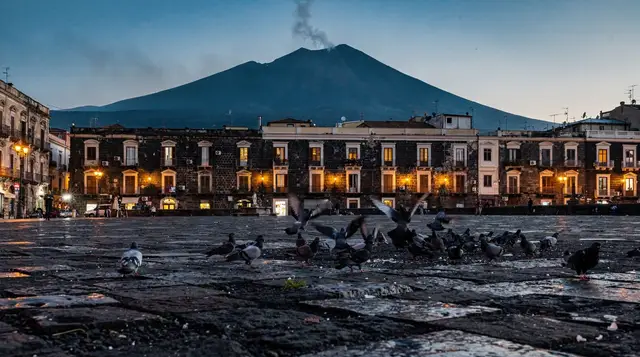
Catania is a good city to wander without a plan, and the Catania destination page and Catania Baroque guide give you enough background to make the walk meaningful. The Catania fish market guide explains what you are looking at and how to eat from the stalls, and the volcano on the skyline is explained in the Etna destination page for anyone who wants to understand it even if this itinerary does not climb it. Climbing the upper slopes without a car is harder and usually means paying for an organised tour, which is why this route leaves it out.
Day 7 — Departure
Morning: A final slow morning in Catania before departing from Fontanarossa airport, about 20-30 minutes from the center — often reachable by a cheap airport bus rather than a taxi.
Where the money really goes
Accommodation is usually the biggest single line, followed by transport, and food is the easiest place to stay cheap without feeling deprived. The Sicily budget guide goes through those categories properly, and where to stay in Sicily helps you pick neighbourhoods that are cheap without being inconvenient for early trains. Sicilians eat late and cheaply at lunch, so a large midday meal and a light evening snack is both the local rhythm and the thrifty one. Our food etiquette and tipping pages explain the cover charge and how little extra you are expected to leave, which are two small costs that surprise first-time visitors.
What to skip, and what to add if you have money left
On a strict budget, skip anything that needs a rental car or a private driver. If you find you have spare money in the middle of the week, the best upgrade is a guided visit at the one site where context matters most, which is why this page offers a guided option at both the Valley of the Temples and Syracuse. A second upgrade is an extra night in Syracuse or Catania rather than a faster, pricier transfer. If you would rather pay a little more for comfort throughout, compare this route with the classic seven-day Sicily itinerary, and if you want a similar trip aimed at lower-effort travel, the Sicily first-time guide can help you decide which style fits you.
Money-saving notes
Buy long-distance coach tickets a day or two ahead where possible — some routes sell out on weekends in peak season. Street food (a few euros per stall) consistently beats sit-down restaurants on both price and, in most cases, quality for a quick meal. Our Sicilian trains guide and buses guide cover ticket-buying mechanics in more detail, including where to validate paper tickets before boarding.
Trip-planning essentials on GetYourGuide
Verified deep-linked GetYourGuide tours. Book through these links and we earn a small commission at no cost to you.
Photo: our own image of the location, not the operator’s product photo.